Story code: ST-000520
Part 4: The Ground War
Arthur steadied himself against the rusted chain-link fence, the metallic squeal of the aging wire piercing the stunned silence of Elm Street. He dragged a breath of hot, stagnant air into his lungs, his gaze locked on the mayor. Julian stood paralyzed in the center of the road, his expensive charcoal suit rumpled, his face slick with a sudden, panicked sweat. The man’s chest heaved, but the frantic energy that had fueled his violent outburst was draining rapidly, leaving behind only the stark realization of what he had just done.
A low, motorized hum drew Arthur’s attention past Julian’s trembling shoulders. The tinted rear window of the black town car glided down exactly three inches.
Arthur could see Mr. Lin’s face through the narrow gap. The executive was no longer smiling the polite, detached smile of a touring buyer. His eyes were cold, narrowed in undisguised revulsion as he stared at the local politician standing in the street. Mr. Zhao leaned forward from the opposite side of the leather bench, speaking a few sharp, clipped syllables that cut through the heavy afternoon heat. The illusion of a clean, frictionless corporate transition-a dead neighborhood quietly waiting for the bulldozers-had completely shattered. Horizon Development hadn’t bought a vacant grid; they had bought a desperate, bankrupt city governed by a man on the edge of a nervous breakdown.
Julian flinched at the sound of Zhao’s voice. The mayor whipped around, his hands coming up in a desperate, pleading gesture as he hurried toward the window. “Gentlemen, please. I apologize. The stress of the receivership-this isn’t indicative of the zone-”
Mr. Lin did not respond. He simply tapped a manicured finger against the driver’s partition.
Before Julian could reach the glass, the taller security guard stepped off the curb. He didn’t approach the mayor with the usual deference owed to a public official. Instead, he grabbed Julian firmly by the elbow, pulling him back from the rear window. It was the rough, unyielding grip of a handler corralling a sudden liability.
“Get in the front, sir,” the guard muttered, his voice flat and commanding.
Julian yanked his arm, but the guard didn’t let go. For a brief, agonizing second, the mayor looked down at his own shaking hands, the reality of his shattered authority washing over his pale features. He wasn’t the visionary architect of a new logistics hub anymore; he was just an erratic middleman who couldn’t control his own streets. Defeated, Julian scrambled awkwardly into the front passenger seat, pulling the heavy door shut.
The driver threw the massive vehicle into gear. As the town car lurched forward, the sudden acceleration caught the folded photograph of Hector Reyes still resting on the pristine black-cherry hood. The slipstream peeled the paper off the hot metal, sending it fluttering helplessly through the exhaust fumes. It spiraled through the shimmering heat waves before landing face-down in the dry, debris-choked gutter.
Arthur watched the two black town cars speed away, tearing around the corner without slowing, leaving only the smell of burning rubber and baked asphalt in their wake.
The oppressive silence of the neighborhood rushed back in to fill the void. Arthur pushed himself off the rusted fence. His ribs gave a dull, throbbing ache where Julian had shoved him, and his heavy work boots dragged against the cracked pavement as he walked toward the curb.
He knelt by the gutter, his knees popping in protest, and carefully peeled the photograph from the pavement. The grease stain that had always framed Hector Reyes’s defiant grin was now joined by a fresh smear of gray street dirt. Arthur wiped it away with the pad of his calloused thumb, a mirror of the way Julian had polished the stolen union hall brass just minutes before.
Standing up, Arthur surveyed the empty expanse of Elm Street. The heat still beat down on the sagging roofs and dead lawns. Nothing had miraculously changed. Horizon Development still had the brass door handle. They still had the capital. And according to the dead-eyed timeline Julian had shouted, the city was still weeks away from absolute financial collapse.
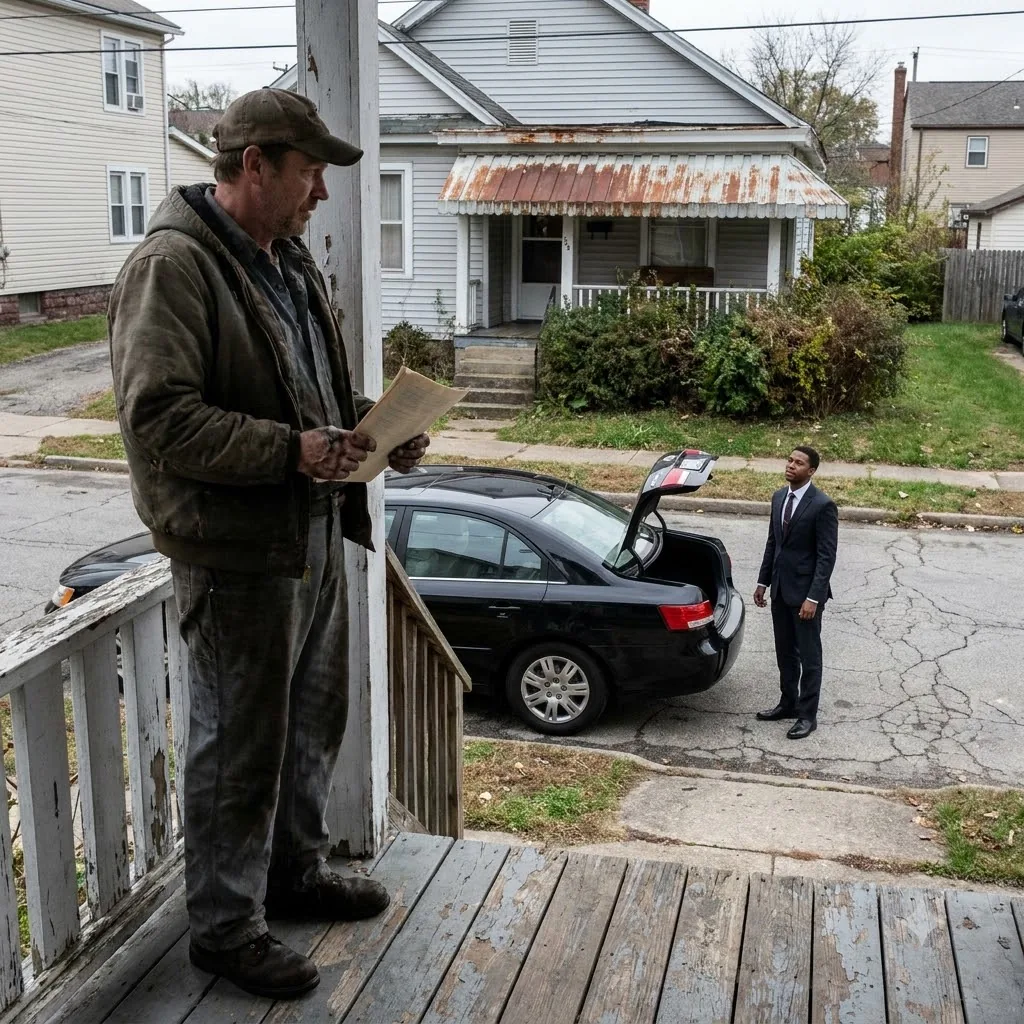
Arthur looked over at the crumpled ball of heavy stock paper resting near the center line of the road-his quadrupled tax assessment. He walked over, picked it up, and flattened the crinkled sheet against his faded denim thigh. The impossibly high number printed at the bottom glared back at him in the harsh sunlight.
The water was still getting shut off on Friday. The demolition of the union hall was still scheduled for Monday. Julian’s breakdown hadn’t stopped the machinery of eviction; it had only revealed how terrified the operators truly were. They were banking on the residents packing up and quietly fading away before the state receivership hit the evening news.
Arthur carefully folded the photograph of Hector and tucked it back into the tight plastic sleeve of his wallet. He wouldn’t take the ten cents on the dollar. He wouldn’t pack up. If Horizon Development wanted to clear the board, they wouldn’t get a silent capitulation. They would have to fight for every porch, every driveway, and every broken sidewalk. Arthur turned his back on the empty road and walked up his front steps, readying himself for the bitter, block-by-block ground war that was about to begin.