Story code: ST-000537
Part 4: The Perimeter
Arthur looked at the black pen hovering in Director Chloe’s immaculate hand. He looked at the false-color terahertz scan glowing on the wall monitor, the neon orange wad of paper condemning him. The silence in the soundproofed cube thickened, pressing against his eardrums until the ringing in his head drowned out the faint hum of the ventilation system.
He had no names to give. He had spent twelve years turning himself into a ghost, speaking to no one, eating alone, walking the aisles with his eyes locked on his worn leather boots to protect his metrics. His utter detachment from the other biological workers was supposed to be his armor. Instead, it had made him the perfect scapegoat for a faceless organizer who needed a blind spot.
He could tell Chloe the truth. He could explain the discarded picking-drone logic board and the stolen proximity badge. But that would upgrade his offense from an unauthorized union dead drop to felony corporate espionage. He would trade the warehouse floor for a federal cell.
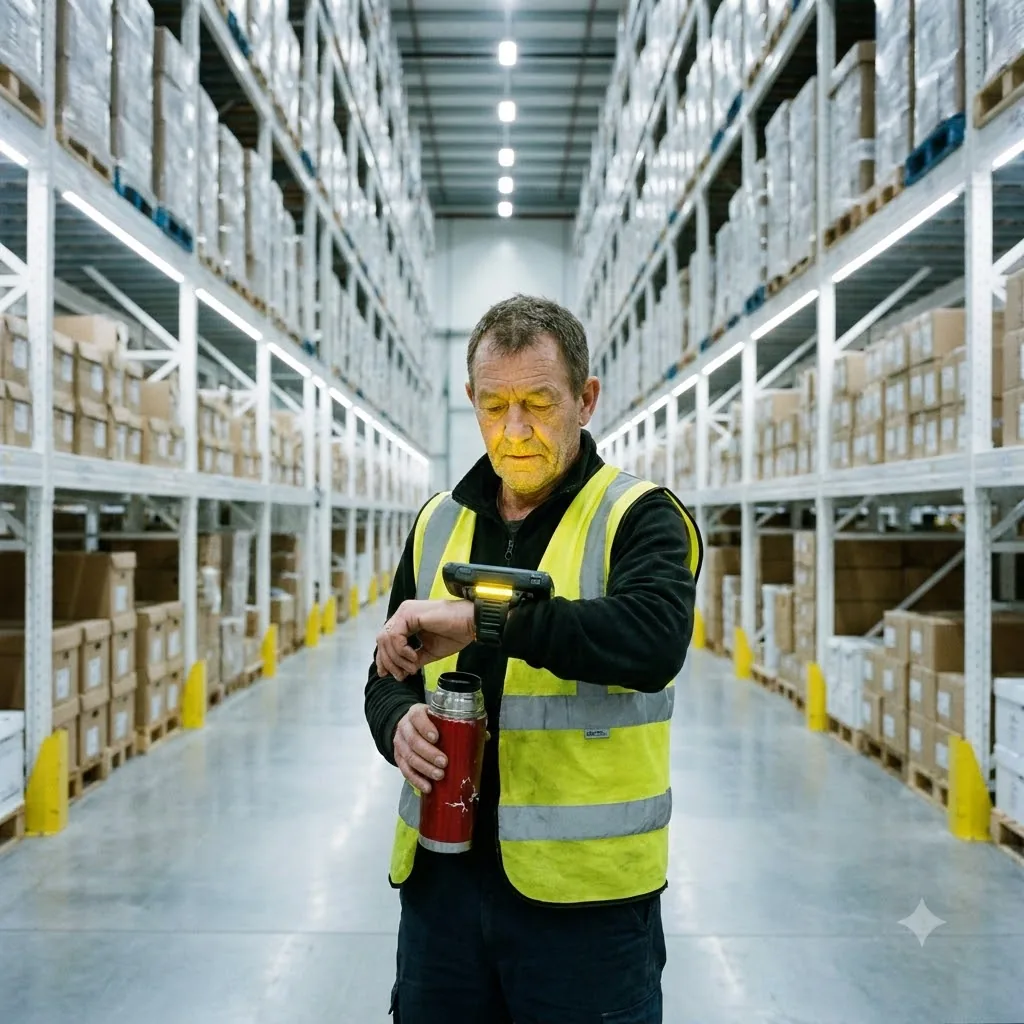
Arthur slowly pulled his trembling, calloused hand back from the table. He set his dented, capless red thermos on the pristine white surface. He didn’t say a word.
Chloe’s eyes narrowed. The mask of polite corporate concern was long gone, replaced by the sterile disgust of a surgeon inspecting a necrotic limb. “Loyalty to a parasitic cause will not save you, Arthur. They used you. And now they are abandoning you.”
Arthur kept his mouth shut. He stared straight ahead at the frosted glass wall.
“Very well,” Chloe said, her voice dropping an octave, entirely devoid of inflection. “Your silence is logged as a willful refusal to cooperate.”
She placed her manicured index finger against the glass screen of her tablet and held it there for three seconds.
The wrist scanner strapped to Arthur’s forearm vibrated once-a sharp, violent buzz that jolted his bones. The solid green light on the digital display instantly flashed to a brilliant, unforgiving crimson. *EMPLOYMENT SEVERED. CLEARANCE REVOKED.* With a mechanical click, the metallic clasp of the scanner disengaged. The heavy device slid off his sweaty skin and clattered loudly against the steel leg of his chair, dead and dark on the linoleum floor.
“Leave the vest,” Chloe commanded, not looking up as she dragged her finger across her tablet, wiping his hab-unit door code from the central registry, zeroing out his cafeteria credits, erasing twelve years of existence with a few casual swipes.
Arthur stood up. The sharp, grinding pain in his left knee spiked immediately, unsupported by the adrenaline that had kept him numb for the last ten minutes. He unzipped his grease-stained hi-vis vest and let it fall onto the chair. Underneath, he wore a faded gray t-shirt that offered no protection against the freezing air of the administrative wing. He picked up his thermos-the empty, useless aluminum cylinder-and turned his back on the HR Director.
“Security drones will track your heat signature until you clear the perimeter,” Chloe said to his retreating back. “If you stop walking, they will deploy kinetic deterrents.”
Arthur pushed through the heavy double doors, stepping out of the chilled cube and back into the deafening roar of the facility. But it was different now. Overhead, the conveyor belts still rattled with endless boxes, and the automated picking drones still whirred past the sixty-foot steel racks, but he was no longer part of their rhythm. The proximity sensors on the automated forklifts didn’t pause as he limped past; he had to physically drag himself out of their path, pressing his back against the cold steel of the overstock cages. He was no longer an employee. He was a biological obstacle.
He navigated the long, gray corridors toward the loading docks, his knee screaming with every agonizing step. He knew there would be no scavenged lidocaine patches waiting for him near the disposal bins. His phantom heat-signature in Aisle 44 would be discovered in hours, and the hollow cap would be destroyed.
He pushed through the heavy exterior turnstiles, the metal bars locking firmly into place behind him with a final, echoing clang. The oppressive, synthetic ozone of the warehouse was instantly replaced by the humid, exhaust-choked air of the sprawling industrial park.
Arthur limped across the massive expanse of cracked asphalt toward the far edge of the employee parking lot. He didn’t walk toward the bus stop. He headed for the chain-link perimeter fence, where a rusted, two-door sedan sat baking in the afternoon sun. It was a relic he had kept registered just in case the hab-unit transit rails ever failed, a forgotten machine coated in a thick layer of gray industrial dust.
He fumbled in his pocket for the keys, his fingers stiff and clumsy. He unlocked the door, the hinges groaning in protest, and collapsed into the suffocating heat of the driver’s seat. He didn’t start the engine. He just sat there, gripping the cracked steering wheel, his breath coming in shallow, ragged gasps.
Through the dust-caked windshield, he stared at the monolithic, windowless gray wall of the fulfillment center. It stretched for miles in either direction, a massive, churning ecosystem that had dictated his heart rate, his meals, and his purpose for over a decade. It was the only family he had known, a cold and calculated parent that he had learned to survive alongside.
Now, he was locked outside its concrete shell. His hab-unit was gone. His credits were gone. There was no one waiting for him anywhere in the world. Arthur sat in the sweltering silence of his car, clutching his empty thermos, crushed by the absolute, permanent weight of his total isolation.