Story code: ST-000537
Part 3: The Dead Drop
The monitor on the wall hummed, casting a pale, bluish light across the sterile white table. Arthur stared at the frozen frame of Aisle 44. The camera angle was impossibly high, a digital hawk peering down at the intersection of towering steel racks. Even zoomed in, the image was perfectly crisp. There, at the bottom right corner of the frame, was the very edge of his scuffed leather boot, captured just before he stepped entirely into the shadow of the printer-paper pallets.
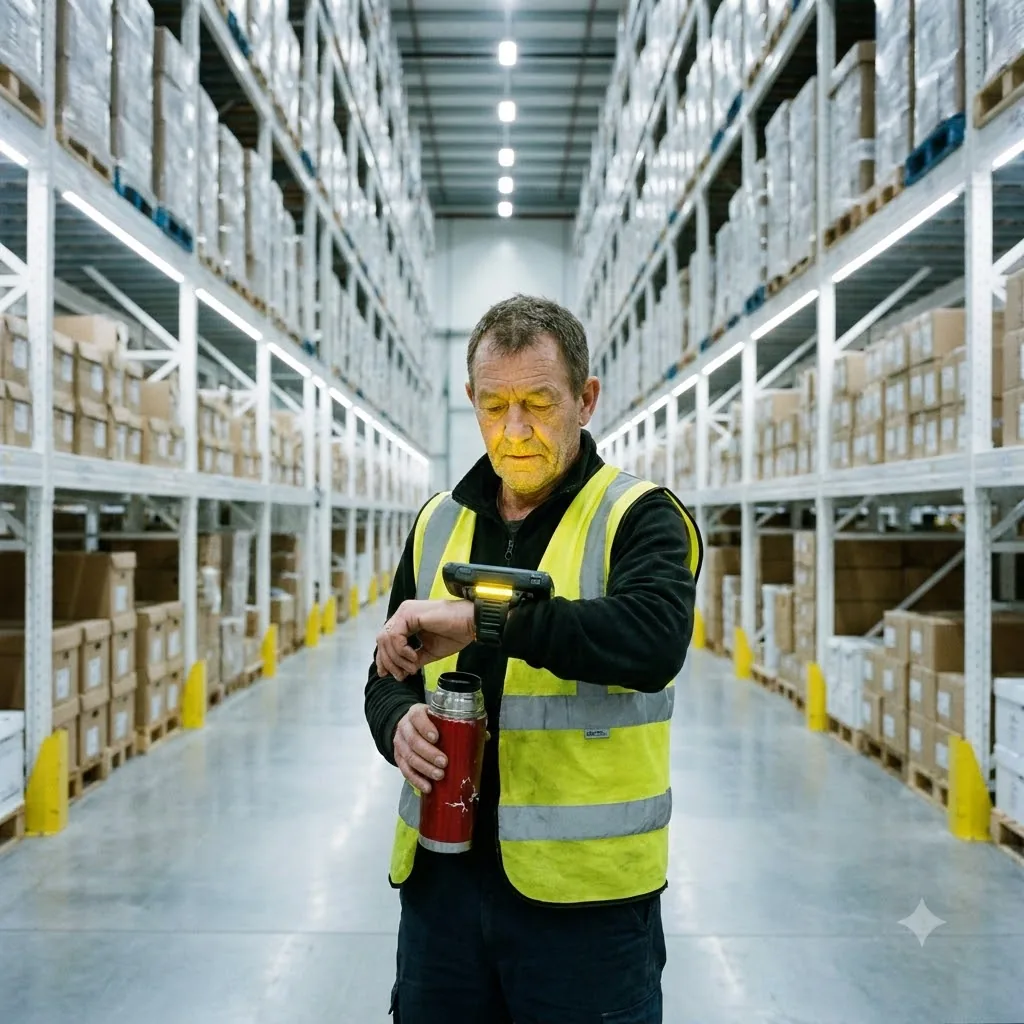
Arthur’s hand slowly retreated from the black pen hovering over his termination clause. He curled his stiff, calloused fingers back into a fist and lowered it to his lap, pressing it against the freezing aluminum of his capless thermos. The sharp ache in his left knee throbbed in time with his racing pulse. He forced his breathing to remain slow and measured, dragging the chilled, synthetic air into his lungs to keep the wrist scanner on his arm from spiking.
“My knee,” Arthur said, his voice sounding paper-thin and raspy in the soundproofed cube. He cleared his throat, trying to inject some gravel back into his tone. “The joint locked up. I had to lean against the pallet to brace myself. The thermos cap must have slipped out of my hand.”
Director Chloe didn’t blink. The mask of polite corporate concern-the practiced tilt of her head, the soft, understanding eyes-vanished. It didn’t just slip away; she actively discarded it, as if the ‘wellness’ protocol had simply run its allotted time and was no longer required. Her face settled into a rigid, absolute stillness, her posture straightening imperceptibly in the ergonomic chair.
“Do you know how much a backscatter terahertz drone costs to operate per minute, Arthur?” Chloe asked. Her voice had dropped the pleasant, synthetic pitch she had used since he walked in. It was now sharp, ruthlessly efficient, and entirely devoid of empathy.
Arthur swallowed hard, keeping his eyes on the sleek tablet resting under her perfectly manicured hands. “I don’t know what that is.”
“It is a specialized mobile security asset,” Chloe said, tapping the glass screen of her tablet with two fingers. “We don’t deploy them for standard efficiency infractions. We don’t deploy them for kinetic energy waste. And we certainly don’t deploy them to check on a biological worker’s bad knee.”
The large monitor behind her flickered. The overhead surveillance still of Aisle 44 disappeared, immediately replaced by a new, high-resolution image. It was a false-color terahertz scan of the dusty floor directly behind the overstock pallets. The heavy wooden slats were rendered in transparent, ghost-gray outlines. Sitting perfectly upright behind the wood, glowing in a vibrant, neon orange that indicated dense, foreign material, was his thermos cap.
Arthur’s breath hitched in his throat. He stared at the glowing orange shape on the screen, his mind struggling frantically to process the visual data. He knew exactly what the inside of that hollow plastic cap was supposed to look like on a density scan. It should have displayed the sharp, geometric lines of the discarded picking-drone logic board. It should have shown the dense metallic square of the stolen proximity badge, and the tangled, hair-like web of copper micro-wires he had painstakingly soldered together with a heated paperclip. It should have looked like scavenged machinery.
But the neon orange mass glowing on Chloe’s monitor had no sharp edges. It was soft, layered, and heavily striated. It looked like tightly packed geological sediment.
It was paper. Thick, dense wads of tightly folded paper, jammed forcefully into the hollow cavity of the plastic cap.
Arthur’s grip tightened on his aluminum thermos until his knuckles turned bone-white. The biometric spoofer-the digital ghost that kept him alive, the only thing hiding his scavenged lidocaine patches from the central algorithm-was gone. Someone had removed it. Someone had found his perfect, solitary blind spot in Aisle 44, ripped out his life-saving hardware, and replaced it with this.
“Cellulose,” Chloe said, the word dripping with quiet, calculated disgust. “Analog paper. Highly irregular in this facility, but I suppose whoever recruited you thought a non-digital medium wouldn’t trigger the local routing sub-network’s sniffers.”
Arthur stared at the screen, a cold sweat breaking out across the back of his neck despite the freezing temperature of the room. He couldn’t speak. He couldn’t even form a coherent denial in his own mind.
“We’ve known about the physical contraband circulating in Sector J for a week,” Chloe continued, leaning over the pristine white table, her immaculate gray suit catching the pale blue light of the monitor. “Organizing is a cancer, Arthur. It destroys the ecosystem. Did you really think you could use a camera blind spot as a dead drop for analog union flyers without the algorithm noticing a disruption in the dust patterns?”
The accusation hung in the chilling air, heavy and immediately lethal. Unionizing wasn’t just a fireable offense; it was corporate treason. The company would have him blacksite-detained by private security before the shift alarm even sounded. They would dismantle his life down to the very studs, seizing his hab-unit and zeroing out his meager credits.
“I didn’t,” Arthur stammered, his voice finally breaking through the paralysis in his throat. “That isn’t… I didn’t put paper in there.”
“The terahertz scan proves otherwise,” Chloe stated flatly, tapping the tablet again to zoom in on the glowing layers of cellulose. “You walked in with the cap. You walked out without it. The cap contains tightly folded union pamphlets. It is a very simple equation, Arthur. You are a mule.”
Arthur looked from the glaring neon orange scan on the monitor to the cold, unyielding face of Director Chloe. The trap had closed, but it wasn’t the trap he thought it was. He was being framed with evidence planted in his own dead drop, but he couldn’t defend himself without admitting the absolute truth.
If he denied being a union mule, she would demand to know what he was actually doing in Aisle 44. To prove his innocence regarding the union flyers, he would have to confess to building an illegal biometric spoofer to steal medical supplies-a federal crime of corporate espionage that carried a mandatory prison sentence. If he stayed silent, he went down for the union pamphlets.
Someone else in the warehouse had been watching him. Some other biological worker knew his routes, knew about his carefully calculated blind spot, and had used him as an unwitting decoy to harbor their contraband. His perfect isolation-the very thing he thought protected him-had made him the perfect fall guy.
Chloe picked up the black pen from the table and held it out toward him, the tip pointed at his chest like a scalpel.
“I don’t care about a decaying sixty-two-year-old biological worker playing messenger,” Chloe said softly, her eyes locking onto his with terrifying precision. “I want the architects. I want the names of the organizers who gave you those flyers. Give me the network, Arthur, and you can walk back down to the floor right now. Refuse, and you don’t walk out of this room at all.”
Arthur sat frozen in the sterile, soundproofed cube, the capless thermos shaking violently in his calloused hand, staring at the pen he could not take and the truth he could never speak.