Story code: ST-000543
Part 2: The Price of Admission
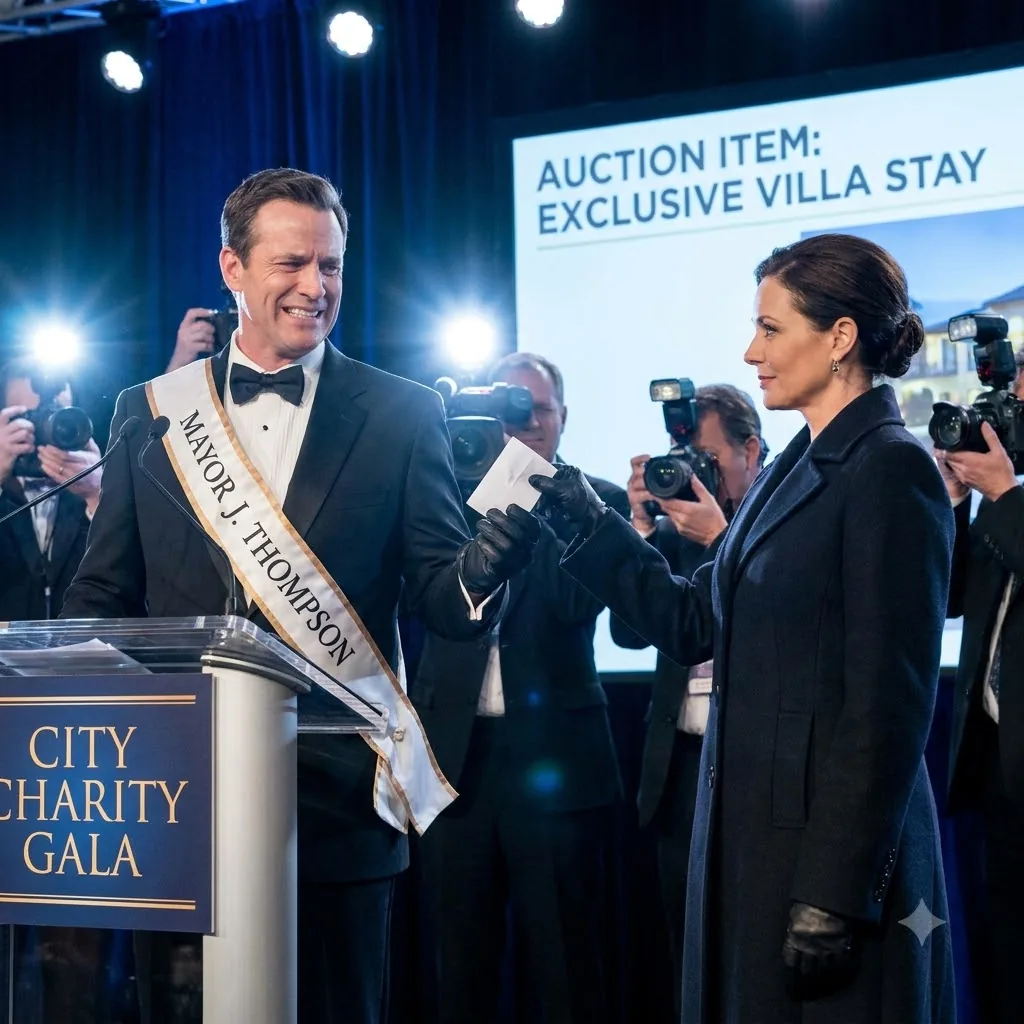
The photographer’s shout-“Hold it up to the light, Mr. Mayor!”-echoed through the vaulted ceiling of the ballroom, cutting through the swells of applause. Elias’s heart hammered a frantic, irregular rhythm against his ribs. The blinding crossfire of camera flashes illuminated the stage in stark, strobe-like bursts, freezing the horrific reality of the medical chart in his trembling hands. Every political instinct he possessed screamed at him to hide the document, to smile, to pivot, to survive the next ten seconds.
He forced a booming, thoroughly artificial laugh that he hoped projected nothing but pure, unadulterated joy. “Now, now, a gentleman never reveals a lady’s private pledge before the ink is completely dry!” Elias projected into his lapel microphone, attempting to turn his sheer panic into a moment of playful suspense. The crowd chuckled, a polite, rolling ripple of wealthy amusement. Elias immediately turned his shoulder away from the press pit, attempting to fold the thick, clinical paper in half and slide it casually into his breast pocket.
He didn’t make it. The woman’s hand shot out with startling speed, clamping firmly over his wrist just as the paper grazed the edge of his suit jacket. To the hundreds of tuxedo-clad onlookers and the eager reporters on the floor, it looked like an exuberant, intimate gesture-a passionate philanthropist playfully stopping her mayor from hiding her generous gift. But to Elias, her grip was an absolute vise. Her manicured fingernails dug mercilessly into the wool of his sleeve, pinching the sensitive skin beneath.
“I want them to see exactly what fifty thousand dollars buys in Oakridge,” she announced, her voice carrying an eerie, theatrical brightness that perfectly mimicked a proud society donor.
Elias tried to subtly pull his arm away, but she held fast, her strength completely disproportionate to her slender frame. “Smile, Elias,” she whispered, leaning in so close that the harsh, chemical sting of her antiseptic perfume burned the back of his throat. She kept her face turned toward the flashing bulbs, her frozen, pale blue eyes boring into the side of his head. “They’re taking our picture. You wouldn’t want to look ungrateful.”
He cast a desperate glance toward the velvet curtains in the wings. Sarah, his fiercely protective campaign manager, was standing in the shadows, aggressively gesturing with both hands. She was furiously pantomiming the act of holding a document high in the air, her face twisted in confusion. She clearly thought he was botching the most critical photo opportunity of his entire reelection campaign. The entire ballroom was waiting for him to produce an oversized prop check or an official bank letterhead to validate the massive interruption.
Elias looked down at the trapped paper still pinched between his fingers and his chest. He could still see the harsh black-and-white grid, the red-flagged column of critical lab values, and the bold patient identification number. He didn’t recognize the digits, but a clinical stamp at the very bottom of the page caught his eye, making his stomach drop: *Oakridge Municipal Water Authority – Confidential Employee File*.
“Who are you?” he muttered through a rigid, teeth-baring smile, nodding to the cheering crowd as if graciously thanking them for their immense patience.
“Someone who knows exactly what those lab results mean,” she murmured back, her public smile never wavering. “Hold up the paper.”
Panic flooded his chest, cold and absolute. The water authority? There had been rumors floating through City Hall for months about contaminated wells near the new luxury development site, but the private contractors had assured him the reports were fabricated. He had buried the inquiries himself to keep the zoning approvals moving. If this woman had proof of a cover-up, she wasn’t just ruining a charity gala; she was preparing to detonate his entire life on live television.
“This isn’t the time or the place,” Elias hissed under his breath, frantically trying to maintain his benevolent public face. He subtly twisted his wrist, trying to break her punishing grip, but a sharp prick of pain shot up his forearm as she dug her nails in deeper.
“This is the *only* place,” she countered, her voice a poisonous thread weaving beneath the thunderous applause. “Fifty thousand dollars is exactly what you accepted from the development board to look the other way. Now, you are going to read the toxicology screen to your lovely, wealthy voters, or I am going to rip that lapel microphone off your suit and read it myself.”
Elias’s mind raced, trapped in a gilded cage of his own making. If he physically fought her for the paper, it would look like a violent altercation on stage. The press would devour him. If he let her take the microphone, she controlled the narrative completely, exposing his corruption to the very people funding his career. He was surrounded by his most ardent supporters, yet he had never been more horrifyingly isolated.
The lead photographer stepped closer to the edge of the stage, waving a heavy lens. “Come on, Mr. Mayor! Give us the front page! Let’s see that generous donation!”
A cold bead of sweat rolled down Elias’s spine. Slowly, agonizingly, he lifted his hand, unfolding the top half of the medical chart just enough to satisfy the relentless camera lenses. He prayed to God that the dense, clinical jargon was too small for the heavy telephoto lenses to decipher from the floor.
Flashbulbs erupted in a blinding, stroboscopic wave. Elias squinted against the searing white light, his vision swimming with dark spots. For a brief, terrifying second, the intense flashes illuminated the back of the page, shining straight through the thin hospital paper.
There, printed in thick, black marker on the reverse side-visible only to him from this angle-was a single, hand-written sentence: *Look at the back of the room, Elias.*
The crowd’s applause finally began to die down, transitioning into an expectant, heavy silence. They were waiting for a speech. They were waiting for him to announce the total, to read the wealthy stranger’s name, to declare the gala a resounding success.
The woman released his wrist, leaving deep, aching indentations in his skin. She took a graceful step back, sweeping her arm elegantly toward the podium, leaving him completely exposed in the center of the stage.
“Go ahead, Mr. Mayor,” she said, her voice echoing with terrifying clarity through the sudden quiet of the grand ballroom. “Tell them exactly what my donation is paying for.”