Story code: ST-000553
Part 4: Leaving the Line
Marcus stood frozen against the rusted gray lockers. For all his cashmere and lectures on the value of hard labor, he shrank away from the raw, bleeding reality of the person standing directly in front of him. The liquidator’s pale eyes darted to the blood slowly dripping from Riley’s clenched fist, but he said nothing. Riley didn’t wait for an apology, an acknowledgment, or a retort. The time for any of that had long passed.
Riley turned away from the liquidator and faced locker G-414 one last time. The heavy plastic trash bag, previously held like a desperate obligation, slipped from Riley’s numb fingers. It hit the cracked tile floor, the sound of the discarded leather work gloves softly muffling the impact. Riley reached deeper into the shadowed, freezing recesses of the metal compartment’s bottom shelf. Behind the spot where the grease-stained tool belt had rested, Riley’s fingers brushed against cold, dented steel.
Riley pulled a battered, green Stanley thermos out into the harsh, flickering fluorescent light. The heavy enamel paint was chipped away at the base, revealing jagged silver scars from decades of rattling around the rusted floorboards of a pickup truck. It felt like an anchor.
Riley carefully tucked the tarnished silver pocket watch into the breast pocket of their heavy canvas jacket, pressing it flat right over their heart. The heavy bronze sobriety chip went back into the zippered canvas side pouch of the tool belt. Riley slung the thick leather strap over their shoulder, the heavy steel buckles clinking a familiar, comforting rhythm, and grabbed the thermos firmly by its worn plastic handle.
Marcus finally peeled himself off the metal lockers. He smoothed the pristine lapels of his camel-hair coat, his gloved hands visibly shaking. “You are making a massive mistake,” Marcus said, his voice entirely stripped of its former aristocratic drawl, replaced by a thin, reedy defensiveness. “You walk out of this building with that property, and I will call the temp agency before you even reach the parking lot. They will withhold your entire week’s pay for breach of contract. You will be permanently blacklisted.”
Riley stopped, but didn’t bother to turn around. The threat of the temp agency-the looming ax that had kept Riley’s head bowed and hands moving in the bitter cold all week-suddenly sounded entirely hollow. It was a ghost story meant to scare people who still believed the system would protect them if they just worked hard enough.
“Keep the pay,” Riley said, the words slipping out into the freezing air, steady and final. “Buy yourself another scarf.”
Riley walked away. The heavy steel-toe boots hit the cracked tile in a steady, unbroken cadence, marching away from row G.
“I’ll have you arrested for theft!” Marcus shouted down the narrow aisle, the arrogant bravado returning only when Riley was a safe distance away. The empty threat echoed off the dented metal walls, fading into the ambient hum of the dying building.
Riley pushed open the heavy double doors of the locker room and stepped back out onto the main factory floor. The cavernous stamping plant was just as freezing, just as dead as it had been at dawn, but the crushing, invisible weight that had pressed down on Riley’s shoulders was gone.
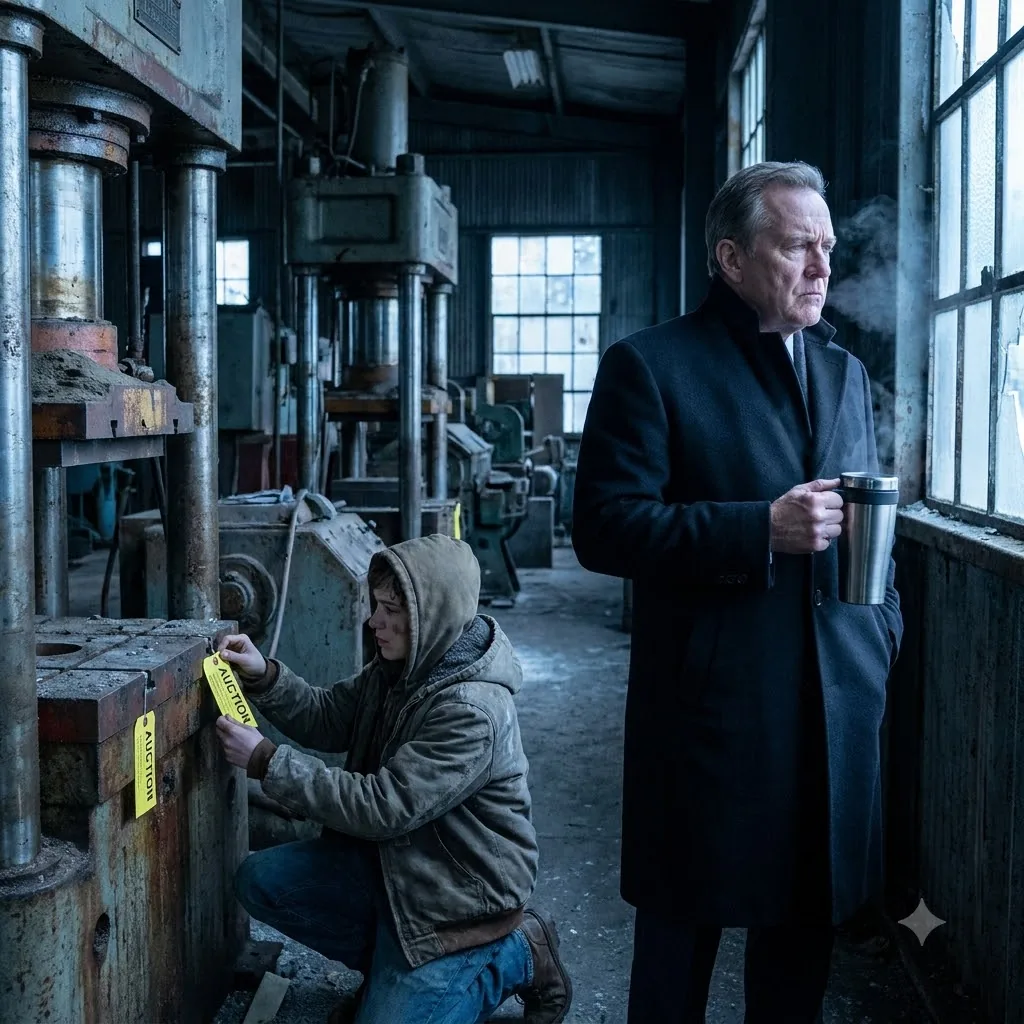
Near the loading docks, three men in expensive insulated parkas were pointing at the giant hydraulic presses, clutching thick clipboards. The scrap buyers. Riley walked straight past them, boots crunching over the discarded coils of copper wiring. One of the buyers glanced up at the heavy tool belt slung over Riley’s shoulder, a frown creasing his forehead, but nobody said a word. The temp worker was officially a ghost.
Riley pushed through the pedestrian door beside the massive rolling bays, stepping out into the biting winter wind.
The sky was the color of dirty iron. Frost crunched loudly under Riley’s boots as they crossed the vast, cracked asphalt of the employee parking lot. Out here, the wind whipped violently, biting through the unlined canvas jacket, but Riley barely felt the cold.
Reaching a rust-bitten sedan parked alone by the outer chain-link fence, Riley unlocked the stiff door and slid into the freezing driver’s seat. The old engine turned over with a painful whine before finally settling into a rough, rattling idle that shook the dashboard.
Riley set the heavy canvas tool belt on the cracked vinyl of the passenger seat, resting the dented green thermos securely beside it. With a trembling hand, Riley reached into the deep pocket of the jacket and pulled out the phone.
The screen was dark. The terrifying, absolute stillness remained.
Riley stared at the blank glass, the silence confirming what the frantic buzzing had already warned. The reality of what waited at home and at the hospice center began to solidify in the icy air of the car cabin. There would be no paycheck this week. Next week, the aggressive collection agencies would start calling again about the student loan defaults. Soon, the crushing, inescapable mountain of end-of-life hospital bills would arrive in the mail, printed on crisp white paper, demanding money that simply did not exist.
The corporate machine had ground Riley’s father down to dust, liquidating his pension, stripping his health, and trying to auction off his dignity for scrap metal. For months, Riley had been desperately trying to play by its rules, enduring the Marcuses of the world, swallowing the bile, smoothing down the neon tags, begging for hourly wages just to keep the debt collectors at bay.
Riley wiped a smear of drying blood from their cut palm onto the thigh of their work pants. Reaching over the center console, Riley ran a thumb across the raised bronze lettering of the sobriety chip protruding from the canvas pouch.
The financial ruin was coming. The grief had already arrived. But as Riley put the battered sedan into gear and drove away from the towering, lifeless silhouette of the auto plant, the suffocating need to appease the system that had destroyed their family was finally left behind in the freezing dust.