Story code: ST-000568
Part 2: Project Strigidae
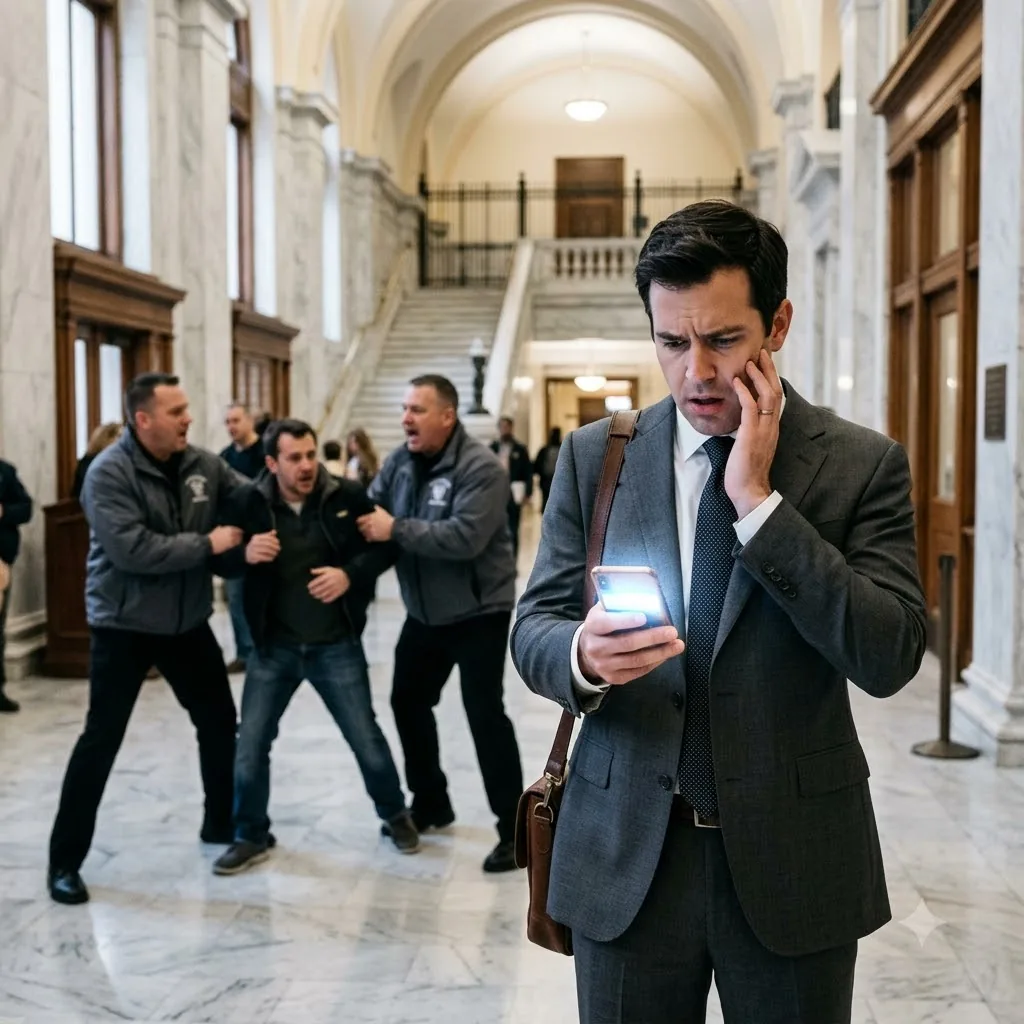
I stared at the glowing blue banner on my phone, my thumb suspended over the geometric owl icon. A new name: Elena Rostova. A new location: Room 114. A new countdown: twenty-two minutes.
My chest tightened, breath catching in my throat as the realization slammed into me. The federal agents weren’t hacking our supposedly impenetrable municipal databases. They didn’t need to cross-reference utility bills, tax records, or DMV photos. They were using a ghost. They were using my ghost.
Five years ago, before I ever ran for mayor, a commuter bridge over the Narrows had collapsed during rush hour. Cell towers instantly overloaded, leaving first responders entirely blind. People bled out in their cars because nobody could locate them in the twisted steel and concrete. In the bitter aftermath, working out of my basement, I coded a solution. I called it Project Strigidae. It was a mesh-networking protocol designed to completely bypass cellular grids. It didn’t look for phone numbers; it looked for Bluetooth handshakes, smartwatch telemetry, RFID transit cards, even pacemaker proximity pings. It aggregated ambient digital noise to map human bodies in physical space, turning every smart device in a ten-block radius into a silent, triangulating radar.
It worked beautifully in simulations. It worked so well, in fact, that it terrified me. It wasn’t just a rescue tool; it was the ultimate, inescapable surveillance net. It stripped away all digital anonymity in a matter of seconds. I realized the horrific civil rights implications of what I had built, scrapped the beta test, scrubbed the repositories, and destroyed the hard drives. I buried the owl.
Yet here it was, nesting on my lock screen, orchestrating a federal purge inside my own sanctuary city.
My phone vibrated violently, snapping me back to the present. The caller ID flashed: Marcus, my head of security. I silenced it and shoved the phone deep into my coat pocket. I couldn’t involve Marcus. I couldn’t involve the IT department. If I raised the alarm that a rogue mesh network was operating inside the courthouse, they would trace the protocol’s architecture right back to its creator. My political career would evaporate overnight, but worse, the public panic would be catastrophic. The mayor who promised absolute privacy had secretly authored the weapon hunting them.
I checked my watch. Eighteen minutes. Room 114 was the basement-level records department, a subterranean maze where citizens pulled ancient property deeds and marriage certificates. I took the stairwell down, the air growing colder and smelling faintly of ozone and decaying paper the deeper I went.
The basement was dimly lit, rows of heavy steel filing cabinets stretching out like a mechanical graveyard. At the far end of the hall, a handful of people stood in line before a plexiglass window. I scanned their faces, cross-referencing them with the name in my head. Elena Rostova.
I spotted her near the back of the queue. She was a young woman with dark circles under her eyes, clutching a thick manila envelope against her chest like a shield. She was bouncing her infant son on her hip, whispering softly to him in Ukrainian.
I had eleven minutes.
I closed the distance quickly, trying to soften my expression to avoid startling her. “Elena?” I asked, keeping my voice low.
She turned, her eyes instantly widening with suspicion. She took a half-step backward, pulling her child closer. “Yes? Who are you?”
“My name is Mayor Thomas. I need you to listen to me very carefully,” I whispered, glancing over my shoulder at the heavy double doors leading to the stairwell. “You need to leave this building right now. Do not go back to your car. Take the service elevator behind that desk, exit through the loading dock, and get on a bus. Do not go home.”
She stared at me, paralyzed by a potent mixture of confusion and terror. “What? No, I have to submit these residency forms today. The clerk said if I miss the deadline-”
“If you stay here for another nine minutes, you are going to be detained by federal agents,” I hissed, the urgency bleeding through my carefully maintained composure. “They know exactly where you are.”
Elena shook her head, tears welling in her eyes. “That is impossible. The city sent a letter. You promised the records were safe. You promised on television.”
The words felt like glass in my throat. “I know what I promised. But the perimeter is compromised. You have to run.”
She took another step back, panic fully taking hold. She didn’t trust me. Why would she? A strange man in a tailored suit was accosting her in a basement, ordering her to abandon her last chance at legal traction. She opened her mouth to call out to the clerk, but the sound died in her throat.
The heavy steel doors at the end of the corridor groaned open.
Two men stepped into the fluorescent light. Unzipped windbreakers. Gray t-shirts. Heavy tactical boots. They were different agents than the ones upstairs, but they carried the exact same predatory stillness.
I stepped squarely into the center of the linoleum hallway, blocking their path to Elena. “I am the Mayor of this city,” I said, projecting my voice so it echoed off the steel cabinets. “This is a sanctuary facility. You have no jurisdiction here, and you have no warrant. Turn around.”
The lead agent didn’t even break his stride. He walked right up to me, stopping only when we were inches apart. He was a head taller than me, his eyes dead and flat. He didn’t argue. He didn’t cite federal law. He simply reached into his pocket, pulled out his own smartphone, and tilted the screen toward me.
Against the black background, a pale blue banner was glowing. The little geometric owl sat next to a pulsing radar icon.
Beneath the icon was a localized mesh map of the courthouse basement. It showed three distinct blue dots. One was me. One was Elena. The third was her infant son.
“We’re just following the pings, Mr. Mayor,” the agent whispered, his voice devoid of any inflection. “Public safety.”
He smoothly stepped around me, his partner mirroring the movement. I stood frozen, entirely emasculated by my own creation, as the agent placed a heavy hand on Elena’s trembling shoulder. She didn’t scream. She just looked back at me, her eyes hollow with an intense, burning betrayal, as they ushered her toward the emergency exit.
As the door clicked shut behind them, my phone vibrated again. I pulled it out with numb fingers.
I didn’t wait for the banner this time. I typed a string of administrative override commands I hadn’t used in half a decade, bypassing the lock screen and forcing the owl application to open its diagnostic overlay. The screen went black, then burst into a sprawling digital map of the entire city.
My breath stopped.
It wasn’t just the courthouse. The entire grid was illuminated. The feds hadn’t just hacked a local node; they had secretly weaponized the city’s entire ambient infrastructure. Tens of thousands of little blue dots pulsed across the map, tracing real-time movements through apartments, schools, and grocery stores.
And at the top of the screen, the pale blue banner flashed red. A new priority target had just been acquired, and the location wasn’t municipal ground. It was my own home address.