Story code: ST-000635
Part 4: Gross Misconduct
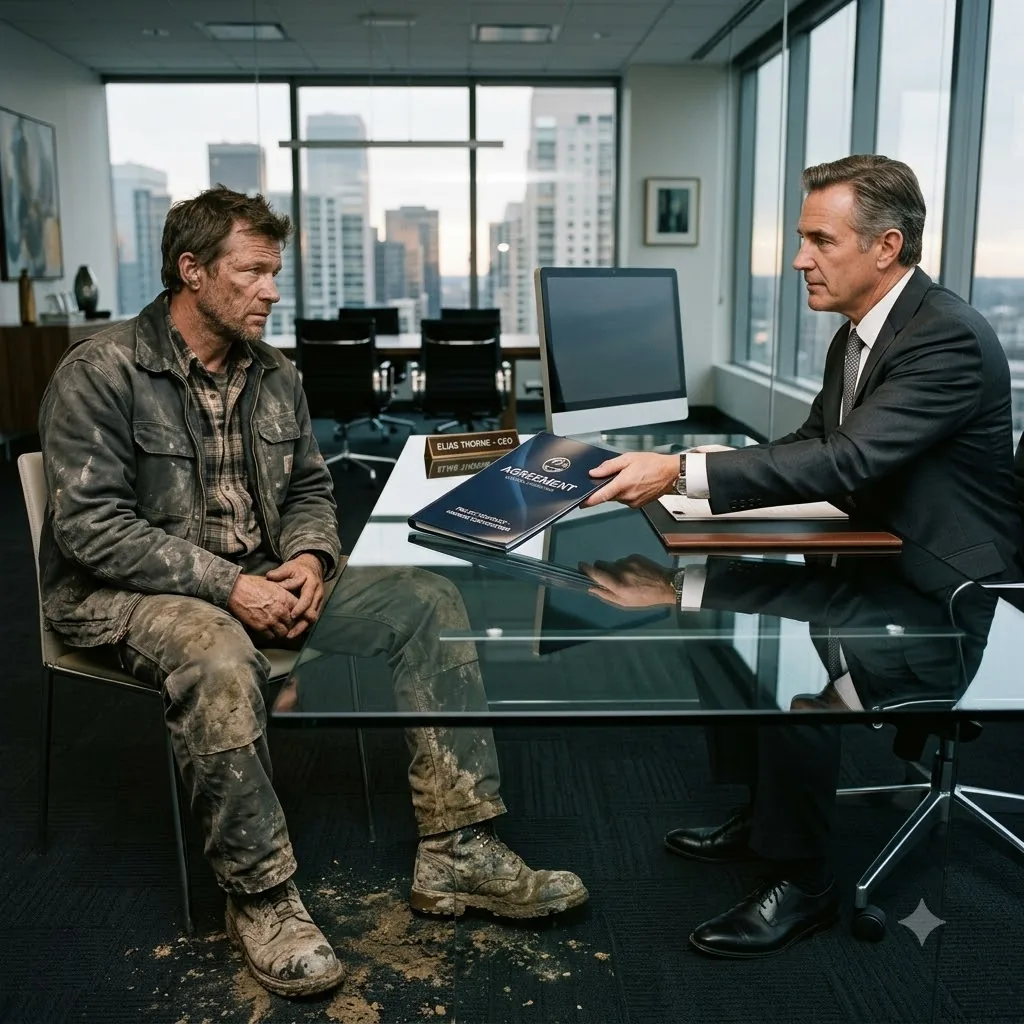
The steady, mechanical blast of the air conditioning was the only sound in the cavernous boardroom. Elaine didn’t look at her gold wristwatch again; she simply stared at Marcus, her eyes completely devoid of the focus-group-tested empathy she had weaponized just minutes before.
Nineteen years and four months. Marcus felt the weight of that time in his shoulders, in the permanent ache of his lower back, and in the faint chemical burn scars on his forearms. He had given his entire adult life to the factory floor. The tier-one pension was supposed to be the reward for surviving it. Four hundred thousand dollars. A house that wasn’t in the toxic runoff zone. A future for Leo.
Now, it was leverage.
Marcus looked down at his cracked phone screen, still resting atop the pristine white waiver. The spreadsheet glowed through the spiderweb of shattered glass. Seventy-two names. Seventy-two families currently sleeping on deflating air mattresses, systematically denied emergency aid, targeted because they dared to ask why their water tasted like sulfur and their children couldn’t breathe.
He thought of Leo’s wet, rattling cough. Ten thousand dollars would buy his son a clean hotel room tonight. But it would also buy the company a permanent, legally binding silence. It would buy them the right to keep dumping, to keep poisoning, to keep winning.
Marcus reached out. He didn’t pick up the heavy, gold-plated fountain pen. He picked up his phone.
He slipped the cracked device back into his damp, mud-stained pocket. Then, he placed his bruised hands on the armrests of the ergonomic mesh chair and pushed himself up. The dried, toxic river mud on his steel-toed boots cracked, raining a fresh layer of gray-green dust onto the immaculate, bone-white carpet.
“You have thirty seconds, Marcus,” Elaine said. Her voice was perfectly flat, a cold and calculated blade.
“I don’t need thirty seconds,” Marcus said. His voice felt solid in his throat, the raspy exhaustion replaced by a heavy, anchoring clarity. “Tell the executives to keep the check. We’re going to need a lot more than ten thousand dollars when this goes to a jury.”
Elaine didn’t flinch, but her jaw tightened, a microscopic fracture in her pristine facade. “You are making a catastrophic mistake. That file is proprietary corporate property. If you walk out that door, I am calling HR. Your pension will be voided before you reach the lobby.”
“Do what you have to do,” Marcus said. “I’ll do what I have to.”
He turned his back on the mahogany table. He didn’t look back at the cream-colored folder or the blank signature line. He walked out of the executive conference room, his heavy boots leaving a visible trail of dried, toxic sludge across the floorboards.
The elevator ride down forty-two floors was perfectly smooth and entirely silent. Marcus stood alone in the mirrored box, staring at his reflection. His face was smeared with gray dirt, his eyes ringed with dark exhaustion. He pulled his phone back out.
His bruised thumb hovered over the cracked screen. He opened his email application. He attached the salvaged spreadsheet. In the recipient line, he typed the email address of the lead attorney handling the Eastside District class action. Then he added the president of the pipefitters union, and finally, the tip-line address for the city’s largest investigative newspaper.
This was the Class A violation. This was the gross misconduct. Pressing the button meant setting fire to nineteen years of his life.
Marcus thought of Leo. He thought of the seventy-one other names on the list.
He pressed send.
The progress bar shot across the top of the cracked screen. A faint swoosh sounded from the phone’s tiny speaker. The file was gone. The proof was out. His pension was dead.
The elevator chimed, and the polished steel doors slid open. Marcus crossed the expansive, marble-tiled lobby, ignoring the startled glances of the impeccably dressed security guards. He pushed through the heavy revolving glass doors and stepped out of the climate-controlled tower.
The August heat hit him instantly, a suffocating, humid blanket that smelled faintly of rotting sulfur and stagnant water. Up here on the hill, the streets were dry, swept clean of debris, bustling with oblivious afternoon traffic. But as Marcus walked to the edge of the corporate plaza and looked down toward the valley, he saw the reality.
The Eastside was a drowned scar across the earth. Brown, oily water still pooled in the lowest tracts. The flashing lights of emergency vehicles pulsed faintly in the distance, blocked by concrete barricades. The devastation was absolute.
Marcus pulled his phone out one last time and dialed his wife’s number. It rang twice before she answered, her voice tight with panic and exhaustion.
“Marcus? Did you get it? Did you get the relief grant?”
Marcus closed his eyes. The hot, polluted wind dried the sweat on his forehead. “No, Maya. I didn’t get it.”
“What? Why? Leo’s coughing so hard, Marcus, we can’t stay in this gym another night-”
“We won’t,” Marcus said gently, his voice thick with the gravity of what he had just surrendered. “I’ll borrow Jimmy’s truck. I’ll get us out of the county, to your sister’s place up north. We’ll find a way to pay for the gas.”
“I don’t understand,” Maya said, her voice cracking. “They promised relief.”
“They promised a payoff,” Marcus said. He opened his eyes, staring down at the flooded ruins of his community. “They tried to buy the lawsuit, Maya. They deliberately denied the emergency funds to starve us out. But I kept the proof. I just sent it to the lawyers.”
Silence hung on the line, heavy and terrifying. Marcus knew she was doing the same math he had just done. She knew what taking corporate data meant. She knew the pension was gone. The safety net had been cut away, leaving them in a terrifying freefall.
“Okay,” Maya whispered finally. The panic in her voice had receded, replaced by the same hard, exhausted resilience that had kept them fighting for two years. “Come back to the shelter. Just… come get us.”
“I’m on my way,” Marcus said.
He hung up the phone and shoved it into his pocket. He had no money, no car, and no job. He was walking back into a devastated city with nothing but the toxic mud on his boots. But as he began the long descent down the hill toward the gymnasium, his stride was steady.