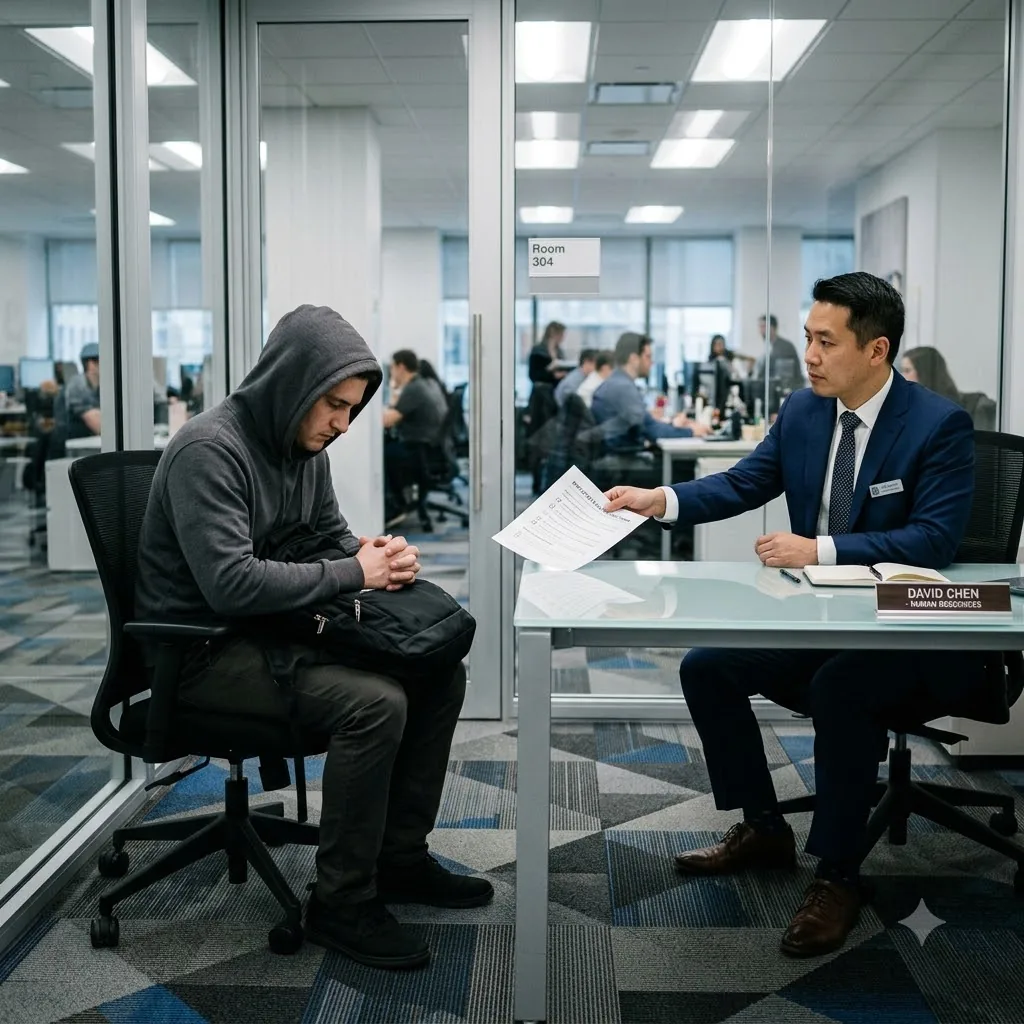
Story code: ST-000641
Part 2: The Alibi
Marcus reached into the dark interior of the bag. His fingers brushed against the dense, heavy brick of continuous-feed printer paper. The edges were still rimmed with the perforated tractor-feed strips, a tactile reminder of the basement’s ancient dot-matrix emergency printer-the only machine on the network not tied to the central logging server. He hauled the stack out and dropped it squarely onto the center of Greg’s pristine glass desk.
The heavy thud made Greg’s silver pen jump, breaking its maddening rhythm.
Marcus did not look at Greg’s face. He stared at the top sheet of the green-and-white striped paper. He had used a yellow highlighter in the server room, and the bright, jagged lines jumped out against the endless columns of hexadecimal code and system timestamps.
“Timestamp 14:03,” Marcus said. His voice was entirely flat, stripped of the polite, upward inflection he usually forced himself to use in the office. The panic in his chest was crystallizing into something cold and sharp. “Yesterday afternoon. A remote script executed directly into the transaction processing loop.”
Greg stopped steepling his fingers. He lowered his hands to the desk. He did not look at the paper. “Marcus, what is this?”
“It is the reason the servers cascaded,” Marcus continued, forcing the words out past the tightness in his throat. He pointed a trembling finger at the first highlighted block. “It was not a memory leak. It was a siphon. Someone bypassed the main ledger and commanded a fractional diversion of all incoming quarterly revenue. The script was set to pull four point two million dollars and route it to an external account. Here. A Cayman South-Trust holding account.”
The fluorescent light overhead continued its sixty-hertz whine, but the room felt suddenly, terrifyingly still.
Marcus tapped the second highlighted block, his fingernail clicking against the glass desk beneath the paper. “The script had a self-wipe trigger. It was designed to erase its own execution history and then corrupt the primary database to make it look like a random hardware failure. I stopped the wipe. I pulled these logs directly from the raw memory dump. And I found the origin point.”
Marcus finally forced his eyes up, locking onto the bridge of Greg’s rimless glasses. “The script was authorized by a tier-one executive login. Elias Vance. The Chief Financial Officer.”
He waited for the shock. He waited for Greg to gasp, or pick up the phone to call the compliance officer, or at least look closely at the routing numbers that proved the company was being robbed from the inside.
Instead, Greg slowly leaned forward, his elbows resting on the desk. The patronizing, tight smile returned to his face, but now it was entirely devoid of warmth. It was the expression of a predator that had finally cornered its prey.
“You printed highly classified, proprietary financial data,” Greg said, his voice dropping to a smooth, dangerous whisper. “You circumvented our digital loss prevention software by using an analog printer, and you brought a physical copy of our internal routing architecture into an unsecured room.”
Marcus blinked, his brain struggling to process the sudden pivot. “No. I saved the data. Elias Vance is stealing-”
“Elias Vance,” Greg interrupted smoothly, “was conducting a highly sensitive, authorized stress-test of our offshore redundancies. A test you recklessly interrupted, causing a catastrophic server failure that cost this company hundreds of thousands of dollars in downtime.”
The sheer audacity of the lie hit Marcus like a physical blow. The misalignment of the carpet hexagons seemed to swim in his peripheral vision. “That makes no sense. The script was malicious. It was a theft. It had a self-wipe command.”
“According to who, Marcus?” Greg asked, tilting his head. He gestured vaguely toward Marcus with the silver pen. “According to the erratic server technician who refuses to make eye contact? The isolated employee who hides in the basement, exhibits antisocial behavior, and refuses to integrate into the company culture? An employee who is currently failing his Performance Improvement Plan?”
The cold fury in Marcus’s chest turned to ice. It all clicked together with horrifying precision. They weren’t just firing him because he was awkward. They had built a psychological profile of him over the last year. They knew he was neurodivergent. They knew he became non-verbal when overwhelmed, that he stimmed under stress, that he avoided social gatherings. To the rest of the company, Marcus was already the weird, unstable guy in the basement.
If Marcus tried to blow the whistle, Greg and Vance would simply claim Marcus had suffered a paranoid breakdown. They would say the stress of the job had caused him to hallucinate a conspiracy, leading him to steal company data and sabotage the servers. The ‘poor culture fit’ narrative wasn’t just HR jargon; it was the foundation of their alibi. They were weaponizing his neurodivergence to completely destroy his credibility.
“You have committed corporate espionage,” Greg said, his tone perfectly level, as if discussing the weather. He opened his desk drawer and withdrew a single manila folder, sliding it next to the towering stack of dot-matrix paper. “This is a Separation and Non-Disclosure Agreement. It includes a very generous severance package, framed as medical leave for your… obvious mental health struggles.”
Marcus stared at the folder. The fluorescent light gleamed off the crisp white label.
“You will sign it,” Greg continued. “You will leave that printout on my desk. You will walk out of this building, and you will never speak of this fabricated conspiracy again. If you do that, the company will not press federal charges for data theft.”
“And if I don’t?” Marcus whispered, his voice barely audible over the hum of the lights.
Greg didn’t answer immediately. Instead, he pressed a small button on his desk phone.
Out in the corridor, beyond the transparent glass walls of the HR fishbowl, Marcus saw movement. Two men wearing the dark grey blazers of corporate security had stepped off the elevators. They were not smiling. They were not holding coffee mugs. They were walking with synchronized, heavy strides directly toward Greg’s office.
“You have about thirty seconds to decide, Marcus,” Greg said, capping his silver pen with a sharp, decisive click. “Be smart. You cannot win a shouting match against the executive board. No one will believe you.”
The air in the room felt entirely depleted of oxygen. Marcus looked at the dot-matrix paper-the only physical evidence of the crime. He looked at the approaching security guards, now just twenty feet away from the glass door. And then, his eyes darted to Greg’s computer monitor. It was unlocked, currently logged into the administrative tier of the corporate network with unrestricted access to the entire company directory.
Marcus’s hands tightened on the coarse fabric of his backpack. He had thirty seconds.