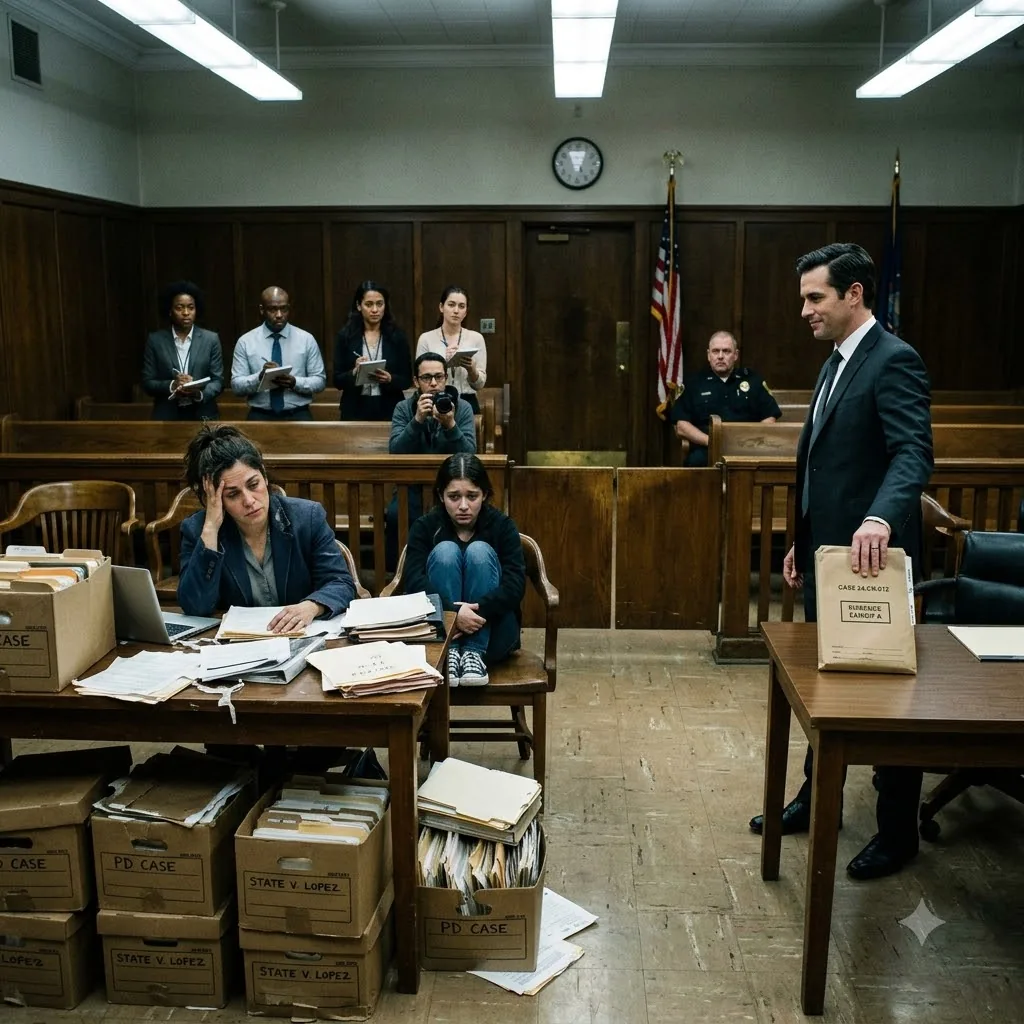
Story code: ST-000645
Part 4: Fruit of the Poisonous Tree
Judge Hernandez cleared his throat, the sound shockingly loud in the sealed, silent room. He looked at the heavy brass locks on his doors, then down at the furious chief prosecutor. The judge was a survivor of municipal politics; he knew exactly when a ship was sinking, and Vance’s illegal dragnet had just been blown wide open on the record.
“Counsel is correct,” Hernandez said, his voice trembling slightly before finding its usual authoritative timber. “The State has utterly failed to demonstrate lawful acquisition of these medical records. Under the doctrine of the fruit of the poisonous tree, I am suppressing the file and the physical exhibit. Motion for no-bail remand is denied. I am ordering the immediate release of the defendant.”
Vance did not shout. He did not slam his fist on the table. Instead, his expression smoothed into a mask of terrifying, reptilian calm. He carefully picked up the biohazard bag containing the bloody locket and slipped it into his leather briefcase, followed by the heavily redacted medical file.
“Unlock the doors,” Vance commanded, not to the judge or the bailiff, but to the men in tactical windbreakers standing at the back of the gallery.
The heavy brass tumblers clicked open. The heavy oak doors swung wide.
The tactical “reporters” seamlessly filtered out into the hallway, abandoning their front-row seats. But their departure created a vacuum that was instantly filled by the actual local press pool. Kept out in the corridor during the lockdown, the legitimate beat reporters and freelance photographers surged forward, a tidal wave of flashing bulbs, shouting voices, and thrusting microphones.
“Take the cuffs off her,” Maya barked at the bailiff, her voice cracking.
The bailiff hastily unlocked the heavy iron chains. The teenage girl slumped forward, rubbing her raw wrists. The dark, rust-colored fluid had stopped leaking from her nose, but her orange county jumper was horribly stained, the collar slick and dark. She looked up at the swarm of cameras, her eyes wide, entirely unprepared for the blinding flashes capturing her terror.
Maya stepped in front of her, raising her hands to block the lenses. “Back off! She’s a minor! You do not have consent to photograph her!”
It was completely useless. The hallway was a public forum. The camera shutters sounded like a swarm of mechanical locusts. They captured the girl’s pale, sweat-drenched face. They captured the bizarre, unnatural fluid soaking her chest. They captured the raw terror of a teenager who had just suffered an unimaginable medical trauma, turning her agony into a front-page spectacle. Her anonymity, her only real shield against a government that wanted to erase her, evaporated in the blinding white light of the camera flashes.
Vance paused beside the defense table, leaning in close to Maya as the chaotic noise of the press pool swallowed his words from everyone else.
“You think you won a victory for civil rights today, Ms. Brooks,” Vance whispered, his peppermint breath cold against her cheek. “But all you did was strip her of federal protection. My team would have kept her quietly quarantined. Now? Her face, her symptoms, her anomaly-it’s going to be broadcast to every rogue agency, corporate bio-lab, and panic-stricken citizen in the state. You didn’t save her. You just threw her to the wolves.”
Vance straightened his perfectly tailored jacket and walked out of the courtroom, effortlessly parting the sea of reporters.
A pair of frantic court social workers pushed through the crowd, wrapping a heavy wool blanket around the teenager’s shoulders and rushing her toward the secure juvenile exit. The girl looked back over her shoulder just once. She didn’t look relieved. She looked hunted. Maya watched her disappear, a heavy, cold weight settling deep in her stomach. Maya knew Vance was right about one thing: the tactical team was waiting out there. If they didn’t grab her in the parking lot, they would track her down tomorrow.
The gallery slowly emptied, the reporters chasing the social workers down the hall, desperate for a quote. The courtroom grew quiet again, leaving Maya standing entirely alone at the scratched wooden defense table.
She looked down at the yellow legal pad. The dark, rust-colored stain had soaked through three layers of paper, leaving a stiff, unreadable mark.
Maya sank into her cracked vinyl chair and pulled her heavy plastic crate of files toward her. One down. One hundred and ninety-nine cases left to go.
She touched the edge of the next manila folder, but her fingers were trembling. The sheer, crushing reality of what she had just uncovered paralyzed her. Vance had bypassed the warrant requirement because he was running a dragnet on municipal pregnancy clinics. He was systematically hunting down women whose bodies had rejected whatever experimental horror the military had subjected them to.
And if Vance was doing it here, in this dilapidated courthouse, he was doing it everywhere. He would learn from today. Next time, he wouldn’t bring a flimsy federal health code to a municipal judge. He would secure a rubber-stamp warrant from a compliant federal magistrate. He would tighten his protocol. He would adapt his playbook.
Maya stared at the mountain of manila folders stacked in her crate. Behind every cheap coffee stain, behind every poorly typed arrest report for petty theft or loitering, could be another terrified girl bleeding dark fluid. Maya was supposed to be a shield for the vulnerable, but as she sat in the empty courtroom, the true scale of the machine she was fighting finally eclipsed her. She was just a public defender with a cracked chair and a yellow legal pad, waiting for the wolves to return.