Story code: ST-000651
Part 3: The Scapegoat
The heavy, rhythmic crunch of tactical boots on shattered glass and concrete grew louder. Elias didn’t peek over the edge of the planter. He didn’t need to. He tracked the attacker’s approach entirely by sound, his mind automatically calculating the distance. Ten feet. Eight feet. The breathing of the man pinned beneath his forearm-Councilman Vance-was a wet, panicked rattle.
Elias checked the stolen nine-millimeter in his grip. He couldn’t go center mass. The attacker was wearing heavy plate carriers that would eat the hollow points without a second thought. He had to take the head or the pelvic girdle.
Six feet. The shadow of the attacker’s rifle barrel crept across the sunlit concrete near Elias’s scuffed boot.
Elias moved. He didn’t rise over the top of the concrete; he rolled hard to the right, clearing the jagged edge of the planter low to the ground. The attacker was already pivoting, his finger tightening on the trigger, but Elias was under his line of sight. Elias punched the pistol forward, aiming for the vulnerable gap just below the heavy Kevlar vest, directly at the unprotected pelvic bowl.
He fired twice. The sharp cracks echoed off the school facade.
The attacker’s legs buckled instantly. As the man pitched forward with a startled grunt, his rifle firing a wild burst into the sky, Elias adjusted his aim and put a third round straight through the dark visor of the balaclava. The man hit the pavement like a sack of wet cement and did not move.
From inside the school, the screaming shifted in pitch. The remaining two gunmen had reached the secondary security doors. But the unmistakable, layered wail of approaching police sirens was already bleeding into the air. The lockdown drill had an automated panic system, and the shattered glass had tripped it.
Elias stayed low, keeping his weapon trained on the destroyed lobby doors. He didn’t advance. He wasn’t a hero, and he wasn’t a cop. He was a survivor. The sirens swelled into a deafening roar. Four black-and-white cruisers jumped the curb, tearing through the pristine landscaping of the plaza, their lightbars painting the morning in chaotic flashes of red and blue.
“Drop the weapon! Drop it now!”
Elias didn’t hesitate. He ejected the magazine, cleared the chamber, and placed the pistol carefully on the concrete. He laced his fingers behind his head and dropped to his knees, eyes fixed on the pavement. He knew exactly how this looked. A man in a faded canvas jacket, a dead body in tactical gear, a frantic scene. Survival in a combat zone meant absolute compliance.
Heavy boots swarmed the plaza. Real police. Officers with patrol rifles moved past him, pushing toward the school to engage the active shooters. Two officers broke off, advancing on Elias and the cowering group behind the planter with their weapons raised.
“Keep your hands where I can see them!” a young officer barked, his face pale with adrenaline.
Suddenly, Vance was on his feet. The councilman scrambled out from behind the planter, his pristine charcoal suit torn and covered in gray stone dust. His face was flushed crimson, distorted by a volatile mix of leftover terror and sudden, desperate arrogance.
Over the officer’s shoulder, Elias saw the local news van-the one that had been idling near the plaza to cover Vance’s ribbon-cutting ceremony. The cameraman had emerged from behind the vehicle, hoisting his heavy rig onto his shoulder, the red recording light glowing steadily. He was capturing the entire perimeter.
Vance saw the camera, too. Elias watched the politician’s eyes track the lens, seeing a frantic calculation click into place. The impenetrable fortress had failed. The sterile zone was a slaughterhouse. His private security contractors were hiding. The politician needed a scapegoat that fit his narrative, and he needed it before the microphones arrived.
“Officers, thank God!” Vance yelled, waving his manicured hands frantically, deliberately stepping into the camera’s line of sight. He pointed a trembling finger directly at Elias. “This man is with them! He’s a spotter! He attacked me right before the shooting started!”
Elias stayed perfectly still, his fingers laced tightly behind his head. “I was disarming your guard,” Elias said, his voice flat, carrying no panic. “He was going to shoot me.”
“Liar!” Vance shrieked, his voice cracking theatrically for the cameras. “He’s a vagrant! An agitator! He was casing the school! He threw me to the ground to clear the way for that van!”
The two officers hesitated, their weapons shifting back and forth between the dead attacker and Elias. “Sir, step back,” the older cop ordered Vance.
But Vance wasn’t listening. He was riding a wave of performative outrage, fueled entirely by the blinking red light of the news camera. He needed a visual. He needed proof of the threat he had been lecturing about all morning. His eyes darted to the heavy olive-drab duffel bag resting near Elias’s knees.
“You want proof? Look at what he brought into a school zone!” Vance roared. He lunged forward, ignoring the officers’ shouted warnings, and grabbed the thick canvas strap of Elias’s bag.
“Don’t touch that,” Elias warned, his voice dropping an octave, a sudden edge of cold steel bleeding through his forced calm.
“Shut up, you piece of trash!” Vance hauled the heavy bag up by its base. He grasped the heavy brass zipper, yanked it open, and violently upended the duffel over the concrete. “Let’s see the weapons! Let’s see the bombs!”
Vance shook the bag frantically. The contents cascaded onto the pavement, right at the feet of the advancing police officers, perfectly framed by the news camera zooming in over their shoulders.
There were no pipe bombs. There were no magazines.
A thick, vacuum-sealed package of military-grade combat trauma gauze bounced on the concrete. Beside it fell a heavy steel flashlight and a worn leather Dopp kit.
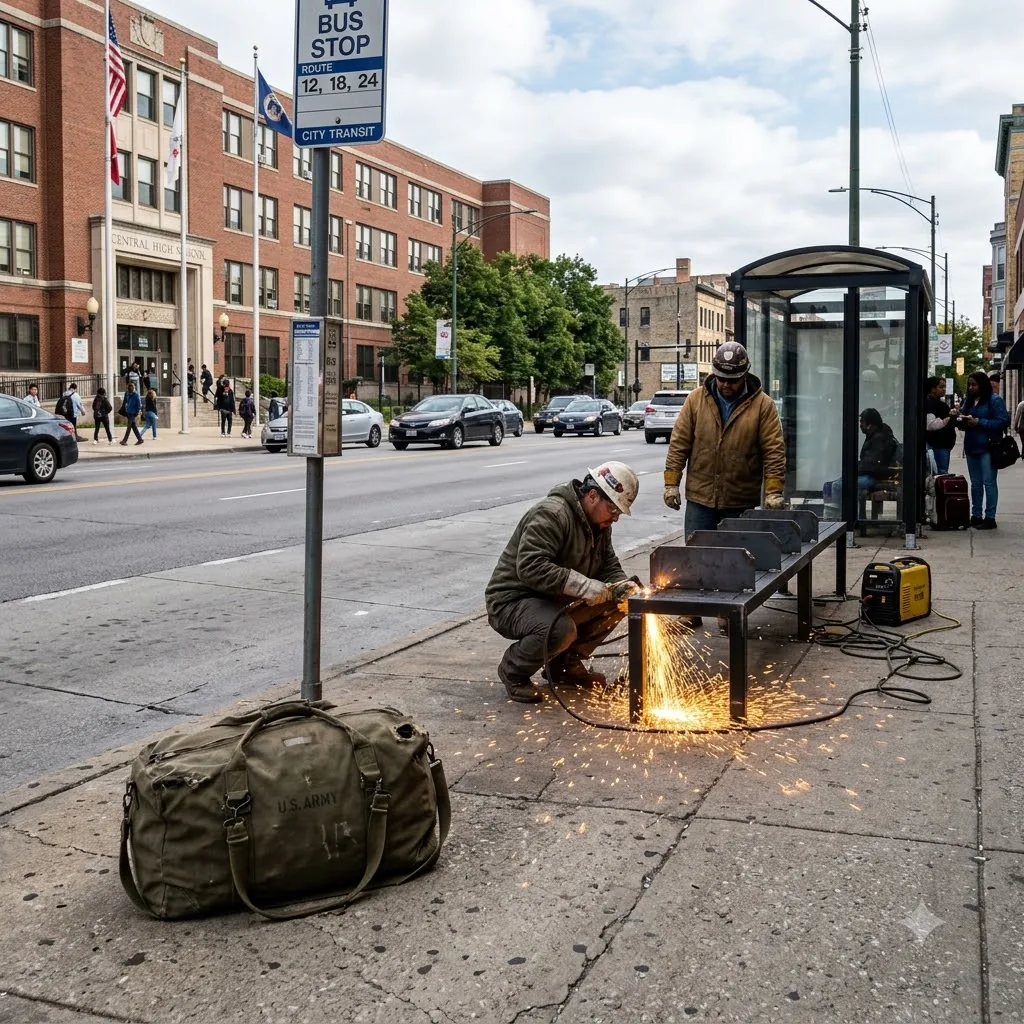
Then, sliding out with a heavy, deliberate grace, came a polished wooden shadow box. The glass cracked as it hit the pavement, but it didn’t shatter. The velvet interior caught the morning sun, illuminating three rows of meticulously arranged ribbons, a Bronze Star, and the unmistakable bronze medallion of a Gulf War campaign medal.
Finally, a tightly folded triangle of heavy cotton slid from the canvas lining. The American flag, folded with absolute mathematical precision, landed softly on top of the cracked glass of the shadow box. The red, white, and blue fabric stood out violently against the gray concrete and the shattered stone.
The silence that fell over their small corner of the plaza was absolute, cutting right through the wail of the sirens.
The older police officer lowered his rifle a fraction of an inch, his eyes locked on the folded flag, then flicking down to the Bronze Star. He swallowed hard, a muscle feathering in his jaw. He looked from the medals, to the dead tactical shooter with three precise bullet holes in him, and finally back to Elias, who was still kneeling with perfect, disciplined stillness.
Vance stood frozen, the empty canvas bag dangling limply from his hands. The politician’s mouth opened, but the hysterical accusations had completely evaporated. He stared at the flag. He looked up at the blinking camera lens. He looked back down at the medals. The dust from the shattered concrete planter settled lightly over his expensive, ruined shoes.
Elias didn’t lower his hands. He just looked up at the councilman, his eyes cold and empty.