Story code: ST-000674
Part 4: The Safe Neighborhood
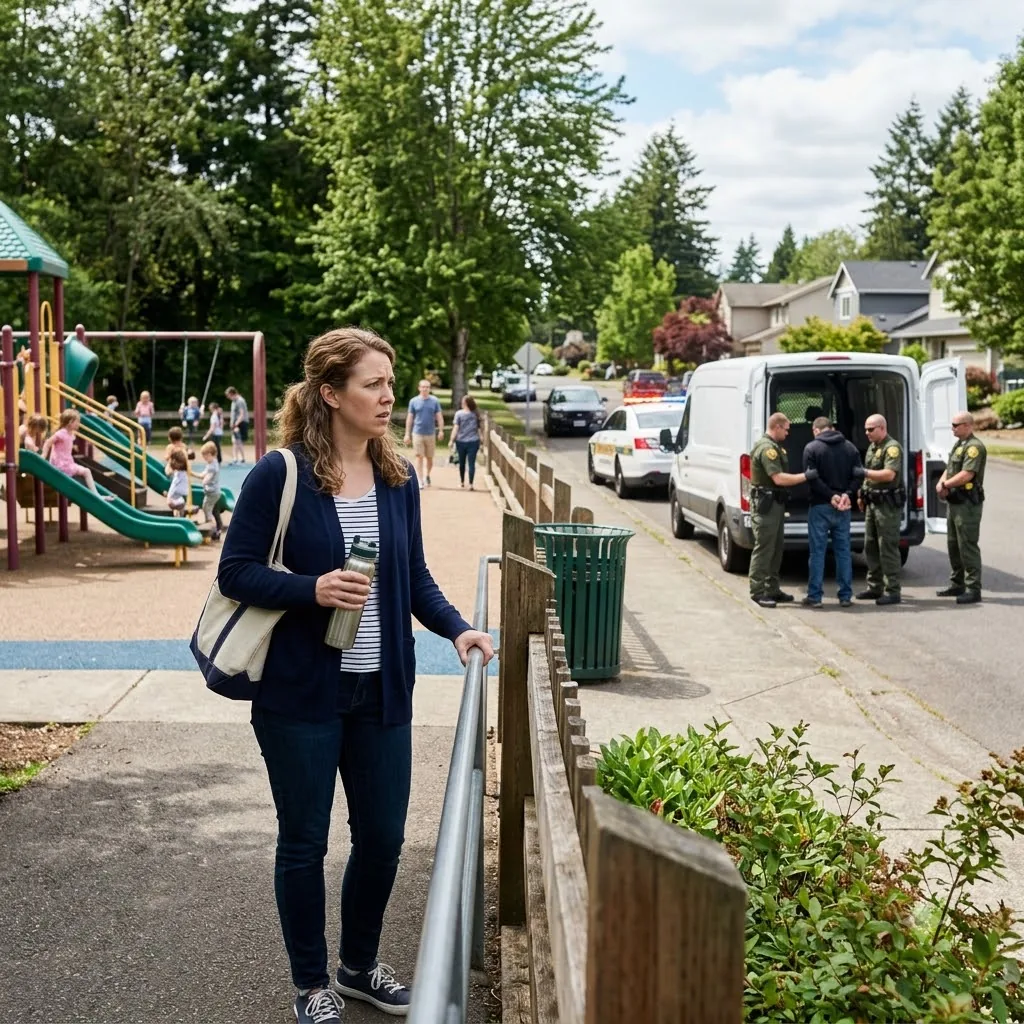
Thirty days later, the morning air was sharp and biting. Sarah sat on the cold green metal of the park bench, her hands wrapped tightly around a cardboard coffee cup. The playground was entirely empty. It had been empty for a month.
Across the street, a pristine white transit van idled silently at the stop sign. It wasn’t there for her. Not today. It was just doing its neighborhood patrol, its mounted cameras scanning license plates and cross-referencing municipal noise complaints and unpermitted lawn modifications.
Sarah watched the van glide past her own house. She knew exactly what was pressed inside the bottom drawer of her kitchen desk: a heavily redacted legal summary from a terrified local attorney, and a finalized home equity loan. The lawyer had charged her four hundred dollars to explain that the municipal contracts were absolutely ironclad. Mayor Thomas had legally signed away the city’s civil enforcement rights in exchange for a balanced budget. The eight-thousand-four-hundred-dollar shortfall from Marcus’s account had legally defaulted to her, the registered complainant. She had paid Apex Secure Holdings to save her own home, draining her children’s college fund to satisfy a corporate algorithm she had begged the city to install.
The transit van turned the corner and disappeared. A moment later, a rusted yellow county cab pulled up to the curb near the basketball court.
The back door popped open. Marcus stepped out onto the asphalt.
Sarah stopped breathing. She hadn’t seen him since the morning the men in the tactical vests had zip-tied his wrists. He looked completely hollowed out. The rigid, defiant posture that had infuriated her at every city council meeting was gone. He wore a cheap, ill-fitting grey tracksuit with a barcode printed squarely on the left breast. He had no boots, just laceless canvas slip-ons.
The cab sped away. Marcus stood on the edge of the park. He didn’t look at the oak tree where he used to stand his ground with his rifle slung over his shoulder. He didn’t look at Sarah.
He turned and began the slow walk down the cul-de-sac toward his property.
Sarah stood up. Her legs felt weak, numb from the cold, but she followed him on the opposite side of the street, keeping her distance. She watched him approach his driveway.
The heavy steel plates still covered his front windows. The lag screws were rusted from a month of rain. The padlock bracket on his front door remained locked tight. Stamped across the wood in thick black ink was an Apex Asset Liquidation Notice.
Marcus stopped at the edge of his dead lawn. He pulled a thick manila envelope from his tracksuit pocket. He opened the flap and pulled out a stack of dot-matrix carbon-copy invoices, identical to the yellow square Sarah had found in the grass thirty days ago.
He stared at the paperwork. He didn’t yell. He didn’t march up to the door and try to break the padlock. He just sank to his knees in the damp, overgrown grass.
He was completely disarmed. His dog was gone, surrendered to the county shelter. His house belonged to a holding company. He owed tens of thousands of dollars in compounding daily containment debt, with interest accruing at eighteen percent-a state-mandated financial ruin that he would carry for the rest of his life.
Sarah stood on the sidewalk across the street, the cold seeping through her boots. She wanted to say something. She wanted to apologize, to tell him she had fought Mayor Thomas, to scream that she had lost her own savings trying to stop the gears she had set in motion.
But the words tasted like ash before they even reached her throat. It didn’t matter what she had intended. Sterling’s vicious voice still echoed in her ears every time she closed her eyes: *You pulled the trigger, Ms. Miller. We just caught the brass.*
She looked down the street. Three houses away, a new yellow Complainant Dividend sticker was plastered to the Johnsons’ front door. Next to that, an Apex repossession sign on the Hendersons’ lawn. The quota required fifty bodies a quarter. Marcus had just been the first.
The neighborhood was perfectly quiet. The park was immaculate. There were no loud arguments, no political demonstrations, no open-carry absolutists ruining the aesthetic of the subdivision.
Sarah looked back at the playground. The swings hung motionless in the grey morning light. The slide was polished and unused. The woodchips were perfectly level.
It was exactly the pristine, orderly utopia she had demanded week after week at the podium. She had successfully outsourced her fear, signing away her neighbors to a corporate ledger just so she wouldn’t have to look at a rifle on a Sunday afternoon.
Marcus remained kneeling in the wet grass, staring blindly at the invoice that owned him.
Sarah walked slowly back to the park bench and sat down. She pulled her coat tighter around her shoulders, shivering violently, trapped in the suffocating silence of the perfect, terrible cage she had built.