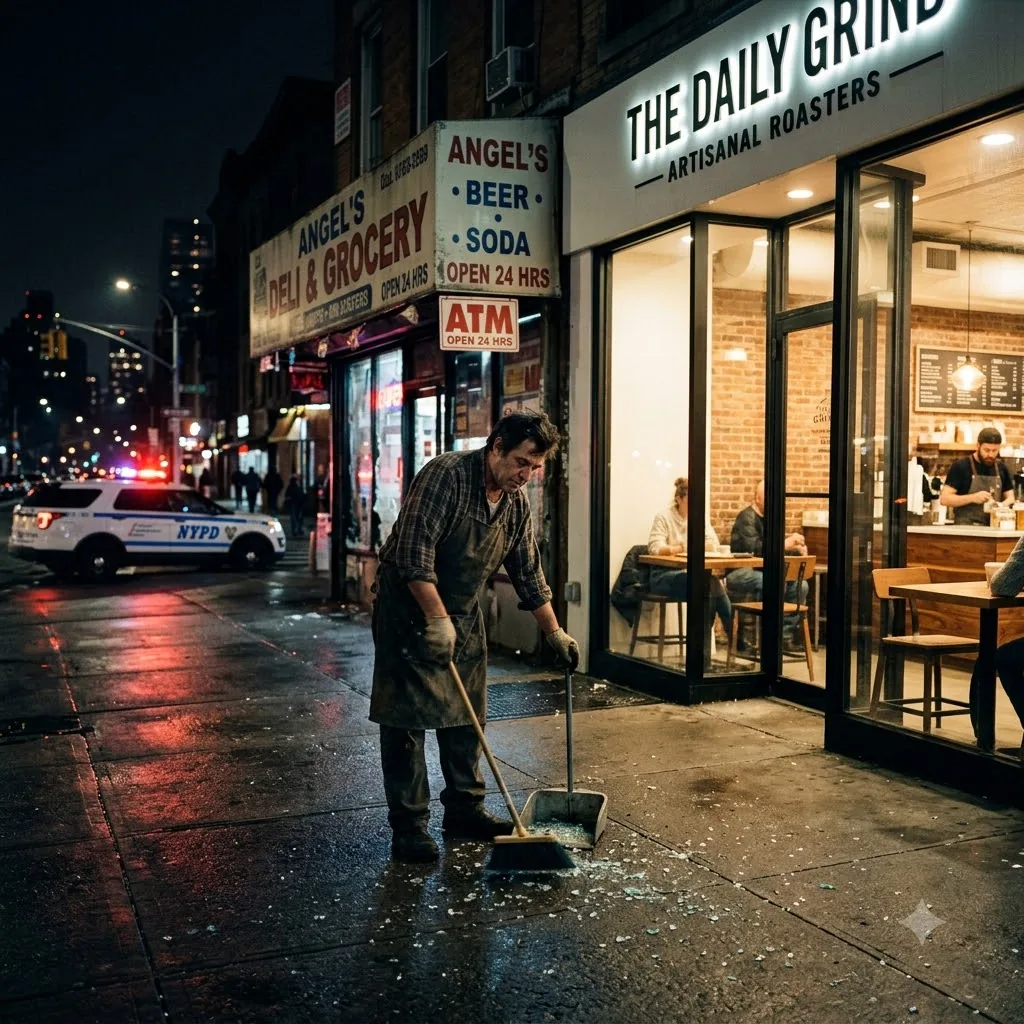
Story code: ST-000675
Part 2: The Contraband
The plastic barrel of the pen snapped. A sharp edge bit into the webbing of Hector’s thumb, but he barely registered the sting. He forced his hand to steady, pressing the mangled ballpoint against the heavy stock paper. He scrawled his name in jagged cursive on the bottom line.
*Just leave,* Hector thought, handing the clipboard back. *Take your petition and leave.*
Julian smiled, inspecting the signature. “Excellent. I knew you would see reason. A permanent police tower is exactly what this corner needs.” He tucked the clipboard into his apron, but he did not turn toward his espresso bar. Instead, Julian adjusted his tortoiseshell glasses and peered down the narrow alleyway that ran parallel to the bodega’s brick wall.
“Though, I suppose we shouldn’t wait for the tower,” Julian murmured, reaching into his pocket for his sleek smartphone. “When the sirens started, I saw three of your regulars scatter down your alley. The ones clutching those brown paper bags you hand out.”
The cold sweat on Hector’s neck turned to ice. The bags.
To the neighborhood outsiders, the brown paper sacks looked like tallboys of cheap beer. But Hector’s bodega had not survived on beer and scratch-offs for three years. The bags held blister packs of imported antibiotics, un-prescribed asthma inhalers, and cut-rate insulin-a clandestine pharmacy for the uninsured kitchen staff and day laborers who kept the gentrifying block running. It was the only way Hector could scrape together the fifty thousand dollars required for the hospital’s escrow account. The loiterers were his couriers, his lookouts, keeping the illegal inventory moving so it was never centralized in the shop.
And today, Hector had packed the master bag-the one holding the actual escrow cash-and given it to Tomas to hold during a shakedown from a delivery driver. Now Tomas was in a police cruiser, and the remaining couriers were hiding in the alley with the medical contraband.
Julian tapped his screen, unlocking it with his face. “I am going to text Captain Miller. He can swing a cruiser around the back and box them in. We can get them for criminal trespass.”
“No,” Hector said, his voice cracking. He stepped into Julian’s line of sight, physically blocking the view of the alley. “I will tell them to leave. You do not need to bother the Captain.”
Julian frowned, his polite veneer thinning into something rigid. “It is no bother, Hector. This is what the merchants’ association is for. You are too soft on these vagrants. You give them handouts, you let them drink out of those bags on your property. I am calling dispatch.”
“Julian, wait.” Hector’s mind spun frantically. It was just past two o’clock. The hospital deadline was five. If the police swept the alley, they would find the un-taxed, illegal medication. They would link it back to the bodega. Hector would be arrested, the shop would be seized, and Tomas would be processed with the fifty thousand dollars, which would vanish into a civil asset forfeiture bin forever. His wife’s name would be erased from the transplant list by dinner.
Hector gestured toward the open door of the bodega. “The cameras. I have security cameras pointing at the alley. Come inside. We can look at the footage, see exactly who went back there. It is better for the police report.”
Julian paused, his thumb hovering over the dial pad. The idea of concrete evidence appealed to him. “You have cameras on the alley?”
“In the back office,” Hector lied, stepping backward into the dim, air-conditioned chill of the shop. “Come. Let me show you.”
Julian hesitated, brushing a speck of dust from his pristine denim apron, before stepping over the threshold.
Inside, the bodega felt like a pressure cooker. The compressor of the ice machine roared in Hector’s ears. On the front counter, his cell phone lit up again. *Mercy Hosp Billing.* Hector quickly flipped the phone face down, leading Julian down the narrow aisle between the canned beans and the cleaning supplies, heading toward the cramped rear storeroom.
“It smells like damp cardboard in here,” Julian complained, following close behind. “You really should let my contractor look at your ventilation. If health and safety comes through, they will issue a citation for mildew.”
“Just through here,” Hector said, stopping at the heavy wooden door of the storeroom. He pushed it open, revealing the windowless, concrete-walled space where he kept surplus inventory. And where, resting openly on a folding table under a single bare bulb, sat a cardboard box overflowing with empty brown bags, rubber bands, and dozens of foil-backed pill packets he had not yet distributed.
Julian stopped in the doorway. The harsh blue light caught the shiny foil of the blister packs. He looked at the Mexican antibiotics, then down at the brown paper bags, and finally at Hector. The realization hit Julian’s face in slow motion.
“This isn’t a bodega,” Julian whispered, his eyes widening. “You’re supplying them. That is what is in the bags. You are running a drug ring right next to my patio.”
“Julian, please, listen to me,” Hector begged, keeping his voice low so it would not carry upstairs to his wife’s bedroom. “It is just medicine. For the people who cannot afford the clinics. I need the money for my wife. Please, I just need to go to the precinct to get Tomas-”
“Tomas?” Julian backed up a step, his face twisting in profound disgust. “The old man I just had arrested? He is your dealer?” Julian raised his phone, his thumb jamming the screen. “I am calling the precinct. They need to send narcotics.”
The words echoed in Hector’s head. *Narcotics. The precinct.*
Hector saw the countdown in his mind. Three hours until the hospital canceled the surgery. An hour before the desk sergeant searched Tomas’s pockets. Seconds before Julian made the call that would end Hector’s life.
Before Julian could press the green call button, Hector lunged. He did not go for the phone. He dropped his shoulder and slammed hard into Julian’s chest.
The impact threw the barista backward into the windowless storeroom. Julian stumbled over a stack of heavy plastic milk crates, crashing to the concrete floor with a sharp shout, his phone skittering away into the dark corner.
Hector grabbed the heavy iron handle of the storeroom door and pulled it shut. He threw his weight against the wood, grabbed the heavy steel deadbolt, and slid it into place with a resounding, terminal click.
He leaned his forehead against the cold wood of the door, his heart hammering violently against his ribs. From inside, Julian began to pound on the heavy timber, shouting muffled threats that vibrated through the floorboards.
Hector turned around to face the empty shop. His phone was vibrating against the laminate counter again. Tomas was miles away in a police car. And Hector had just kidnapped the president of the merchants’ association.