Story code: ST-000708
Part 2: The Conservation Flag
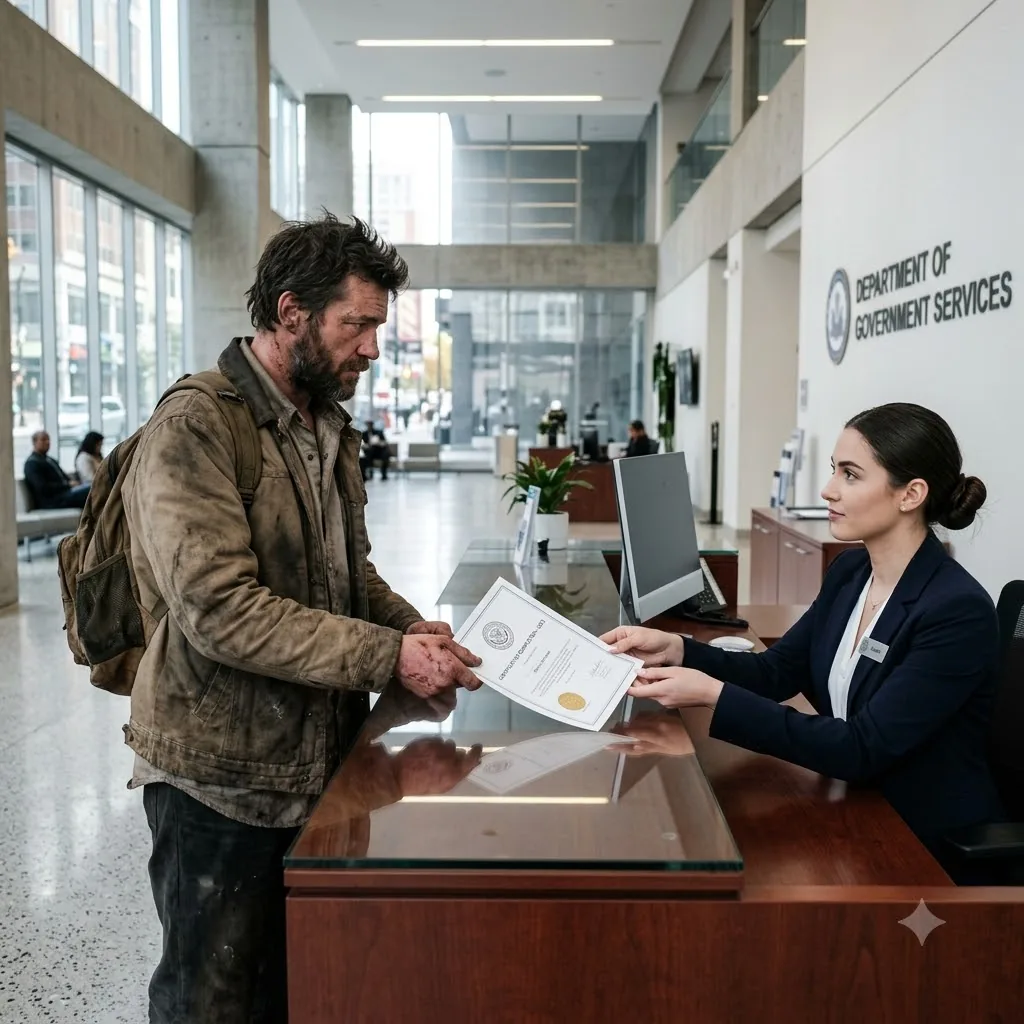
Cole heard the subtle, heavy thunk of the magnetic locks engaging on the lobby’s main glass doors. The quiet sound echoed through the high-ceilinged room, instantly transforming the climate-controlled waiting area into a sealed box. The security guard’s thick rubber soles squeaked aggressively against the polished tile, closing the distance from the entrance to the desk at a rapid, tactical pace.
Cole did not turn around. He kept his hands perfectly still on the marble counter, his broad palms flat and visible against the cold stone. Over the last four years, he had learned exactly how not to startle men who carried zip-ties and pepper spray.
The receptionist shoved her rolling chair backward. It slammed violently into the rear metal filing cabinets. She clutched the collar of her pressed silk blouse, her chest heaving as if Cole had just pulled a knife instead of a manila folder.
“Sir, I need you to step back from the glass,” the guard said. His voice was loud, projecting a forced, rigid authority designed to command the room.
Cole glanced over his shoulder. The guard-whose silver nameplate read *Barrows*-had his right hand resting deliberately over the retention snap of his holstered Taser.
Cole pulled his hands off the marble. He moved with agonizing slowness, telegraphing every inch of his motion to ensure there were no surprises. He took one measured step backward. The thick, shiny burn scars along his neck and collarbone pulled tight as he kept his posture completely neutral.
“I’m just filing my certification,” Cole said, keeping his voice carefully level. He swallowed hard, fighting the sharp, familiar tickle of damaged tissue in his throat. “There’s no issue here. The scanner just threw a flag.”
“Hands out of your pockets. Keep them where I can see them,” Barrows ordered, stepping into the space between Cole and the desk. Barrows was tense, his eyes darting from the melted, pink flesh creeping up Cole’s jaw down to his scuffed, soot-stained boots.
Behind the receptionist, a heavy frosted glass door swung open. A man in a tailored gray suit stepped out of the inner offices. He wore a dark blue lanyard carrying a silver administrative badge. He looked at the receptionist, who wordlessly pointed a trembling acrylic nail at her monitor. The administrator leaned over, his eyes scanning the bright red block of text illuminating the screen.
Cole watched the man’s jaw set tightly. The administrator stood up, smoothing his silk tie, and looked at Cole with a mixture of profound annoyance and deep, institutional disgust.
“I am Deputy Director Hayes,” the man said. His voice was smooth, carrying the insulated confidence of someone who spent his career behind blast-proof glass and heavy mahogany doors. “You are not supposed to be in this building.”
“I need my physical override processed,” Cole said. He pointed a stiff, calloused finger at his folder sitting on the desk. “The regional memo said three thousand hours waives the entry exam for seasonal crews. I have four thousand. It’s stamped by the state fire marshal.”
“That documentation was issued under a Department of Corrections mandate,” Hayes said, his tone dropping into a hushed, sharp hiss, as if the very words contaminated his pristine lobby. “You were property of the state when those hours were logged. You were on an inmate conservation crew.”
“I was on the line,” Cole corrected, his voice hardening despite his effort to stay calm. “Same as the municipal boys. Same as the federal smokejumpers. I cut the same line and breathed the same smoke.”
“It is a completely different employment classification,” Hayes replied, his lip curling in a faint sneer. “State forestry does not insure or employ felons on civilian handcrews. The system automatically flagged your barcode because you are restricted from municipal hiring pools.”
“I have a clearance letter from the camp commander,” Cole said, keeping his hands raised slightly. “I’ve served my time. I was released on Tuesday. The state trained me. The state handed me that certification and told me it was good for a job.”
“The state gave you a piece of paper to make you feel rehabilitated,” Hayes said smoothly. “But you are currently standing in a secure government facility, frightening my staff, and triggering a severe security protocol.”
Cole stared at the man. The sheer, suffocating absurdity of it choked him more than the lingering damage in his lungs. Two summers ago, when the Diablo winds pushed a massive, roaring wall of fire down into the valley, Cole and his crew of inmates had worked seventy-two hours straight. They had cut the firebreak that saved an entire subdivision of expensive houses-houses exactly like the one Hayes probably lived in. The forestry bureaucracy had been terrified then. They had begged the prison crews to hold the line when the municipal engines had to pull back. Cole had held it. It cost him the skin on his neck and shoulder, and left him with a permanent, rattling cough.
Back then, he was a necessary hero in a sweat-drenched orange Nomex shirt. Now, standing in civilian flannel, he was just a liability.
“Give me my paperwork back,” Cole said. His voice dropped lower, the heavy gravel in it scraping against the silence of the room.
Hayes picked up the manila folder. He held it by the corner, avoiding the faint smell of old smoke and diesel. “This documentation contains internal state correction codes. It is government property. I am confiscating it for destruction.”
Cole’s chest seized. That folder was everything. It held the original, signed logbooks of his deployments. It held the fire marshal’s official ink stamp. Without those original papers, he had absolutely zero proof he had ever swung a Pulaski on a fireline. He would be just another guy with a record and burn scars, completely unemployable, pushed right back to the bottom of the concrete barrel he had just spent four years crawling out of.
“You aren’t taking that,” Cole said. He took a half-step forward.
Barrows instantly drew his Taser. The bright yellow plastic weapon snapped up, pointing directly at Cole’s center mass. A red laser dot danced erratically over the faded fabric of Cole’s shirt.
“Stop right there! Get on the ground!” Barrows shouted.
The quiet lobby erupted into chaos. The civilians sitting in the plastic waiting chairs scrambled backward, clutching their bags, gasping in shock as they rushed toward the far wall.
Cole froze. The red dot settled steadily over his heart. If he moved forward, Barrows would shoot. If he dropped to the ground and let himself be handcuffed, he would violate his parole conditions within forty-eight hours of his release, sending him straight back to a cell. If he turned and walked out the door, he left behind his only chance at a life.
“Call the police,” Hayes told the receptionist, casually sliding Cole’s folder into a locked metal drop-box secured behind the front desk. “Tell them we have a parolee attempting an assault.”
Cole stood completely rigid, his hands still raised in the freezing, sterile air, listening to the receptionist frantically dial 911.