Story code: ST-000708
Part 4: The Gate Money
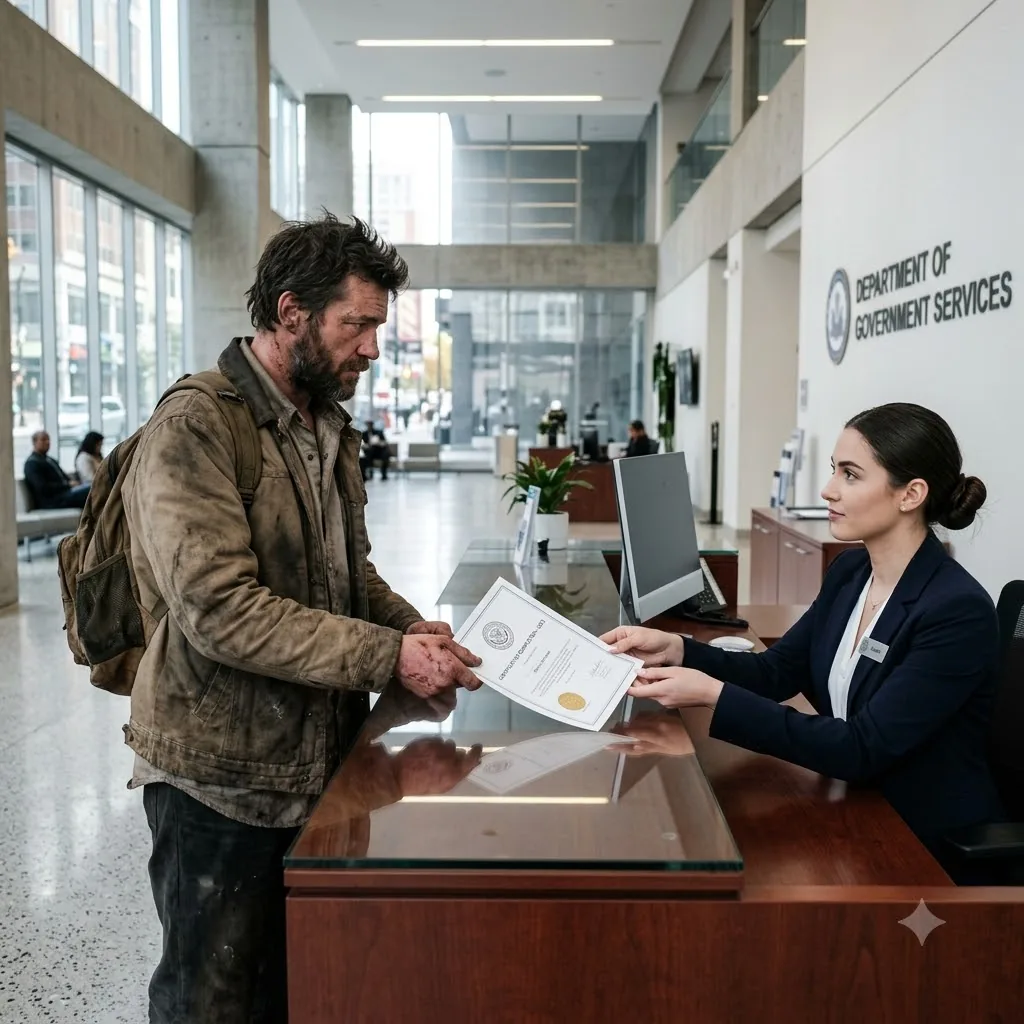
The flashing red and blue lights reflecting off the lobby’s pristine glass finally gave Hayes his voice back. When the two municipal patrol officers came through the magnetic doors, hands resting on their duty belts, Hayes smoothly transitioned from stunned silence back to insulated bureaucratic authority. He didn’t press assault charges. An arrest meant paperwork, court dates, and potentially putting Cole’s math on the public record. Instead, Hayes simply cited a trespassing violation, pointing to the red alert banner on the receptionist’s monitor as proof of Cole’s ineligibility to be in the building.
Cole didn’t fight as the officers patted him down. He kept his hands raised and let them walk him out. He kept his eyes locked on the metal drop-box beneath the mahogany desk as he was escorted backward through the sliding doors. His four thousand hours, his melted skin, his sweat, and his state-sanctioned heroism remained inside that locked square, scheduled for the shredder.
The transition from the climate-controlled lobby to the cracked asphalt of the department’s parking lot hit Cole like a physical blow. The afternoon sun was brutal, baking the blacktop and radiating a dry, suffocating heat that instantly made the burn scars on his neck pull and ache. The officers warned him that setting foot on forestry property again would result in a parole violation and immediate remand to custody. They didn’t put him in the back of a cruiser. They just watched him walk to the edge of the property line, then climbed into their vehicle and rolled away.
Cole stood alone on the dusty shoulder of the highway. He reached into the front pocket of his faded flannel shirt and pulled out his gate money. Two crisp hundred-dollar bills and a state-issued debit card with twenty-two dollars loaded onto it. That was the sum total of his transition fund. It was supposed to buy him a few nights in a cheap motel and food while he secured a position on a seasonal handcrew. Without the certification, the money wasn’t a bridge to a new life. It was just a countdown timer.
He looked down at his scuffed lug-sole boots. They were built for traversing burning scree fields and kicking through smoking root systems. Now, they were just heavy, impractical shoes standing on municipal concrete.
A low, grinding rumble vibrated through the soles of his boots.
Cole looked up. Coming down the highway from the direction of the foothills was a heavy transport vehicle. It wasn’t a sleek, million-dollar red municipal fire engine. It was an old, retrofitted state corrections bus. The windows were covered in heavy steel mesh. The paint was a dull, fading white, streaked with fresh soot and dust.
As the bus rumbled past the state forestry office, shifting gears with a harsh, metallic whine, Cole saw the silhouettes behind the wire mesh. Men in bright orange, fire-resistant Nomex shirts. They were slumped against the hard plastic seats, their heads resting against the rattling windows. A few of them looked out at Cole as they passed. Their faces were smeared with the unmistakable grey-black ash of a fresh deployment. Their eyes were hollow and exhausted, carrying the thousand-yard stare of a crew that had just spent forty-eight hours breathing poison to save someone else’s real estate.
Cole instinctively raised his hand to his chest, pressing his fist against his sternum as a dry cough rattled up his throat. The exhaust from the bus washed over him, smelling heavily of cheap diesel and old smoke.
He turned his gaze away from the retreating taillights and looked toward the eastern horizon. Above the jagged line of the foothills, a massive column of dirty, brown-black smoke was building, mushrooming up into the stratosphere. The Diablo winds were picking up, pushing the plume directly toward the valley. The air pressure was already dropping. The sky was taking on a sickly, bruised orange tint.
It was a monster of a fire. The kind that required thousands of hands to cut a line through the rock and dirt to stop it from reaching the suburbs. The kind that would drain the state forestry budget in three days if they had to pay union wages for every swing of an axe.
The corrections bus merged onto the freeway on-ramp, heading straight for the smoke.
Cole slipped his gate money back into his pocket. He understood the math now, with a terrifying, absolute clarity. The state didn’t need him to rehabilitate. They didn’t need him to reintegrate into civilian society, pay taxes, or rent an apartment. They just needed him to run out of those two hundred dollars. They needed him to get hungry, get desperate, and miss a parole meeting or sleep on the wrong park bench.
He was banned from the fireline today. But the system was incredibly patient. It had a steel bunk waiting for him in the mountain camp, and a freshly sharpened Pulaski with his name on it. All he had to do was fail, and he could go right back to saving their world for two dollars a day.
Cole pulled up his collar against the hot wind, turned his back on the sterile glass building, and started walking down the asphalt, trying to figure out how to stretch two hundred dollars against a machine designed to starve him out.