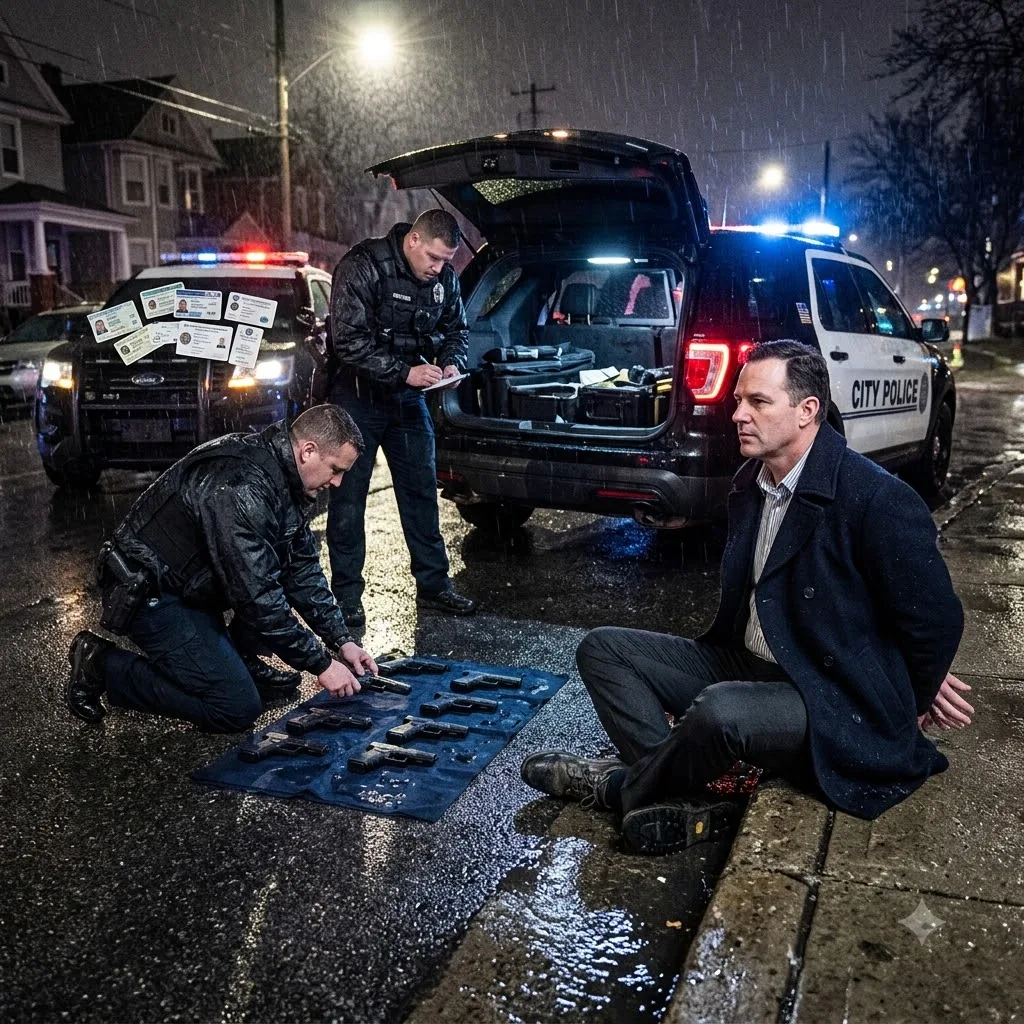
Story code: ST-000734
Part 2: The Substrate
The hard plastic seat of the cruiser offered no give as the patrol car hit every pothole on the way to the city center. Marcus sat rigidly, his shoulders screaming from the unnatural angle of the zip-ties. The freezing rainwater soaked through his thermal base layer, chilling him to the bone, but he refused to shiver. Shivering showed physical vulnerability. He kept his eyes locked on the heavy wire mesh separating him from the two silent officers in the front, watching the orange glow of the streetlights blur past the rain-streaked glass.
They didn’t take him to the local precinct. Marcus knew the route to the Fourth District station-he had trained half the patrolmen there on the firing line, walking them through basic weapon retention and malfunction drills. Instead, the cruiser bypassed the local exits and merged onto the interstate, speeding toward the towering brutalist architecture of the downtown federal and county justice complex.
The car descended a steep concrete ramp into an underground sally port. Heavy steel roll-up doors slammed shut behind them, the mechanical crash echoing off the subterranean walls like a gunshot. Two plainclothes detectives were already waiting by the elevator bank, their gold shields hanging from thick black lanyards over tactical windbreakers. They hauled Marcus out by his armpits, cut the plastic zip-ties with a rescue hook, and immediately locked his raw wrists into heavy, double-hinged steel cuffs connected to a heavy chain wrapped around his waist.
“I am a licensed state firearms instructor,” Marcus said, projecting his voice clearly in the cavernous garage. “My registration number is on the dash of my-”
“Save your breath,” the taller detective grunted, grabbing Marcus by the bicep and shoving him toward the freight elevator.
They bypassed the standard booking procedures entirely. There was no fingerprint scanner, no mugshot camera, no desk sergeant taking his inventory, and no offer of a phone call. They marched him down a sterile, windowless hallway on an upper floor and shoved him into an interrogation room. It wasn’t the standard police box with a two-way mirror. It was a reinforced, soundproofed bunker with a stainless steel table bolted to the concrete floor and a heavy iron ring welded to the center. They threaded his waist chain through the ring, locked it with a heavy padlock, and walked out without a single word.
Marcus sat alone for what felt like hours. The air conditioning blasted from an overhead vent, turning his damp clothes into an ice pack against his ribs. He closed his eyes and focused on his breathing, defaulting to the rhythmic four-count tactical breathing he forced onto his students when they flinched at loud noises. Inhale for four, hold for four, exhale for four, hold for four. Panic was a cascading failure. He had to keep his mind sharp and operational.
The heavy door finally clicked and swung outward. The man in the tailored charcoal suit stepped inside. Up close, under the harsh fluorescent lights, the man looked deeply exhausted, his tie slightly loosened, though his eyes remained sharp and entirely unblinking. He carried a single thick manila folder, which he placed precisely in the center of the steel table. The two detectives filed in behind him, crossing their arms and standing like statues against the reinforced door.
“I want my lawyer,” Marcus said immediately. “And I want my phone call. I have absolute documentation for every piece of equipment in my trunk.”
The suit opened the folder. He didn’t look at Marcus. He smoothed out an enlarged, high-resolution photograph on the table. It was the macro shot the rookie had taken of the large range bag’s heavy nylon handle.
“Do you know how difficult it is to move sixty million dollars in physical currency across an international border?” the suit asked, his voice a low, conversational hum that barely carried over the hum of the air conditioning.
Marcus stared at him, the chain rattling as he shifted his weight. “I teach basic handgun safety to accountants and real estate agents. I have sixteen unloaded training pistols in my trunk.”
“A hundred pounds of paper,” the suit continued, acting as if Marcus hadn’t spoken at all. “It’s heavy. It’s bulky. And thermal scanners catch the density anomalies. The cartels got tired of losing massive bulk shipments in transit. So, they stopped putting the money inside the bags.”
The suit tapped a silver pen against the photograph. “They started making the bags out of the money.”
Marcus frowned, pulling against the heavy chain holding him to the table. “You’re talking to the wrong guy. I bought those range bags at a military surplus store in the Westside industrial park three years ago. I have the paper receipts in my office filing cabinet.”
“The fibers we extracted from your bag’s reinforced stitching aren’t standard 1000-denier nylon,” the suit said, finally looking up and meeting Marcus’s eyes. The sheer intensity of the prosecutor’s gaze made Marcus’s stomach twist. “It is a proprietary polymer matrix. It’s woven using a micro-filament that contains liquefied, unprinted currency substrate, chemically bonded with synthetic narcotics. The bags aren’t carrying the contraband, Marcus. The bags are the contraband. When they reach their destination, a specialized chemist melts the fabric down, separates the polymer, and reclaims both the drugs and the paper.”
Marcus looked down at the photo, a cold, heavy realization creeping up his spine. He thought about the thick, over-engineered bags he had been lugging to and from the gun range for three years. The reinforced stitching that never seemed to fray, even under the weight of thousands of rounds of ammunition. The dense, unnatural weight that he had always mistakenly attributed to high-quality manufacturing.
“I don’t know anything about that,” Marcus said, his voice tightening despite his strict breathing exercises. “I bought them off a clearance rack.”
“The problem,” the suit said, leaning over the table until his face was inches from Marcus’s, “is that the specific chemical signature in the fiber we pulled from your trunk matches a two-ton shipment that vanished from a Juarez processing facility last month. A hijacked shipment that cost a cartel boss his head, and left six undercover federal agents dead in a warehouse fire.”
The suit slid a second photograph out of the folder and dropped it onto the steel surface. It was a grainy surveillance still of Marcus, taken from a long distance, loading his sedan’s trunk at the surplus store three years ago. Only, standing in the background, watching Marcus intently from the shadows of a parked SUV, was a man whose face was circled in thick red marker.
“So,” the suit whispered, tapping the circled face. “Let’s talk about why the Sinaloa cartel’s chief logistics officer was personally overseeing your clearance rack purchase, and where the rest of my missing evidence is.”