Story code: ST-000734
Part 3: Fruit of the Poisonous Tree
The municipal courtroom was stifling, smelling faintly of floor wax and old paper. Marcus sat rigid in a stiff, borrowed suit at the defense table, his hands folded deliberately on the scarred oak surface. He focused entirely on his breathing. Inhale for four, hold for four, exhale for four. He refused to let the tremor deep in his chest travel down to his fingers.
At the prosecution table sat the man in the tailored charcoal suit, introduced to the record only as Special Prosecutor Vance. Vance looked exactly as immaculately rested as he had in the subterranean federal bunker two months ago. Back then, under the humming fluorescent lights of the interrogation room, Vance had laid out a narrative of synthetic drug polymers, dissolved currency, and a Sinaloa cartel logistics officer. A conspiracy so massive and terrifying it had nearly crushed Marcus under its sheer weight.
But today wasn’t about the cartel. Today was a pre-trial suppression hearing. It was strictly about how Vance had obtained his miraculous evidence in the first place.
On the witness stand, the young patrolman from the rainy night of the arrest cleared his throat. Officer Miller looked deeply uncomfortable in his Class-A dress uniform, his eyes darting frequently to the prosecution table.
“Officer Miller,” Vance said, his voice carrying that same smooth, conversational hum he had weaponized in the bunker. “Can you reiterate for the court your probable cause for initiating the search of the defendant’s vehicle?”
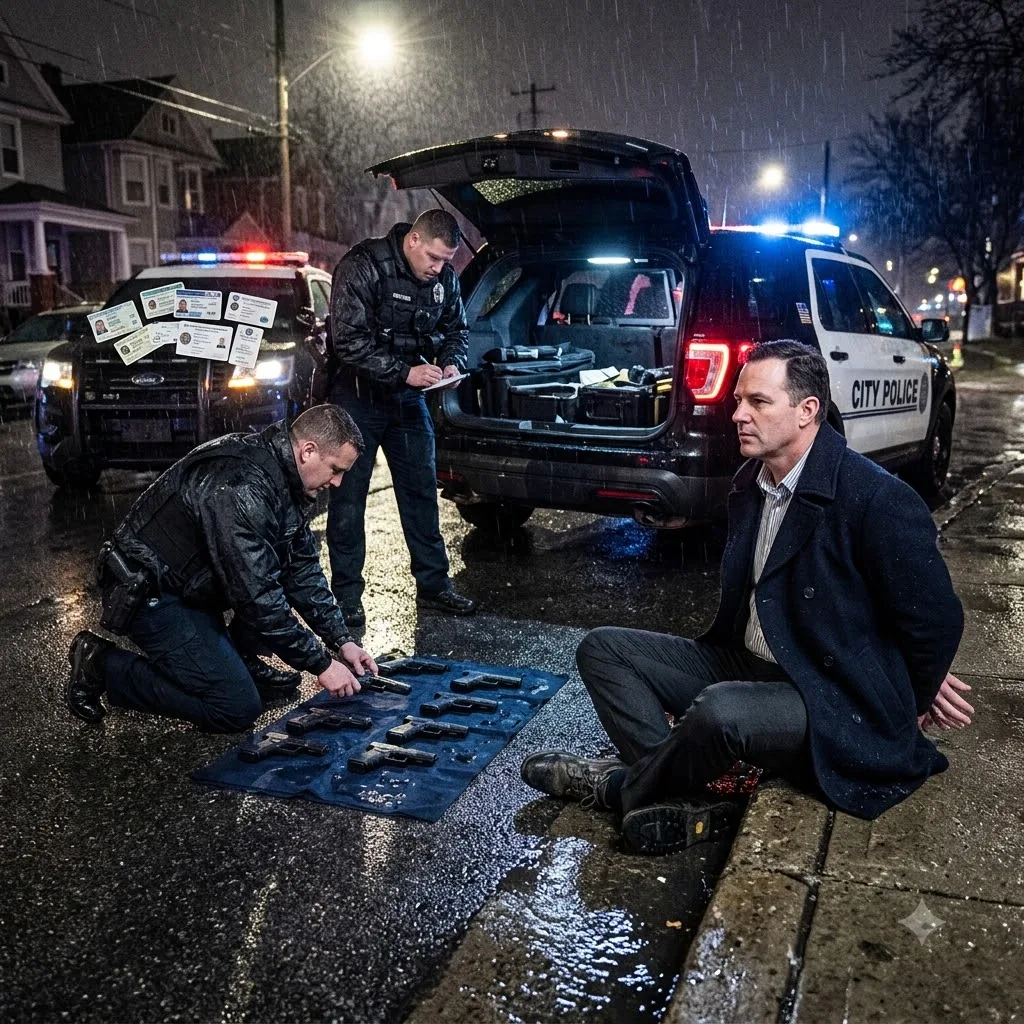
“Yes, sir,” Miller said, sitting up straighter. “When I approached the vehicle, I asked the defendant if he was transporting any weapons. He stated he was a state firearms instructor and had training pistols in the back. I asked him to pop the trunk. When he did, I observed the weapons were contained inside black nylon range bags. Under Municipal Ordinance 41.2, the transport of firearms requires them to be secured in a fully enclosed, locked, hard-sided compartment. Nylon is soft-sided. That obvious violation gave me probable cause of a misdemeanor offense, allowing me to impound the bags and conduct an evidentiary search.”
Vance smiled thinly. “And that lawful, routine search led directly to the discovery of the highly illegal polymer material comprising the bags themselves?”
“Objection,” Marcus’s attorney, Elias, said mildly from his seat next to Marcus. “Beyond the scope of the officer’s knowledge.”
“Sustained,” the judge mumbled, not looking up from her paperwork.
“Nothing further,” Vance said, adjusting his cuffs as he returned to his seat. He shot Marcus a look of absolute, predatory certainty. If the initial search held up, the polymer evidence would come in. If the polymer evidence came in, Marcus was facing life in a federal penitentiary for international cartel logistics.
Elias stood up. He was an older man, rumpled where Vance was tailored, moving with a slow, deliberate shuffle as he approached the podium. He took his time putting on a pair of wire-rimmed reading glasses.
“Officer Miller,” Elias began, his tone polite and entirely unthreatening. “You stated you asked my client to ‘pop the trunk’. Meaning, the trunk was locked prior to your request?”
“Yes, sir. He hit the electronic release button on his keychain.”
“I see. And you asked him to do this because you suspected he was carrying firearms?”
“Yes.”
Elias pulled a single sheet of paper from his legal pad. “Let’s read the exact text of Municipal Ordinance 41.2 together. It states: ‘Any person transporting unloaded firearms in a motor vehicle must secure said firearms within a fully enclosed, locked, hard-sided compartment, completely inaccessible from the passenger cabin.’ Is that correct?”
“That’s the statute, yes.”
“And you testified that because the nylon range bags were ‘soft-sided’, my client was in violation of this statute, giving you probable cause to breach the trunk, seize his property, and call in the prosecutor’s office without a warrant.”
“Yes, sir. Nylon is not a hard-sided compartment.”
Elias walked over to the evidence board. He tapped a high-resolution photograph of Marcus’s vehicle-the 2018 sedan, sitting in the freezing rain with its trunk wide open.
“Officer Miller, what is a standard vehicle trunk made of?”
Miller frowned, his brow furrowing. He glanced quickly at Vance. “Excuse me?”
“The trunk of my client’s car. What material comprises the exterior framing and the interior shell?”
“Metal. Stamped steel, mostly.”
“Stamped steel,” Elias repeated slowly, letting the words hang in the quiet courtroom. “Would you describe stamped steel as ‘soft’?”
“No.”
“Would you describe it as ‘hard’?”
Miller shifted his weight on the wooden chair. “Yes, steel is hard.”
“Indeed. Now, as a fully licensed state firearms instructor, my client drives a vehicle specifically modified to meet the absolute highest state transportation standards. This includes a factory-installed, reinforced steel backing plated directly behind the rear seats, preventing any physical access from the passenger cabin. You noted this reinforced plating in your own initial police report, didn’t you?”
Miller swallowed. “I… yes. I noted the reinforced steel plating when I inventoried the vehicle.”
“So,” Elias said, leaning heavily on the podium. “Let us review the facts of the physical space. My client’s firearms were secured within a space bounded by stamped steel and reinforced metal plating. A space that is, by your own written admission, completely inaccessible from the passenger cabin. A space that was locked, until you specifically instructed him to open it.”
Marcus watched the prosecution table. Vance’s pen had suddenly stopped moving. The federal prosecutor was staring at the back of Elias’s rumpled suit, a tight, bloodless line forming across his mouth.
“Officer Miller,” Elias continued, his voice echoing cleanly off the mahogany panels. “Does a locked, reinforced steel vehicle trunk meet the literal, legal definition of a ‘fully enclosed, locked, hard-sided compartment’?”
The young patrolman stared at the microphone. He looked desperately at Vance, but the prosecutor was frozen rigidly in his chair.
“The bags were nylon,” Miller said defensively, his voice rising an octave. “The guns were in the bags.”
“I did not ask you about the bags,” Elias said, his voice hardening into a sudden, unyielding edge. “The statute does not prohibit placing soft bags inside of a legally compliant container. I asked you about the exterior compartment holding the weapons. Does a locked, reinforced steel trunk constitute a fully enclosed, locked, hard-sided compartment? Yes or no?”
Miller looked up at the bench. The judge had stopped writing entirely. She was staring intently at the young officer over the rim of her glasses.
“Answer the question, Officer,” the judge instructed quietly.
“Yes,” Miller whispered.
“I’m sorry, the court reporter needs to hear you.”
“Yes,” Miller said louder, a dark flush creeping up his neck. “A trunk is a hard-sided compartment.”
“Therefore,” Elias said, taking off his glasses and folding them with a sharp click, “my client was in absolute, perfect compliance with Municipal Ordinance 41.2 at the exact moment you pulled him over. He was legally transporting his training equipment inside a locked, hard-sided, reinforced steel compartment.”
Marcus felt a sudden, massive release of pressure in his chest, an involuntary intake of air that completely bypassed his four-count tactical breathing.
Elias turned his head, locking eyes directly with Special Prosecutor Vance across the aisle.
“And because my client was in perfect legal compliance,” Elias said softly, “you had absolutely no probable cause to initiate a search of that trunk. You had no legal right to detain him, no legal right to photograph his belongings, and absolutely no legal right to seize a single microscopic thread of nylon from his property.”
Vance sat completely paralyzed. The grand, sprawling federal cartel conspiracy-the sixty million dollars, the dead undercover agents, the proprietary synthetic drug polymer-it was all balancing precariously on a single, tiny point of misunderstood municipal traffic code.
And Elias had just snapped that point cleanly in half.
“No probable cause,” Elias repeated, turning back to the judge. “Which renders the entirety of the prosecution’s physical evidence the fruit of an illegal, unconstitutional search.”
The judge slowly moved her gaze from the sweating patrolman down to the prosecution table.
“Mr. Vance,” the judge said, her voice dropping into a dangerous, inquisitive register. “Do you have any redirect for this witness, or would you like to explain to me why I shouldn’t throw your entire case out of my courtroom this very second?”
Vance slowly opened his mouth, but the arrogant, conversational hum was completely gone. He stared at the open municipal code book on the defense table, having absolutely nothing to say.