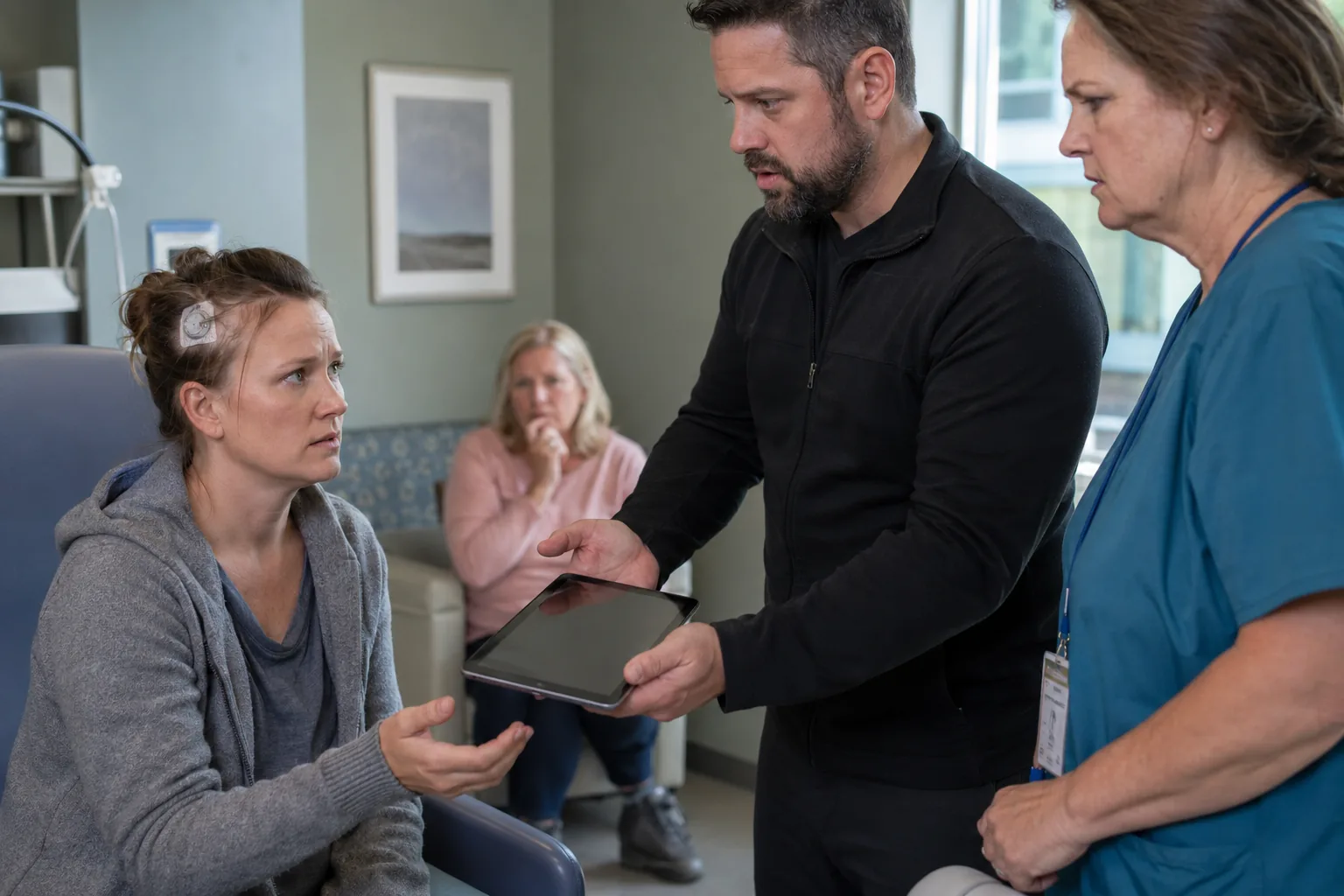
Story code: ST-000211
Part 4: The System Closed the Lie Without Him
Once Rina Solis read the verification response into the room, the dispute narrowed to something cold and measurable.
No charted medical discharge hold.
Technician consent re-entry after support workflow variance.
That wording did not explain motive, and it did not need to. It stripped away the safer explanation Evan Mercer had been leaning on all afternoon. If there was no medical hold, then the blocked ride at the transport desk had not been waiting on bedside danger. If the unresolved item was technician consent re-entry, then the implant consent tablet had been exactly what it looked like: the center of the obstruction.
Lauren did not make a speech. She stood up, gathered her tote, unplugged her phone from Tessa’s charger, and left the tablet sitting on the side table.
“I’m not signing anything else,” she said. “If transport is still held, document why without using me to cover it.”
That line set up the final failure mode because it removed the one thing Evan appeared to need from her: participation.
He stepped forward with the tablet again, but now every movement had to pass through the same visible facts everyone else had. Rina had the verification response on screen. Malik had the hold time and release field on the dispatch system. Tessa had call logs, account wording, and her own arrival time written down. The bay itself had become hostile to improvisation simply because the records no longer matched the explanation.
“You can’t leave the workflow incomplete,” Evan said.
Lauren answered without taking the device. “Watch me.”
Then she walked to the transport handoff desk and stood beside Malik instead of beside him.
That walk was the climax in the plainest possible form. No confrontation. No crowd. She just physically exited the loop he had been forcing her to stand in and let the clinic systems handle the contradiction without her cooperation.
The consequence arrived with the same administrative flatness that had made the whole day possible.
Rina called the clinic account support line from the workstation phone and read the verification code attached to the active request. She did not editorialize. She asked for the post-visit restriction to be checked against the discharge basis just confirmed in the chart. Malik refreshed the dispatch screen again. Tessa stood by Lauren’s shoulder and read back the 2:14 hold time when asked. Evan spoke twice more about continuity and workflow, but he was no longer the person anybody needed to answer the main question.
The system did.
First, Lauren’s account access changed. Her phone lit with a new text before anyone said anything out loud: verification completed, recovery support functions restored. Tessa read it from the screen to make sure the wording was captured exactly.
Second, Malik’s display updated.
He looked at it, clicked once, and said, “Medical hold removed. Transport release received 4:03 p.m. Dispatching car now.”
He printed the release slip and set it on the counter with the kind of ordinary motion that made the whole thing harsher, not softer. After hours of pressure, the reversal happened in seconds once the verification crossed systems.
The tablet was still there.
That mattered because PKG-001 and the whole day paid off through the same object. The thing Evan kept insisting was routine was now sitting in plain view while the ride got released without it being signed. Deliberate leverage looked deliberate because the need it claimed to represent vanished the second independent verification touched the record.
There was one more visible consequence, and it landed with even less drama.
Rina’s workstation printed a follow-up note requiring supervisory review of any future technician-only consent re-entry tied to discharge status. She did not announce it like punishment. She read the header, attached it to the verification ticket, and said, “This workflow is locked pending review.”
In a clinic like that, losing the ability to keep that step informal was not symbolic. It meant the exact path Evan had used to keep Lauren pinned in place was no longer his to operate quietly.
He did not confess. He did not apologize. He reached for the tablet one last time, saw nobody needed it, and stepped back toward the programming hallway while Rina kept the note and Malik finalized the ride. The system had taken the situation away from him in the driest manner possible: by closing the fields he had been using.
Lauren stayed at the desk until the car arrival time appeared. Wristband still on. Tote bag in hand. Tessa beside her. When the dispatch line flipped from pending to driver assigned, Malik read the plate number aloud and handed Lauren the slip.
That was the actual ending. Not a victory speech. Not a public shaming. A stranded patient got her route home back because routine verification finally forced the records to match reality.
Later, when Lauren laid out the sequence, the ugliest part was how small the closing steps looked compared to the pressure that came before them. A text restored. A release field updated. A workflow locked for review. Dry process broke the lie, and that was enough.
By the time Lauren and Tessa walked out through the transport doors, the implant consent tablet was still inside the bay where Evan had kept trying to make it look like the only way home. It turned out he had needed Lauren to keep touching that screen far more than Lauren had needed him.