Story code: ST-000211
Part 3: He Needed Her Back Inside His Screen
Tessa Pike reached the post-procedure discharge bay carrying a charging cable, a folder with ID copies, and her phone already open to a page of call times. That practical little entrance changed the geometry of the room more than any raised voice could have. Until then, Evan Mercer had been dealing with Lauren Pike one-on-one inside a controlled loop: transport still pending, account still restricted, tablet back in her hands. The minute Tessa arrived, every piece started getting compared out loud.
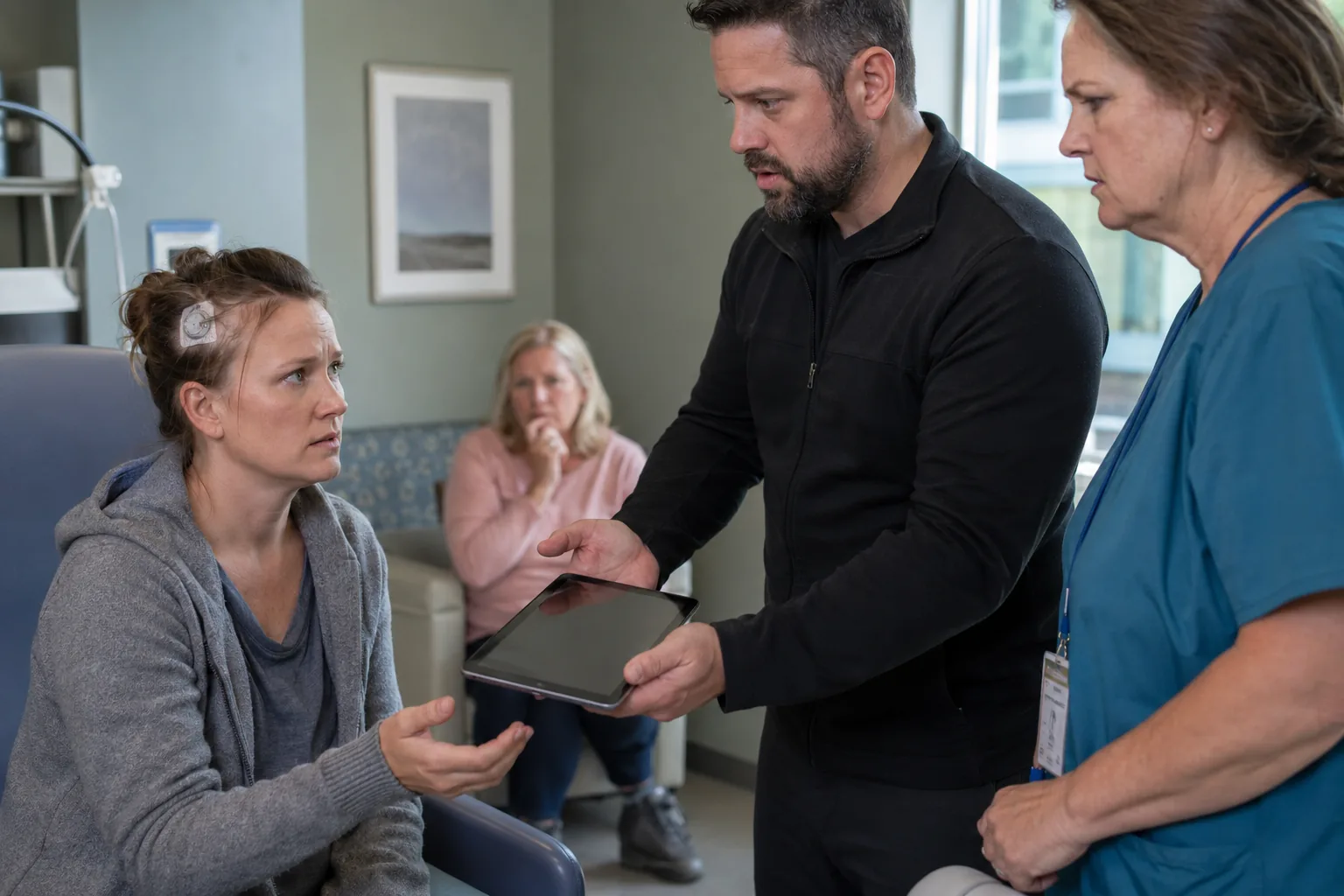
Lauren stayed in the same chair. Wristband still on. Tote bag still by her feet. The implant consent tablet was still on the side table beside the paper cup, its screen dimming and lighting as Evan touched it awake.
Tessa did not start with him. She went straight to Lauren.
“Battery first,” she said, plugging in the longer cable she had brought.
Then she turned and asked the room, not dramatically, just clearly enough for the nearby desk and workstation to hear, “Who entered the hold at”-she checked her phone-“2:14?”
Malik Dunn answered from the transport handoff desk the same way he had answered everything else: by reading what was visible. “Transport received hold status at 2:14 p.m. Release still not complete.”
Rina Solis looked at her screen and said, “My verification request is still open.”
Evan stepped in with the tablet before either statement could sit very long.
“We can resolve this now,” he said, rotating the screen toward Lauren. “I just need her to complete consent continuity.”
That phrase had already appeared enough times to sound practiced. What changed in that moment was that Tessa asked him to anchor it to something visible.
“Show where the ride depends on that.”
He did not. He tapped through screens, then held the tablet in a way that kept the text facing Lauren and away from everybody else. Lauren leaned back instead of taking it.
That movement mattered because it was the first full refusal that happened after support arrived.
Before Tessa got there, Lauren had been trying to separate the problems without losing the only path home she thought she had. After Tessa got there, she had enough backup to stop re-entering the loop. She asked the same kind of procedural question she had been asking all afternoon, but this time she did not reach for the device.
“Is this a new consent or a correction to an old one?”
Evan said, “It’s part of the same support workflow.”
“Then why was my ride held before she even called?” Tessa asked.
He answered too fast. “Because refusal interrupts continuity.”
That was the first clean bridge between the hold and the tablet anyone made in plain language.
Rina looked up from the workstation. “Refusal of what, exactly?”
Evan turned toward her. “Implant support consent.”
“I need the charted basis,” Rina said. “My request is asking whether discharge was blocked by a documented bedside issue or by programming workflow.”
He did not answer her question directly either. He said, “This should not be discussed like this in the bay.”
But by then it already was being discussed in the bay because the visible pieces no longer fit the routine version. Lauren’s floor care had been complete for a while. Transport had a hold time. Account support had logged a post-visit restriction. And the only object Evan kept offering as the fix was still the tablet.
Tessa held up her phone. “Account support read back temporary restriction on post-visit support functions. Transport has a hold time. Nurse has a verification pending. So if you need her to sign again before any of that gets lifted, say that plainly.”
He did not say it plainly. He pushed the tablet closer.
“Lauren, if you want to get home tonight, finish this now.”
That line is where the dependency reversal becomes visible.
Because once he tied getting home tonight to the tablet in front of witnesses, the pressure stopped looking like neutral process and started looking exactly like leverage. And Lauren, with her phone charging and her sister next to her, finally had room to test what happened if she did not cooperate.
She put both hands in her lap and said, very evenly, “No. If there is a real medical reason to hold me, put it in the chart and let them read it. If there isn’t, take the hold off without that tablet.”
Nobody in the discharge row missed that sentence. It was not loud. It did not need to be.
Evan’s posture changed first. He stopped hovering over the chair and moved toward Rina’s workstation, then toward the programming side hallway, then back again when Rina said, “Do not take the device out of view. Verification is active.”
That was another small line with large consequences. The tablet was no longer just something he was presenting to Lauren. It had become the proof object in an open process check.
Malik refreshed his dispatch screen and announced what he saw because Tessa asked him to read every change as it happened.
“Still held. Same time stamp. No new release.”
Then Rina’s screen changed.
She read silently for a second, looked once at Lauren, once at the tablet, and said the one sentence that made Evan stop moving.
“There is no charted medical discharge hold. The only unresolved item flagged here is technician consent re-entry after support workflow variance.”
Lauren did not touch the tablet.
Evan did, and for the first time all afternoon the device in his hand looked less like a requirement than a record someone had been trying to keep from standing by itself.
Part 4 begins when Lauren stops helping him hold that record together.