Story code: ST-000211
Part 2: The Status Screen Started Telling a Different Story
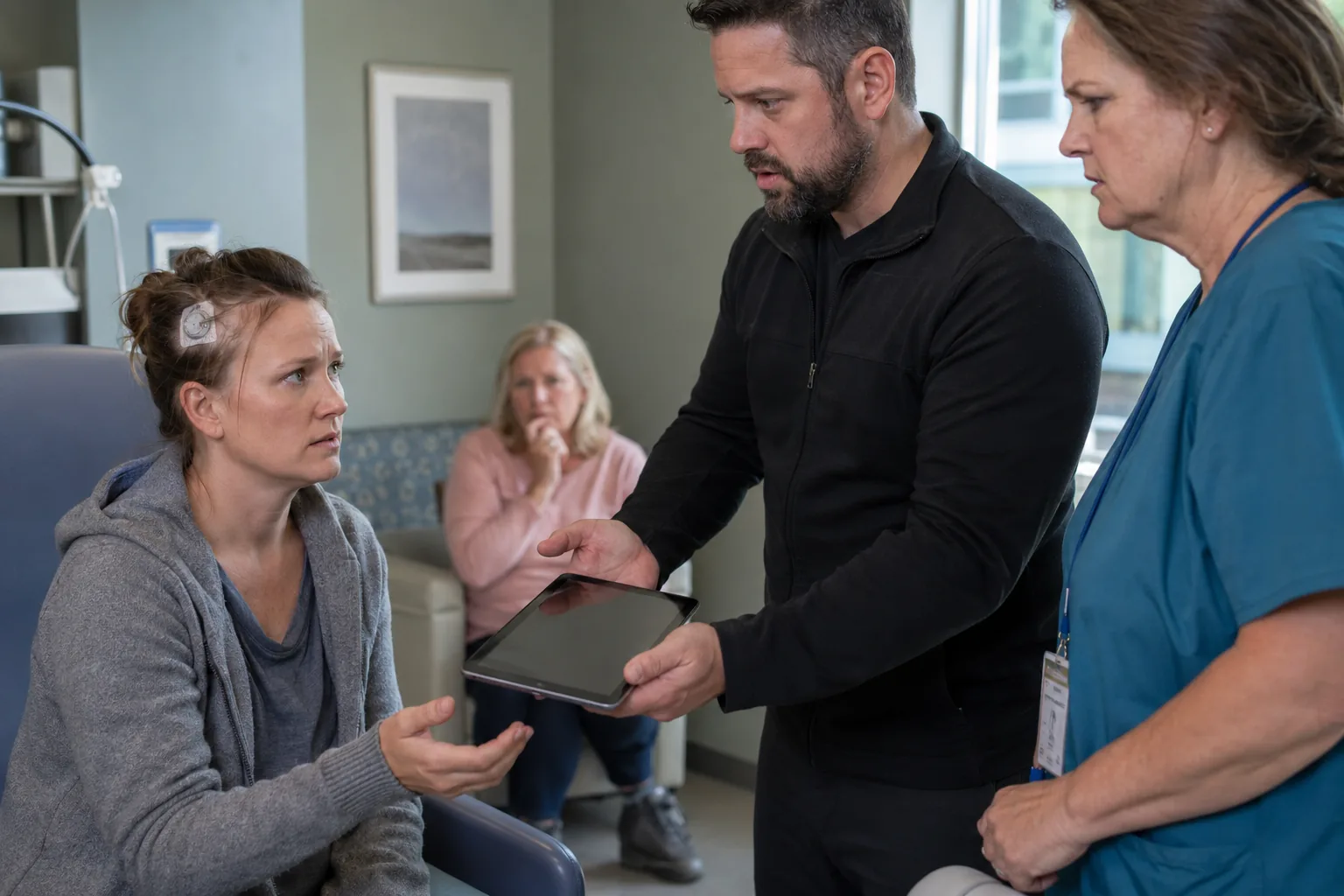
By the time Tessa Pike called back into Morrow Neural Clinic, Lauren was still wearing the wristband, still not released to transport, and still being met with the same implant consent tablet every time she asked a direct question. The floor around her kept moving like a normal afternoon. That ordinary rhythm made the hold look routine until the timestamps started lining up against the story Evan Mercer was telling.
Lauren’s backup plan was not dramatic. It was practical. She used the last workable charge on her phone to call Tessa, gave her the clinic name, said the ride had not been released, and said her account alerts were looping. Tessa did what relatives do when they know they are not in the room and have to build the room from pieces. She started preserving a timeline.
She called the clinic account support line first. The person there could not discuss implant settings, but they could read back what kind of account event had just been triggered. Tessa later repeated the wording exactly because she had written it down: recent visit verification, access challenge, temporary restriction on post-visit support functions pending confirmation. That did not explain the ride. It did show that more than one access point had tightened around Lauren at the same time.
Then Tessa called transport.
Malik Dunn gave her the same kind of answer he had given Lauren, just cleaner because it was over the phone. He read from the dispatch screen. Pickup assigned, then held pending medical release, no final release received. He gave the hold time. He also gave the original pickup window that had been in place before the hold.
That is where the public version started to fray.
Lauren had already been told, in person, that the issue was her failure to complete what Evan called routine consent. But on the transport side, the ride had existed before the repeated tablet push and was then stopped by a release status change. No one at transport mentioned a consent refusal. They only had a hold.
Back in the discharge bay, Lauren kept asking the same plain-language question in slightly different forms.
“What is incomplete?”
“What exact step is blocking the ride?”
“Who entered the hold?”
Evan answered with policy phrases.
“We need continuity of consent.”
“This has to stay inside the workflow.”
“I am trying to help you resolve this.”
He stayed close to the handoff area too. Not close to another patient. Not buried in a room. Close enough to see whether Lauren was talking to the nurse station, the transport desk, or her phone. Each time she tried to break the problem into separate pieces, ride release over here, account text over there, implant tablet in her lap, he folded it back into one demand.
Sign again.
Rina Solis did not overstep, but her behavior changed in ways you can actually point to. She checked Lauren’s status more than once. She lowered her voice and told Lauren, “Your floor care has been complete for a while.” When Lauren asked if that meant she was being medically held, Rina did not say yes. She said, “I don’t see a new bedside issue entered here.” That is not the same thing.
What she did next mattered more than any hallway opinion. She routed a verification request.
Not a speech. Not a confrontation. A request into the official system asking for the discharge blockage to be confirmed against the charted basis for it.
That sounds small until you compare what happened before and after.
Before the request, Evan could keep the whole issue verbal. He could stand over the side table, turn the implant consent tablet toward Lauren, and speak as if release and consent were naturally the same thing. After the request went in, everyone had to deal with fields, times, and entries. The screen either matched the story or it did not.
Tessa’s presence from outside made that harder to contain. She called back with the account wording. She asked who had entered the latest hold. She said she was on her way with Lauren’s charger, ID copies, and the call times written down. None of that solved the ride by itself. What it did do was open a second trail outside the little loop Evan kept trying to maintain inside the discharge bay.
Lauren’s phone was on the charger again when Tessa’s final pre-arrival call came through. A staff member handed it to her because she was sitting within sight of the nurse station. Lauren put it on speaker for a moment and Tessa asked one question that cut straight through the routine language.
“If this is just normal consent, why did transport get a hold time before I ever called?”
Nobody answered that question directly.
Malik, when asked again from his desk, repeated the hold timestamp. Rina looked at her screen and said the verification request was pending response. Evan did not point to anything on the tablet. He only said, “You are making this harder than it needs to be.”
That line landed differently now because the pressure was no longer sealed inside one technician’s explanation. There was a hold time. There was a preexisting pickup. There was floor care complete without a matching bedside problem. There was an outside contact arriving with a charger and a written call log. And there was still that tablet, sitting faceup beside Lauren’s paper cup like the clinic wanted it to look ordinary when it had become the most suspicious object in the room.
When Tessa finally texted that she was pulling into the lot, Lauren looked at the transport display, then at Rina’s workstation, then at Evan’s hand resting on the edge of the consent tablet. The setup no longer looked like one patient failing to cooperate. It looked like someone needed her back inside that screen before the verification came back.
Part 3 is where that need becomes impossible to hide.