Story code: ST-000738
Part 2: Geofence Active
Elias stared at the brass floor register. The water inside the ductwork gave a soft, mocking gurgle as the key sank into the flooded crawlspace. He adjusted his grip on his plastic briefcase, his mind struggling to process the breach of protocol. Policyholders yelled. They cried. They threatened to call their lawyers, the state insurance commissioner, or the local news affiliates. They did not lock the deadbolt and deliberately trap the adjuster inside.
“Ma’am,” Elias said, his voice maintaining the practiced, even cadence of a corporate de-escalation seminar. “I need to remind you that holding an insurance representative against their will is a felony. It will also permanently void any right to appeal your claim.”
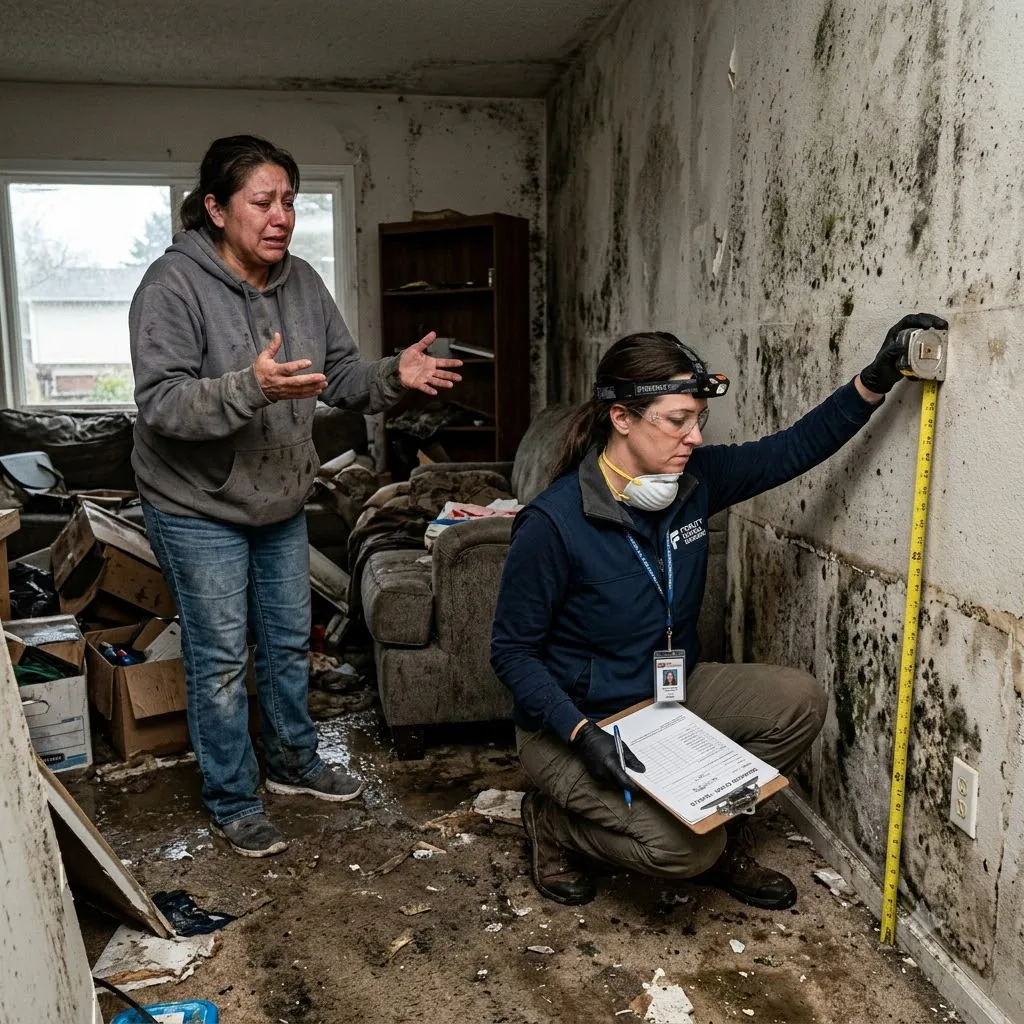
Sarah did not turn around. She waded past the ruined sofa, her boots sloshing through three inches of standing water, and began methodically pulling canned goods from the lower kitchen cabinets. She stacked them on the island, right next to the zero-dollar payout notice.
Elias set his briefcase on the dry half of the kitchen counter. He pulled his smartphone from his breast pocket. The screen displayed ‘No Service,’ a common enough occurrence in storm-ravaged counties where cell towers were running on depleted backup generators. He wasn’t panicked. He was profoundly annoyed. His schedule was mapped in strict fifteen-minute increments, and this delay was going to ruin his completion metrics.
He walked back to the front door. The deadbolt was a heavy, double-cylinder lock. It required a key on both the inside and the outside to turn. He knelt by the floor register, shining his phone’s flashlight through the brass grates. The water was pitch black, swirling with mud and drywall debris. The key was gone.
“Open the door, Sarah,” Elias said, dropping the polite honorific.
“The back door is swollen shut,” she said quietly, lining up a tin of soup next to a can of beans. “The foundation shifted on Tuesday. The doorjamb is crushed. You couldn’t kick it out if you tried.”
Elias marched toward the rear of the house. He passed through a dark, narrow hallway that smelled of wet dog and raw sewage. The back door was solid steel, set into a wooden frame that had visibly buckled under the weight of the shifting structure. Elias grabbed the handle and yanked. The metal groaned, but the door didn’t yield a millimeter. He planted his boot against the wall and pulled with all his weight. Nothing.
He turned his attention to the windows. He unlatched the nearest double-hung frame and tried to push it up. The track was warped solid. He grabbed a heavy cast-iron pan from the flooded stovetop and swung it hard against the glass. The impact sent a painful shock up his arm, but the window didn’t shatter. It only spider-webbed.
“Impact-resistant,” Sarah called from the kitchen. “Required by the county for all new builds in the flood plain. You approved the discount on our premium yourself.”
Elias dropped the pan into the water with a heavy splash. His heart rate finally broke its steady, resting rhythm. He waded back to the kitchen island and opened his briefcase, powering up his company-issued tablet. It possessed a proprietary satellite uplink, designed to bypass downed local networks to upload claims data directly to the corporate mainframe.
He tapped the emergency beacon icon. The screen buffered, displaying a spinning blue circle. Then, a dialogue box popped up: *Uplink Denied. Geofence Active.*
Elias frowned. He tapped the network diagnostic tool. The satellite connection was perfectly strong, but the company’s own server was rejecting his device. The firewall had explicitly blocked any outward transmissions from his current GPS coordinates. He opened the mapping software to check his location.
The map loaded from the tablet’s localized cache. It displayed County Road 119 as a bright red line, bracketed by two dozen highlighted parcels. Sarah’s house was Parcel 14. Elias zoomed out. He had only ever looked at the topographical flood layer, but now, trying to find a way to bypass the network block, he toggled through the other administrative overlays. He clicked a checkbox marked ‘Future Acquisitions’.
The screen refreshed. The red line of County Road 119 disappeared. In its place, a massive, shaded blue polygon covered the entire two-mile stretch of the neighborhood. Elias tapped the polygon to pull up the metadata. It wasn’t listed as a residential disaster zone. The system recognized the entire area as ‘Valley Sink Retention Basin – Phase One.’ The listed owner wasn’t the county. It was a subsidiary holding company entirely owned by his employer.
The company wasn’t denying the claims because of a technicality. They were systematically driving the homeowners into immediate bankruptcy. A zero-dollar payout meant foreclosure for most of these people. The bank would repossess the worthless, flooded structures, and the holding company could sweep in and buy the massive tract of land for pennies on the dollar.
“Why did you lock me in?” Elias asked, staring at the screen. His mouth felt suddenly dry.
“My husband works for the municipal water district,” Sarah said. She picked up the zero-dollar claim paper and carefully folded it into a small square. “He’s the one who monitors the upstream reservoir. He told them the spillway was failing three days ago. They told him to shut up and go home.”
“That has nothing to do with me,” Elias said, closing the tablet. “I just write the estimates.”
“You’re the man on the ground,” Sarah replied. “The neighbors who evacuated yesterday? The company already sent demolition crews to their lots. They bulldozed the Miller house at 4:00 AM. Said it was a structural hazard and expedited the teardown. We aren’t leaving. If we leave, they destroy the evidence.”
“Evidence of what?” Elias demanded, stepping toward her. “It’s a flood.”
Sarah looked toward the front window. The afternoon light was fading, casting long, gray shadows across the ruined living room. “Listen.”
Elias held his breath. Over the soft trickling of water in the walls, he heard a deep, mechanical thrumming originating from outside. It wasn’t the sound of rescue helicopters or county emergency vehicles. It was the heavy, rhythmic vibration of industrial diesel engines.
He waded to the front window and peered through the spider-webbed crack in the impact glass. Half a mile down the road, massive yellow machinery was rolling into the flood zone. They weren’t dump trucks or excavators. They were high-capacity industrial water pumps, trailing thick black hoses the size of tree trunks.
Elias watched in horror as a crew of men in unmarked reflective vests began dropping the massive hoses directly into the standing water of the neighborhood. But the pumps weren’t pulling water out of the basin. The thick canvas hoses expanded, vibrating violently, as they began discharging thousands of gallons of dark, muddy water directly onto the already flooded street.