Story code: ST-000744
Part 3: The Ghost Coordinates
Trent’s finger trembled against the smooth glass of the trackpad. The red *Initiate Freeze* icon glowed beneath the cursor, a single millimeter of pressure away from executing the financial seizure. The man’s grip on Trent’s wrist was icy, a skeletal clamp fueled by a terrifying, terminal desperation.
“I can’t,” Trent whispered. His voice cracked, entirely stripped of its sterile, corporate authority. He tried to pull his arm back, but the man’s fingers dug deeper into the tendons of his wrist. “Please. Let go of me. The system logs inactivity. If I don’t input a command, it’s going to auto-assign your profile to another collector anyway.”
“Then let it,” the man rasped, his breathing a wet, rattling sound in the dead silence of the coffee shop. “But don’t you dare hide behind a machine. You want the last of my life? You take it yourself.”
Trent stared into the man’s bruised, sunken eyes. The comforting anonymity of the digital queue was gone, replaced by the overwhelming, metallic smell of stale sweat and sickness. Trent jerked his arm hard, finally breaking the man’s grip. He pulled his hands back to his chest, pressing himself deep into the expensive leather booth, trying to put as much physical distance between them as the corner table allowed.
The man didn’t reach for him again. Instead, he reached into his other faded sweatpant pocket. He pulled out another thick handful of folded, heavily creased papers and slammed them down directly onto Trent’s open laptop. The machine emitted a continuous, angry tone as the keys depressed under the weight, the collection software furiously registering the random inputs.
“Look at them,” the man demanded.
Trent’s eyes darted to the papers. They weren’t just standard discharge summaries like the first batch he had dropped. They were densely itemized oncology bills. The word *Radiotherapy* was printed over and over in harsh black ink, stacked next to staggering, catastrophic dollar amounts. The address printed at the top of the invoice was the derelict house across the street.
The name above the address was Arthur Pendelton.
Trent stared at the name. A strange, uncomfortable static buzzed in the back of his mind, a fleeting spark of recognition that he immediately tried to suppress.
“You think I’m just a data point, don’t you?” Arthur said, his voice dropping to a harsh, accusing whisper. He leaned his weight heavily on the bistro table, his frail arms shaking from the exertion. “Just another deadbeat holding onto a plot of land the property developers want.”
“I don’t look at names,” Trent deflected, staring fixedly at the oncology bills, terrified to make eye contact again. “I just process the routing numbers. The algorithm flags the risk tier. It’s not personal.”
“It’s intensely personal, Trenny,” Arthur said.
Trent froze. The breath completely vanished from his lungs.
The soft jazz playing over the cafe’s hidden overhead speakers seemed to warp and fade into absolute nothingness. The ambient, hushed chatter of the tech workers in the background disappeared. Trent slowly looked up from the keyboard, his heart hammering a frantic, sickening rhythm against his ribs.
*Trenny.*
Nobody had called him that in fifteen years. It was a dead name, buried deeply in a past he had spent his entire adult life trying to outrun, scrubbed from his professional resume and erased from his carefully curated social media profiles.
Arthur Pendelton stood over him, his skeletal chest heaving, a bitter, exhausted smile cracking his chapped lips. “Yeah. I recognized you the second I saw you through my window. You’re wearing a nice, expensive suit now, but you’ve still got your mother’s eyes. And that same terrified look you had when you were twelve.”
Trent gripped the edge of the bistro table, his knuckles turning white. “How do you…”
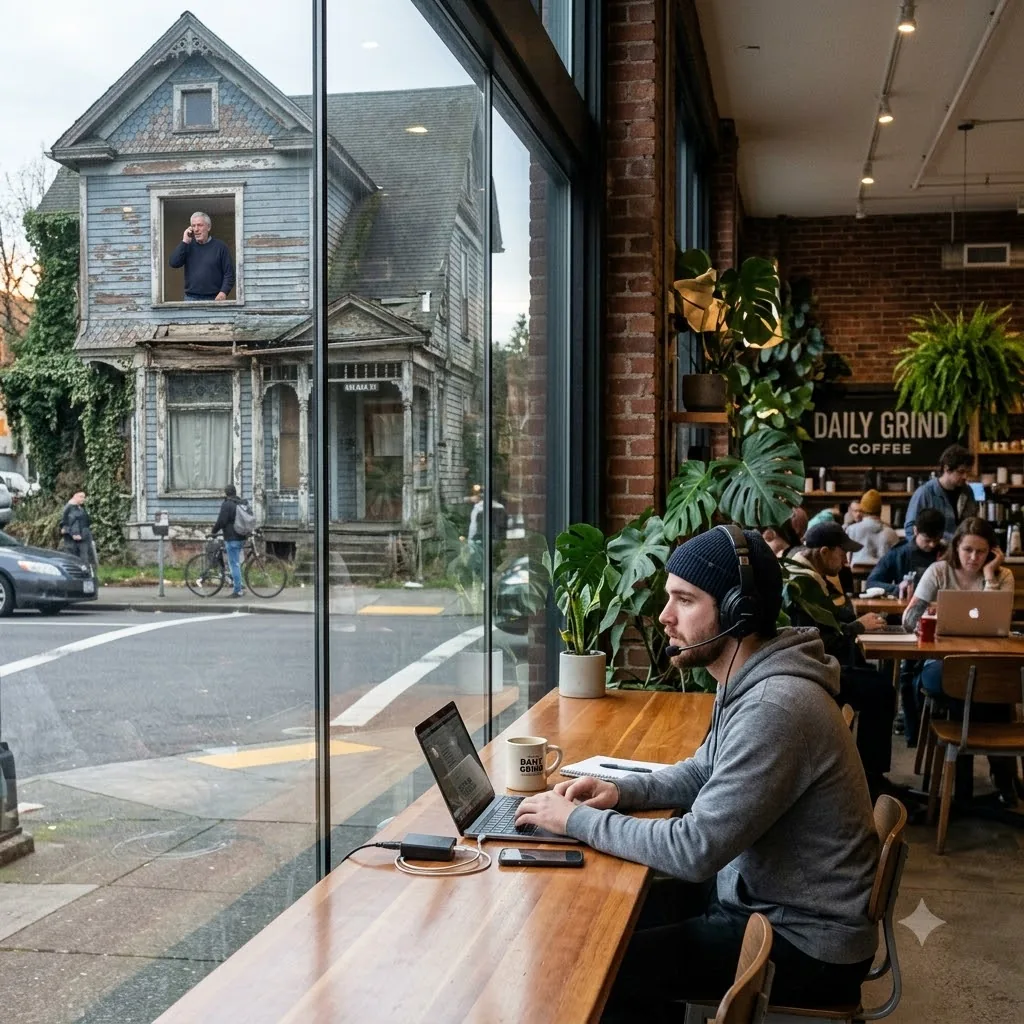
“How do I know?” Arthur scoffed, coughing a wet, hollow sound into his fist. He pointed a trembling, yellowed finger out the pristine floor-to-ceiling glass of the cafe window. He pointed directly at the sagging, blue-tarped Victorian across the bustling avenue. “I’ve lived in that house for forty years. I was sitting on that porch the day the county sheriff deputies came and threw all your parents’ furniture onto the sidewalk.”
A cold sweat broke out across the back of Trent’s neck. He looked out the window, then back at Arthur, the geography of the street suddenly twisting and reshaping itself in his memory. The brutalist architecture of the gentrified block seemed to peel away, revealing the ghosts of chain-link fences and cracked pavement.
“We lived on the East Side,” Trent stammered blindly, a desperate, irrational defense mechanism kicking in as his mind tried to reject the reality of the coordinates.
“You lived right here,” Arthur said, tapping his knuckles heavily against the polished concrete floor of the cafe. “This coffee shop? This used to be the brick duplex. You lived in the lower unit. Your dad used to work on that beat-up Ford Taurus right where the barista is steaming milk.”
Trent looked at the reclaimed-wood condiment bar, then down at the expensive artisanal saucer holding his cooling matcha latte. The nausea hit him in a violent, dizzying wave. He wasn’t just working remotely in a random gentrifying neighborhood. He was sitting on the exact square footage of his childhood bedroom.
“The bank priced your family out,” Arthur said, his voice dropping into a register of quiet, absolute devastation that echoed through the silent cafe. “They jacked the variable interest rate, forced the foreclosure, and sold the dirt to the highest commercial bidder. Your mother cried on the curb out there while it rained on your mattresses. I brought you umbrellas.”
Arthur reached down and tapped the crushing oncology bills resting on Trent’s laptop keyboard. Beneath the crumpled paper, the red *Initiate Freeze* button pulsed steadily on the screen, partially obscured by the edge of a radiation invoice.
“And now,” Arthur whispered, the words cutting through the sterile, affluent air of the coffee shop like a rusted blade, “the boy who lost his home to the algorithm sits in a glass box, built on top of his own ruined living room, pushing buttons to do the exact same thing to the last man on the block who remembers his name.”
Trent stared at the pulsing red button beneath the medical debt. He couldn’t speak. He couldn’t defend himself. The impenetrable corporate armor he had worn to survive the daily, grinding extraction of the collection matrix had completely evaporated, leaving him entirely exposed. The flashing yellow prompt on his screen patiently waited for a command, but Trent’s hands remained locked to his sides, paralyzed by the truth buried beneath the polished concrete floor.