Story code: ST-000806
Part 4: The Private Footprint
The ringing, suffocating silence in the municipal chamber stretched out for ten agonizing seconds. It was a heavy, suffocating weight that confirmed the town’s polite illusion was completely dead. Councilwoman Hayes stood frozen behind the mahogany dais, her chest heaving, her eyes locked on the glowing red recording light of the clerk’s soundboard. The veneer of civic duty had evaporated, leaving only the ugly, unvarnished truth suspended in the cold, climate-controlled air.
Director Sterling did not rush to her defense. He did not offer a polished, administrative deflection. Instead, with the cold survival instinct of a career bureaucrat, Sterling quietly closed his leather-bound folio. He slid his silver pen into his breast pocket, picked up his briefcase, and looked away from Hayes entirely, severing himself from the fallout.
Leo didn’t gloat. He didn’t need to. He simply rolled the heavy blue architectural schematics back into a tight cylinder. The sharp *snap* of the rubber band echoed loudly in the paralyzed room.
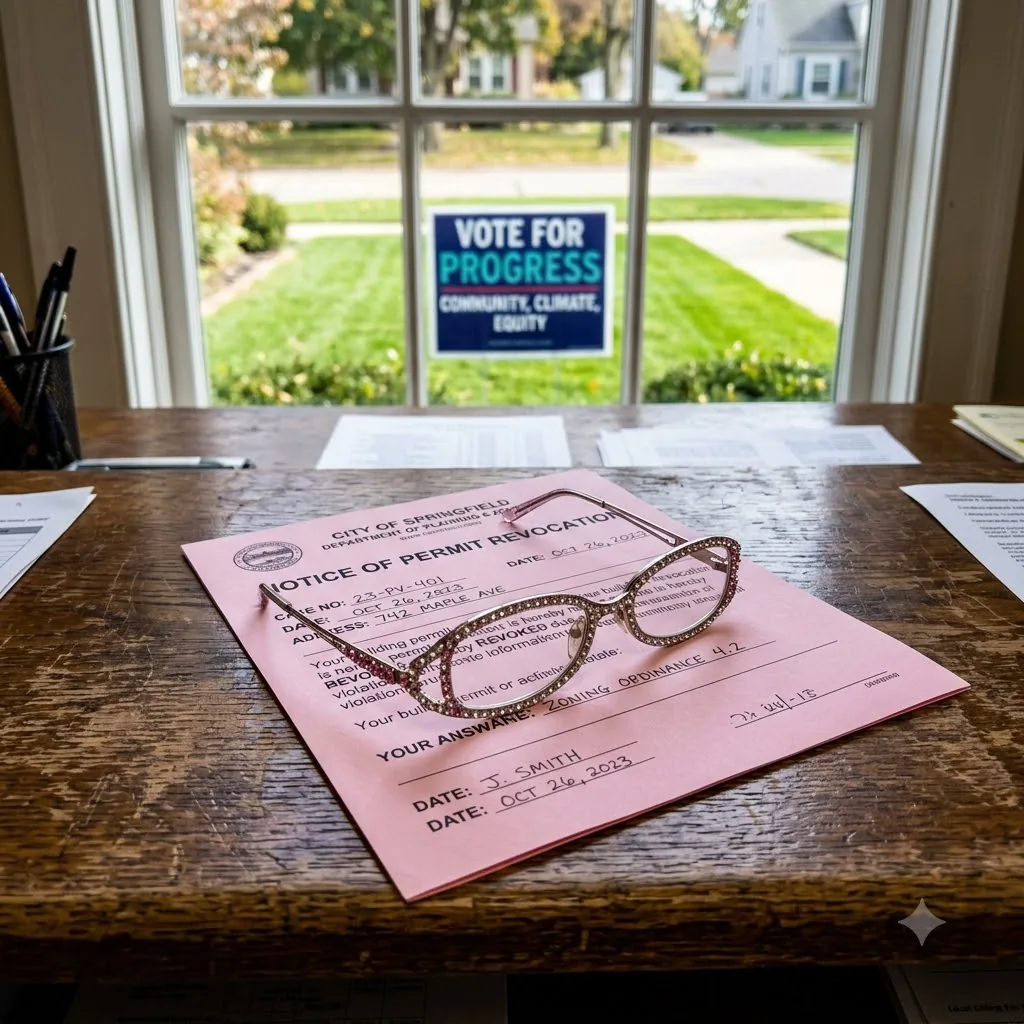
He turned away from the podium and walked back up the center aisle. As he pushed through the heavy oak double doors of the chamber, he glanced up at the digital clock in the hall. It flashed 5:00 PM. The deadline had passed. The $34,850 premium remained unpaid, and the pink carbon-copy slip in his pocket officially became a permanent revocation. The permit remained denied.
Centennial Park would sit empty that weekend. The city had successfully protected its precious, three-acre slab of poured concrete.
Three days later, on a bright Saturday morning, Leo unlocked the front door of his business on 4th Street. The faded gold leaf lettering on the glass read *Vance Vintage & Supply*. Inside, the shop smelled of beeswax, aged denim, and old paper. Usually, the floor space was carefully curated, a maze of mid-century armchairs, racks of canvas workwear, and heavy oak display cases.
Today, Leo pushed the heavy racks aside. He dragged a 1970s velvet sofa against the back wall and rolled up two frayed Persian rugs, stacking them beneath the cash wrap. He cleared a massive, circular space in the center of the scarred hardwood floor, dragging over every mismatched cushion, ottoman, and throw blanket he had in his inventory.
He didn’t know exactly what to expect. After the video of the zoning board meeting leaked, the city council had immediately locked down their social media pages. Hayes had taken an indefinite leave of absence. The town’s administrative offices had issued a brief, heavily sanitized statement about “reviewing municipal safety codes,” but the park remained barricaded behind yellow caution tape. They could have tried to pivot the festival to the public library’s community room, risking another wave of arbitrary municipal restrictions and hostile zoning clerks.
Instead, the community bypassed the library entirely.
At ten o’clock, the brass bell above the shop door jingled. A young couple walked in, holding the hands of a toddler wearing a brightly colored tutu.
“Is this the right place?” the mother asked, looking nervously at the racks of vintage leather jackets.
“You’re exactly where you need to be,” Leo said, gesturing to the clearing in the center of the room.
Ten minutes later, the bell jingled again. Then again. Within half an hour, the door was propped open with a cast-iron doorstop just to accommodate the flow of people. They came in droves, filing into the cramped, unregulated private space of the vintage shop. There were no algorithmic stress models here. There were no emergency injunctions, no off-duty police officers, and no concrete anti-terrorism barricades.
By eleven o’clock, over sixty people were packed into the shop. Parents leaned against display cases and sat on the arms of antique sofas. The youth volunteers, who had spent six months planning the festival, wove through the crowd handing out juice boxes and homemade name tags.
In the center of the room, sitting in a refurbished, high-backed floral wingchair, sat a young drag performer in a glittering emerald cape. Surrounding the chair, dozens of children sat cross-legged on the floor, their eyes wide and attentive.
Leo stood by the front register, his arms crossed over his chest, watching the reader open a large, brightly illustrated picture book. The performer’s voice rose above the quiet hum of the shop, warm and expressive, acting out the different characters as the kids giggled and leaned forward.
The crowd was dense. It was arguably a high-friction gathering, packed shoulder-to-shoulder in a space meant for a fraction of that number. But looking around at the smiling faces, the relaxed shoulders of the parents, and the kids sharing cushions on the floor, Leo knew there was absolutely no danger here.
The city board had kept their public plaza. They had hidden behind their codes and successfully locked the community out of the municipal square. But as the reader turned the page and a wave of joyful laughter echoed through the vintage clothes and antique furniture, Leo realized the city had lost the only thing that actually mattered. They had lost their power to make anyone feel small.