Story code: ST-000809
Part 3: The Cryptographic Catch
Forty-eight hours had passed since I walked out of Richard Thorne’s office, leaving him paralyzed in his thousand-dollar chair as his academic life detonated. I had walked the four miles home in the freezing sleet. I had eaten a dinner of tap water and stale saltines. I had slept for fourteen hours straight, waking only to check my banking app. The balance remained a glaring red negative forty-two dollars. The crushing weight of poverty had not vanished just because I had finally done the right thing.
Then, at 9:00 AM on Friday, my phone buzzed on the nightstand. A text message illuminated the cracked screen, sent from a number I had saved only for weekend lab emergencies.
*My office. Now. Use the side door.*
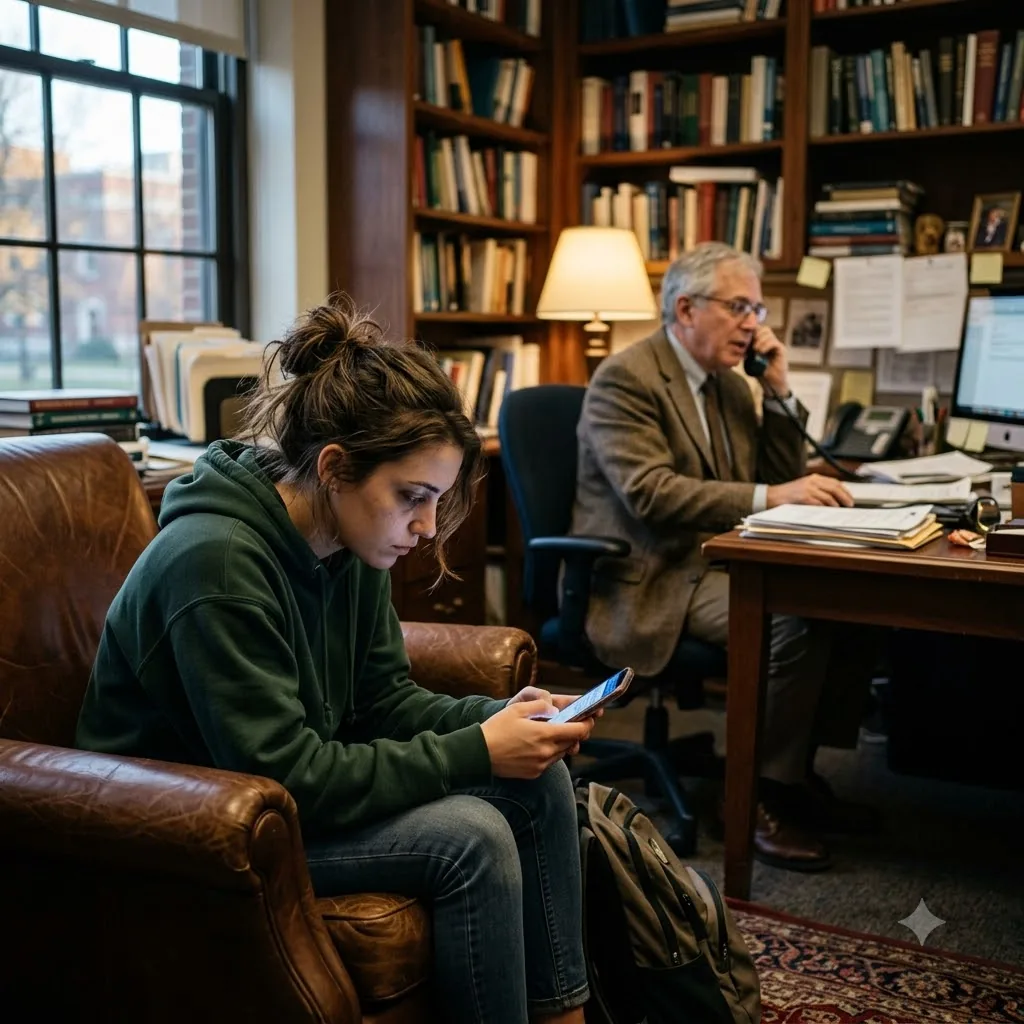
I expected the science building to be locked down, guarded by campus security, but the gears of university bureaucracy turn agonizingly slow. The hallways were quiet, filled only with the hum of the fluorescent lights. I pushed open the heavy oak door to Thorne’s suite without knocking.
The climate control was still cranked to a stifling seventy-four degrees, but the room’s expensive cedar-and-old-paper scent had been completely overpowered by the sour tang of nervous sweat and stale espresso. Thorne looked like a man who had aged a decade since Wednesday afternoon. His signature suede-patched tweed jacket was crumpled in a heap on the floor near the coat rack, discarded like trash. His sleeves were rolled up to the elbows, exposing pale, trembling forearms. The majestic mahogany desk, usually pristine and intimidating, was a chaotic landscape of printed emails, legal pads filled with frantic scribbling, and half-empty paper coffee cups.
Thorne did not swivel around to greet me. He was hunched over the desk, his head buried in his hands.
“Sit down, Maya,” he rasped, his voice raw and hollow.
I walked to the same rigid wooden guest stool I had occupied two days ago and sat down. I kept my damp coat on. I didn’t say a word. I just waited, letting the silence press in on him.
He finally lifted his head. The smug, aristocratic arrogance that usually defined his face had been completely hollowed out. The skin around his eyes was bruised purple from lack of sleep.
“The Dean has placed me on administrative leave,” he said softly, staring at a spot on the desk just past my left arm. “All my lab access has been revoked. Apex Therapeutics called my cell at midnight. They are halting all disbursements and preparing a breach of contract lawsuit. They are threatening litigation against the university, Maya. Against me. Do you understand the magnitude of what you have done?”
I didn’t answer. The bone-deep exhaustion I had felt on Wednesday was gone, replaced by a cold, solid weight in my chest.
Thorne let out a ragged breath and abruptly shifted his tone. The anger evaporated, replaced by a desperate, sickeningly sweet imitation of fatherly concern. “You were delirious, Maya. Thirty-eight hours without sleep. I pushed you too hard. That is my fault, and I take full responsibility as your mentor. You were exhausted, and you attached the wrong files. You attached the corrupted diagnostic outputs instead of the cleaned, finalized dataset.”
He reached under a stack of legal pads and pulled out a single sheet of heavy, cream-colored cardstock. He slid it across the mahogany surface. It stopped exactly where the fraudulent Apex contract had sat forty-eight hours ago.
“This is an internal university fellowship approval,” Thorne said, his eyes wide, locking onto mine with a pleading intensity. “It isn’t tied to the Apex grant at all. It comes directly from the department’s discretionary endowment. I fast-tracked it yesterday morning, right before the Dean locked my administrative credentials. It is fully funded. Fifty thousand a year, guaranteed for three years. I have already signed it.”
I looked down at the paper. The bold numbers stared back at me. Fifty thousand dollars. It was more money than I had ever seen in my life. It was a lifeline that didn’t just pull me out of debt; it secured my entire graduate career.
“The bursar has the funds isolated,” Thorne whispered, leaning so far across the desk I could smell the stale coffee on his breath. “All you have to do is hit reply-all to that email thread. Write a short addendum to the ethics board and the journals. Say you made a catastrophic clerical error due to sleep deprivation. Say the emails between us were taken out of context, discussing a completely different trial. You take a minor reprimand for sloppiness. I endorse this fellowship to protect you from the fallout. You get paid, you graduate, and this all goes away.”
I stared at his signature in blue ink at the bottom of the page. He was trying to buy my silence using the institution’s own money. It was a brilliant, desperate move.
But it relied on a fatal misunderstanding of what I had actually done.
“You didn’t read the whole data payload, did you?” I asked, my voice barely above a whisper.
Thorne froze. “What?”
“When the emails started coming in on Wednesday, you panicked. You probably called your lawyer. You read the regression tables I attached, and you read the email transcripts, but you didn’t look at the raw data payload in the compressed folder.”
“I read enough to know you sent them unfinished data!” he snapped, the veneer of the gentle mentor instantly cracking. “I am offering you a way out, Maya!”
“Dr. Thorne, I didn’t send them unfinished data,” I said, my voice steady, ringing clearly in the stifling room. “I sent them the primary instrument logs from the flow cytometer.”
His hand, which had been hovering over the desk, dropped heavily onto the wood.
“I didn’t just send a spreadsheet showing the sixty percent failure rate,” I continued, looking directly into his bloodshot eyes. “I pulled the secure, uneditable XML logs directly from the cytometer’s local drive. They have cryptographic checksums built in by the manufacturer. You cannot fake them. You cannot mistype them due to a sleep-deprived clerical error. The machine itself recorded that the cells died, timestamped to the exact minute we ran the assays.”
Thorne’s mouth opened, but no sound came out. The color rapidly drained from his face, leaving his skin the color of dirty ash.
“I also BCC’d the lab technician who calibrates the cytometer,” I said, leaning forward slightly. “Because in one of those emails you think can be taken out of context, you explicitly ordered me to tell him to clear the local cache so we could ‘free up hard drive space.’ I attached that email, too.”
The ticking of the brass clock on his shelf seemed to grow deafeningly loud.
“If I send an email right now saying I made a mistake, the ethics board isn’t just going to take my word for it and close the case,” I said. “They are going to walk down to the lab, pull the cytometer’s physical hard drive, and check the XML hashes against the ones I emailed them. They will match perfectly. My retraction wouldn’t save you. It would just prove to the board that you are currently trying to coerce me into lying.”
Thorne slowly looked down at the fellowship paper resting between us on the desk. The fifty-thousand-dollar offer. The signature he had rushed to ink before his access was revoked.
He stared at it, the realization washing over him that the physical document in front of him was entirely worthless. His eyes flicked back up to me, wide, empty, and completely devoid of any remaining leverage.