Story code: ST-000809
Part 2: The Apex Addendum
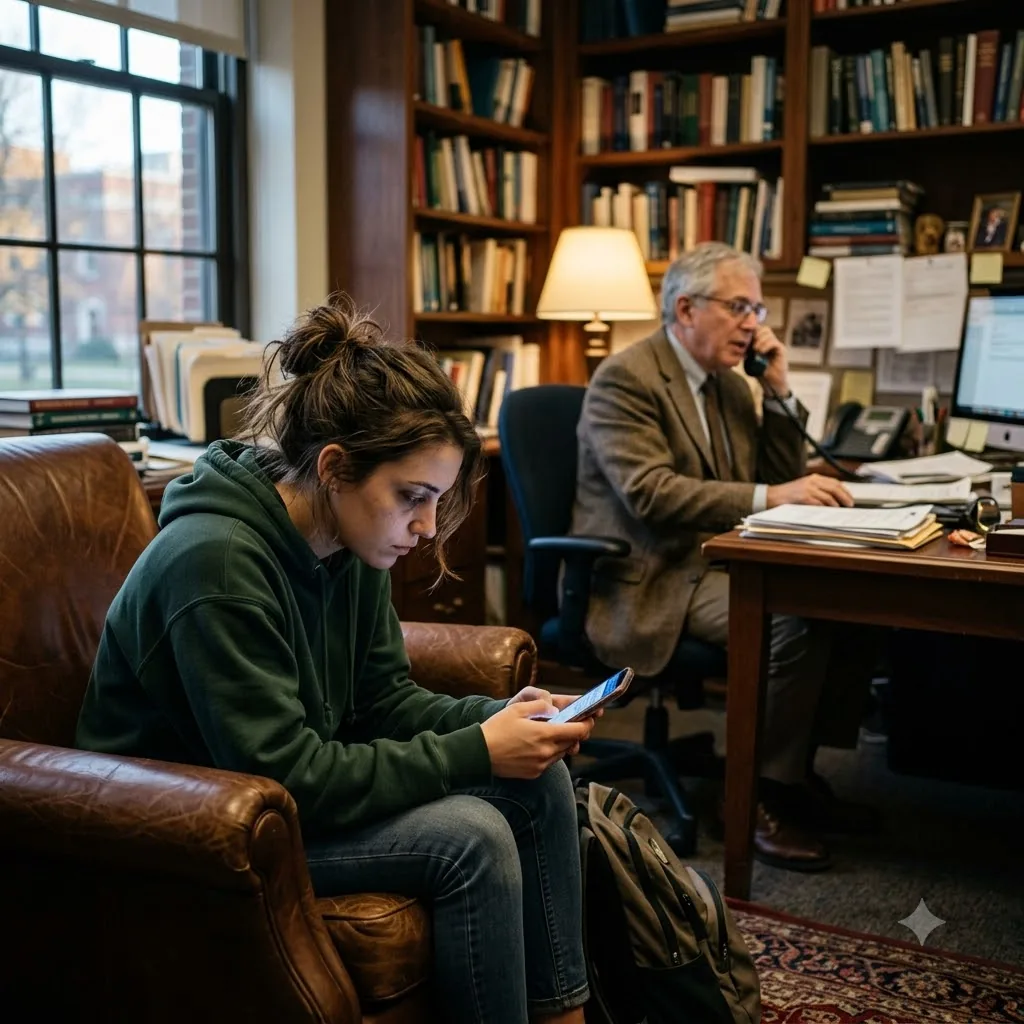
“Maya,” Thorne said, completely dropping the frantic, high-pitched tone he had used with his kitchen contractor. He smoothed the lapels of his tweed jacket and settled back into his thousand-dollar chair, lacing his fingers together on the pristine surface of his mahogany desk. “You look absolutely dreadful. Please tell me you aren’t going to pass out on my Persian rug. It is a vintage import.”
I slipped my phone into the pocket of my cheap cardigan, my thumb trembling so violently I could barely push the device past the fabric. The digital swoosh of my sent message was already gone, swallowed by the relentless, quiet hum of the climate control. He hadn’t heard a thing. He had no idea that a payload of raw, unedited data files and timestamped emails was currently fracturing into encrypted packets, speeding toward the university ethics board, the dean of sciences, and the editors of three major academic journals.
“I am fine, Dr. Thorne,” I managed to whisper. My throat was so dry it felt lined with crushed glass.
“Excellent. Because we have news.” He smiled, a wide, predatory flash of perfect veneers, and slid a thick, cream-colored folder across the desk. It stopped inches from my hand. “Open it.”
I stared at the folder. My brain felt sluggish, thick with the gray fog of thirty-eight hours without sleep. I reached out, my fingers clumsy and numb, and flipped open the heavy cardstock cover. Inside was a university letterhead document, dense with legal jargon and bolded numbers.
“Apex Therapeutics loved the preliminary findings,” Thorne said, leaning back and crossing his legs. He looked out the window at the manicured campus, looking every bit the triumphant academic visionary. “They were incredibly impressed by the regression tables you finalized for me last week. The ones showing zero cellular degradation in the trial phase. They have officially fast-tracked the second round of funding. Three point two million dollars, Maya.”
I looked down at the paper. The text blurred, then swam into sharp focus. It was an addendum to my graduate contract.
“You have been… adequately dedicated,” Thorne continued, his tone dripping with magnanimous condescension. “So I am moving you up to lead research assistant on the Apex grant. That comes with a full tuition waiver, retroactive to the start of the semester, and a substantial stipend increase. Forty-five thousand a year, plus a five-thousand-dollar immediate signing bonus to cover your housing.”
My breath hitched. The air in the stifling, seventy-four-degree office suddenly felt too thin to breathe. I stared at the bolded *$5,000.00* at the center of the page.
My current bank balance was negative forty-two dollars. I had three dollars in quarters in my backpack. I had skipped three meals. I was going to walk four miles in the freezing rain tonight because I could not afford bus fare. This piece of paper was a lifeline. It was a heated apartment, a full refrigerator, a night of uninterrupted sleep. It was everything I had been starving for over the last two years of relentless, uncredited labor under this man.
And I had just set it on fire.
The email I had sent less than sixty seconds ago did not just expose Thorne’s habit of cutting corners. It explicitly proved that the “zero cellular degradation” he was boasting about to Apex Therapeutics was a complete fabrication. I had attached the original, unaltered lab results-the ones that showed a sixty percent failure rate-alongside Thorne’s written emails instructing me to delete the negative data points to “clean up the visual presentation.”
“All I need from you is your signature on the bottom line,” Thorne said, pulling a heavy silver Montblanc pen from his breast pocket and placing it perfectly parallel to the folder. “And your sign-off on the data verification annex on the second page. Standard compliance. Since you handled the raw inputs, the university requires your attestation that the dataset submitted to Apex is complete and unaltered.”
I looked at the silver pen.
If I signed it, the bursar would release a five-thousand-dollar check in my name by five o’clock today. I would survive the winter. But I would also be legally, permanently bound to a multi-million-dollar corporate fraud. When the journals and the ethics board opened my email, my signature on this physical document would make me a willing co-conspirator, not a whistleblower.
If I did not sign it, Thorne would know something was wrong immediately.
“Go on,” Thorne prompted, tapping his index finger impatiently against the mahogany wood. “I have a department faculty lunch in twenty minutes. Sign the paperwork, Maya. Then go home and sleep. You have earned it.”
My hand hovered over the silver pen. My empty stomach cramped so violently I had to bite the inside of my cheek to keep from groaning. The physical pain grounded me. It reminded me of the cold, vibrating clarity I had felt when I pressed the send button.
I could not take it back. The servers had already routed the message. The digital bomb was already dropping.
Before my fingers could touch the cold metal of the pen, a sharp, crystalline chime cut through the quiet office.
*Ping.*
It came from Thorne’s massive, curved desktop monitor. A notification banner slid into the top right corner of his screen.
*Ping. Ping. Ping.*
Three more chimes followed in rapid succession, overlapping each other in a chaotic digital harmony.
Thorne frowned, his eyes darting away from me and toward the screen. “Honestly,” he muttered, deeply irritated by the intrusion. “People act as if email is an instant messaging service.”
He grabbed his wireless mouse and clicked, waking the screen fully. I sat perfectly still on the rigid wooden stool, my hand still suspended halfway between my lap and the pen. In the reflection of the floor-to-ceiling window behind him, I could see the layout of his Outlook inbox. I could see the bold black text of new messages stacking up at the top of the list.
“What on earth…” Thorne’s voice trailed off. His brow furrowed in deep confusion. “Why is the Dean of Sciences emailing me marked urgent? And why is the ethics board copied?”
He clicked on the top message. The silence in the room stretched, thick and suffocating. The ticking of the brass clock on his shelf suddenly sounded like a hammer hitting an anvil.
I watched the reflection in the glass as Thorne’s eyes tracked across the screen. I watched the smug, aristocratic annoyance drain out of his face in real time. His jaw slackened. The color completely washed out of his cheeks, leaving his skin a pale, sickly gray.
His hand released the mouse. It was a slow, mechanical movement. He did not say a word. He just slowly rotated his thousand-dollar chair back toward me, his eyes wide, locking onto mine with a look of absolute, unvarnished terror.