Story code: ST-000865
Part 2: Chain of Custody
The handle on the door began to turn.
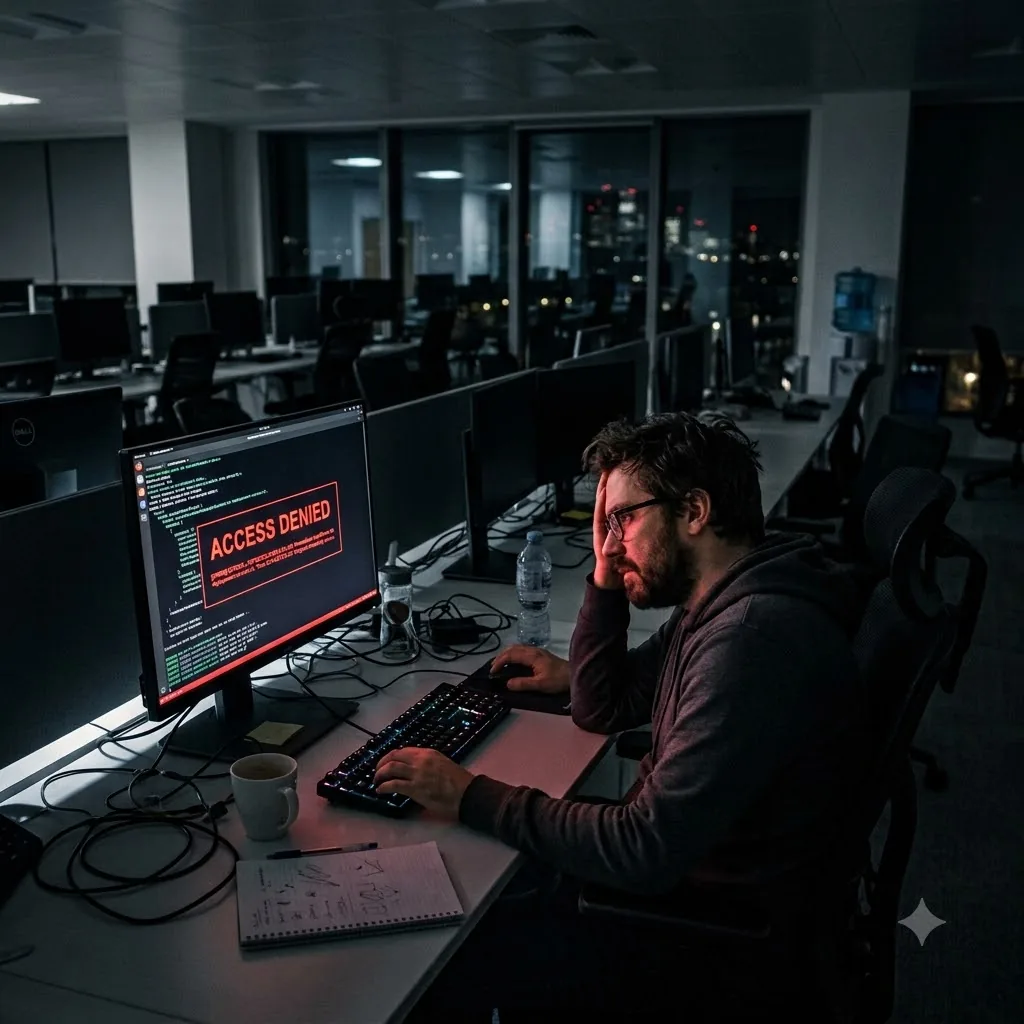
I slammed my palm against the `Ctrl` and `B` keys, then `D`, detaching my `tmux` terminal session and dropping the raw root access out of sight just as the heavy glass door swung open.
I pulled up a harmless error log on my main display, my heart hammering against my ribs like a trapped bird.
Julian stood in the doorway. He was still wearing the tailored navy suit he’d had on since eight this morning, looking immaculately put together for a man who should have been exhausted. Behind him stood David Vance-no relation to me, much to my annoyance-the senior partner from the outside legal firm handling our IPO. David looked like a shark stuffed into a gray trench coat, clutching a silver Halliburton briefcase.
“Marcus,” Julian said, his voice dripping with synthetic warmth. “Buddy, what are you still doing here? I told you to go home.”
“Just running down a final syntax error on the staging server,” I lied, keeping my eyes fixed on the dummy log file. “Wanted to make sure the deployment is completely clean for the bell tomorrow.”
Julian stepped into the office, his expensive leather shoes squeaking softly on the floorboards. He walked around my desk, invading my personal space, looking over my shoulder at the screen. I could smell his cologne, sharp and metallic.
“You worry too much,” Julian chuckled, patting my shoulder. The physical contact made my skin crawl. “The architecture is rock solid. You built it. But right now, we need you sharp for the press junket. We can’t have the CTO looking like a zombie on CNBC.”
David stepped forward, his face an emotionless mask. “Mr. Vance. We need to secure your hardware.”
I stiffened. “Excuse me?”
“Chain of custody,” David explained smoothly, tapping the silver briefcase. “Standard SEC compliance procedure for a tech offering of this magnitude. As of 2:00 AM, all localized development machines with administrative access are being quarantined to prevent any unauthorized commits or insider trading allegations before the market opens. We’re swapping your machine for a clean, read-only tablet until the offering closes.”
It was a lie. A beautiful, air-tight corporate lie. They weren’t quarantining anything for the SEC. They were disarming me. They knew I was a liability, and they were severing my physical access to the building’s network before the sun came up and I saw the revised S-1 filing.
“I’m in the middle of a diagnostic,” I said, gripping the edge of my laptop. “I just need ten minutes to wrap this up, and then I’ll bring it down to IT myself.”
“IT is already asleep, Marcus,” Julian said. His voice had dropped half an octave. The synthetic warmth was gone, replaced by the cold, calculating tone he usually reserved for hostile board meetings. “David’s team is handling the lockdown. Close the lid. Now.”
They were standing over me. Two against one. If I refused, they would simply call building security, have me physically removed for violating protocol, and I’d be fired for cause before the sun even rose. I would lose the company, my shares, and any severance.
But if I handed over the laptop, I lost the ghost account session. I lost the only leverage I had left.
My fingers hovered over the keyboard. My `tmux` session was still running in the background. The command to wipe the cloud architecture was typed out, waiting for a single keystroke.
*I built this. You don’t get to steal it.*
“Fine,” I said, sighing in mock defeat. “Let me just terminate the active background processes so I don’t corrupt the local database.”
David narrowed his eyes, but Julian nodded. “Make it quick.”
I toggled back to the hidden terminal session. The window flared to life, the destructive command glowing in the harsh white text.
Julian wasn’t a developer. He didn’t know what the server wipe commands meant. But he knew enough to recognize that I was in a root directory.
I didn’t hesitate. I hit `Enter`.
The script executed instantly. The terminal began returning a cascading waterfall of deleted file paths. The cloud infrastructure was eating itself alive.
I immediately hit the keyboard shortcut to kill the display window, closed the laptop lid, and slid the aluminum machine across the desk.
David snatched it up, unlatched his silver briefcase, and dropped my laptop inside. The thick foam padding swallowed my life’s work. He locked it with a heavy snap.
“Smart move,” Julian said, his fake smile returning. “Get some sleep, Marcus. Tomorrow is going to be a big day.”
I stood up, grabbing my coat. My pulse was deafening in my ears. I had done it. I had burned the ship. The staging environment, the production environment, the client databases-all of it was being systematically shredded by the ghost account. By the time they reached the opening bell, the entire platform would be a smoking crater. They couldn’t launch an IPO for a software company with no software. I was going down, but I was taking Julian with me.
We walked out of the glass office together. As we reached the elevator bank, Julian pressed the down button.
“Oh, I almost forgot,” Julian said, turning to me as the elevator doors chimed open. “I know how paranoid you get about server stability during crunch time. You’ll be happy to know David’s team took a complete, physical snapshot of the AWS repositories at midnight.”
I froze. The breath trapped in my throat.
“Yeah,” David added, stepping into the elevator. “We mirrored the entire environment. Air-gapped it to a secure proprietary server at my firm. Totally isolated from the cloud. We can spin up a perfect clone in ten minutes if anything happens to your live servers.”
Julian winked at me. “Just an insurance policy. See you at eight, Marcus.”
The elevator doors slid shut, leaving me standing alone in the silent, dimly lit lobby.
A cold dread washed over me, heavy and suffocating.
Midnight. They took the backup at midnight. Two hours before I executed the wipe command.
I hadn’t destroyed the company’s IP. I had only destroyed the live servers. Julian had a perfect, untouched copy of my life’s work sitting safely in a law firm’s vault. He could still launch the IPO.
But now, when DevOps woke up and found the production servers maliciously wiped from the inside, Julian would have a digital trail leading straight back to my ghost account. I hadn’t stopped the theft. I had just handed Julian the evidence he needed to press federal sabotage charges, void my remaining equity for cause, and put me in a maximum-security prison.
And I had just given them my laptop.