Story code: ST-000851
Part 4: Sundown
The chaotic hum of the zoning chamber erupted into overlapping shouts. The chairwoman banged her wooden gavel, the sharp cracks entirely swallowed by the frantic questions of the local news reporter. Marcus did not wait to see if the board officially dismissed the variance. He stepped back from the microphone, the worn wood of the podium slipping from his damp palms.
In the back row, the oak pew sat empty. Vargas had evaporated the moment the camera panned, slipping out the heavy brass doors before the cameraman could lock focus again. The cowardice confirmed everything.
Marcus turned and walked down the maroon carpet of the center aisle. He expected Elena to be standing there with fury in her eyes, but she was kneeling on the floor, her hands hovering over the scattered pages of the security contract. She was not gathering them. She was just staring at the bold black ink of the Bayfront Protection LLC letterhead.
Marcus stopped beside her. The reporter was too busy trying to get a statement from the flustered zoning board to notice them.
Elena looked up, her bloodshot eyes wide, the anger completely hollowed out and replaced by a horrifying, suffocating clarity. She grabbed the edge of a page, her fingers trembling. “Miller Street,” she whispered, her voice barely carrying over the noise of the room. “The old rail yard.”
Marcus said nothing. He kept his posture rigid, his face a stone mask.
“That is where the police found him,” Elena said, her voice cracking as she stared at the address listed for Bayfront’s motor pool. “That is where my boy overdosed. Where they sold him the blue glass.”
“It is a staging ground, Elena,” Marcus said, keeping his tone flat to hide the tremor in his chest. “It always was.”
She pulled the page against her wool cardigan, crushing the paper against her chest as a choked sob tore from her throat. The realization hit her with physical force. “They gave me the funding. The anonymous corporate donor who covered the legal fees for this clinic… it was them. They used his memory. They used my grief to build a fortress.”
“They needed a sympathetic front,” Marcus said. “Something the city would not inspect too closely. You gave them that. Now, you didn’t.”
Elena looked at him, the devastating truth settling between them. She saw past the cruel words he had used that morning, past the manufactured villainy he had worn to keep her out of the crossfire. He had publicly burned the syndicate to keep her hands clean. She reached out, her fingers brushing the heavy canvas of his work pants. “Marcus… what did you just do?”
“I protected my neighborhood,” he lied, his voice tight. “Go home, Elena. Lock your doors. Do not talk to the camera.”
Marcus did not wait for her to argue. He turned and pushed through the heavy brass doors, leaving the frantic noise of the chamber behind.
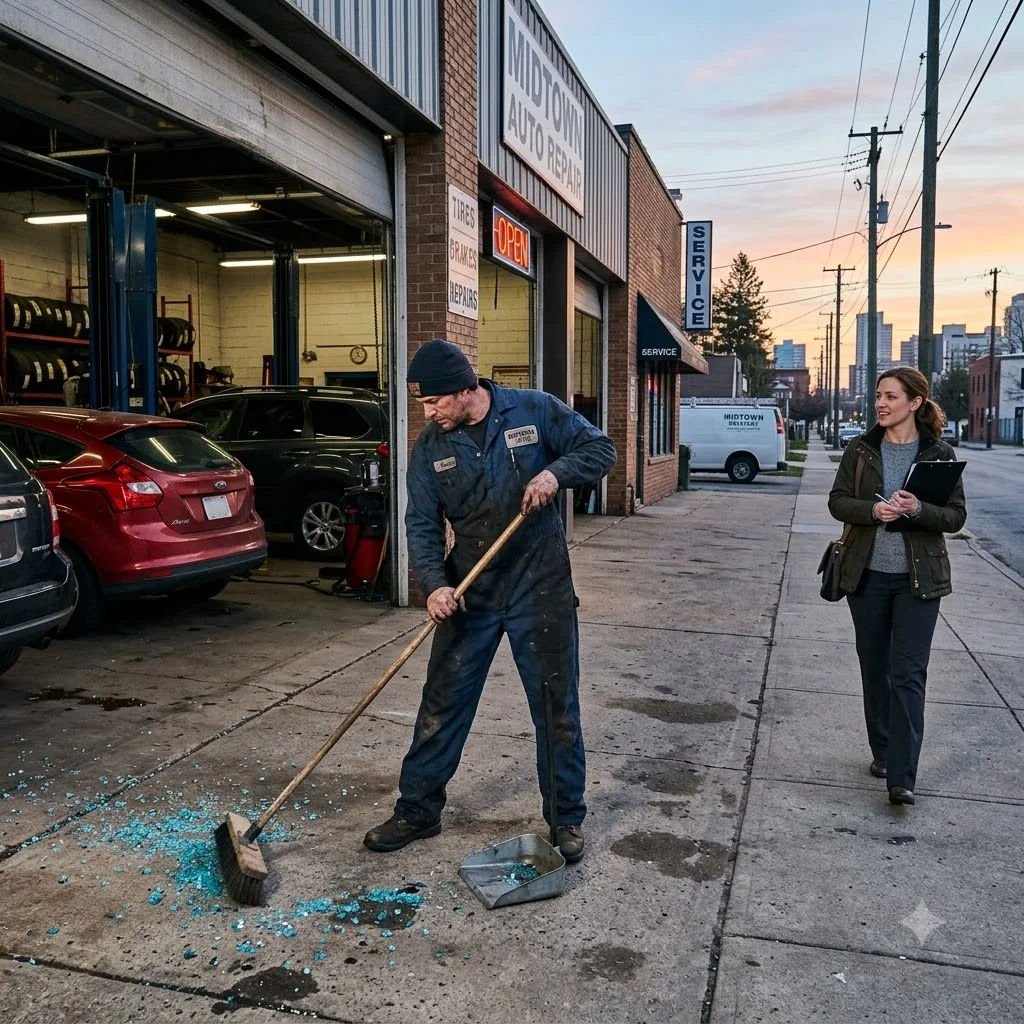
By the time Marcus pulled his truck into the gravel lot of his auto shop, the sun had dropped below the jagged skyline of the harbor. Six-fourteen. The exact time of the original deadline set by the crescent of blue grit. The sky bruised into deep purples and ash gray.
The shop was dark. Hector’s beat-up truck was gone. The bays were locked tight, the rolling steel doors pulled down and chained against the concrete. Marcus killed the engine but did not make a move to open his door. He just sat in the cab, listening to the metallic ticking of the cooling exhaust block.
He stared through the windshield at the mouth of the narrow brick alleyway. The shadows there were deep, absolute. There was no sign of Dante, no gleam of a shattered cobalt vial. But Marcus knew how this worked. Exposing Vargas on the evening news had severed the syndicate’s cleanest supply route. Millions of dollars in real estate and distribution logistics had evaporated the moment Marcus spoke into that microphone.
They would not send a lawyer with a cease-and-desist. They would not file a counter-appeal. The syndicate traded in terror, in fire and shattered glass.
Marcus reached across the cab and opened the glovebox. The small, heavy lockbox inside felt cold against his calloused fingers. He punched in the three-digit code by muscle memory, the mechanical click sounding incredibly loud in the silent cab. Inside rested a compact, snub-nosed revolver. He had not loaded it in seven years, not since the last time the neighborhood pushed back against the harbor gangs.
He lifted it out, checking the cylinder in the dim ambient light of the streetlamp.
He had spent over a decade building this shop, pouring his sweat and blood into the concrete floors, earning the respect of his mechanics and the neighborhood. He had cultivated a quiet, honest, civilian life. In three minutes at a zoning podium, he had traded all of it away. The shop was no longer a sanctuary; it was a bunker.
Marcus leaned his head back against the headrest and closed his eyes. The engine continued to tick. Out in the distance, a siren wailed, fading quickly into the sprawling labyrinth of the city. He kept the heavy steel of the revolver resting on his thigh, sitting alone in the dark parking lot, waiting for the street war to arrive.