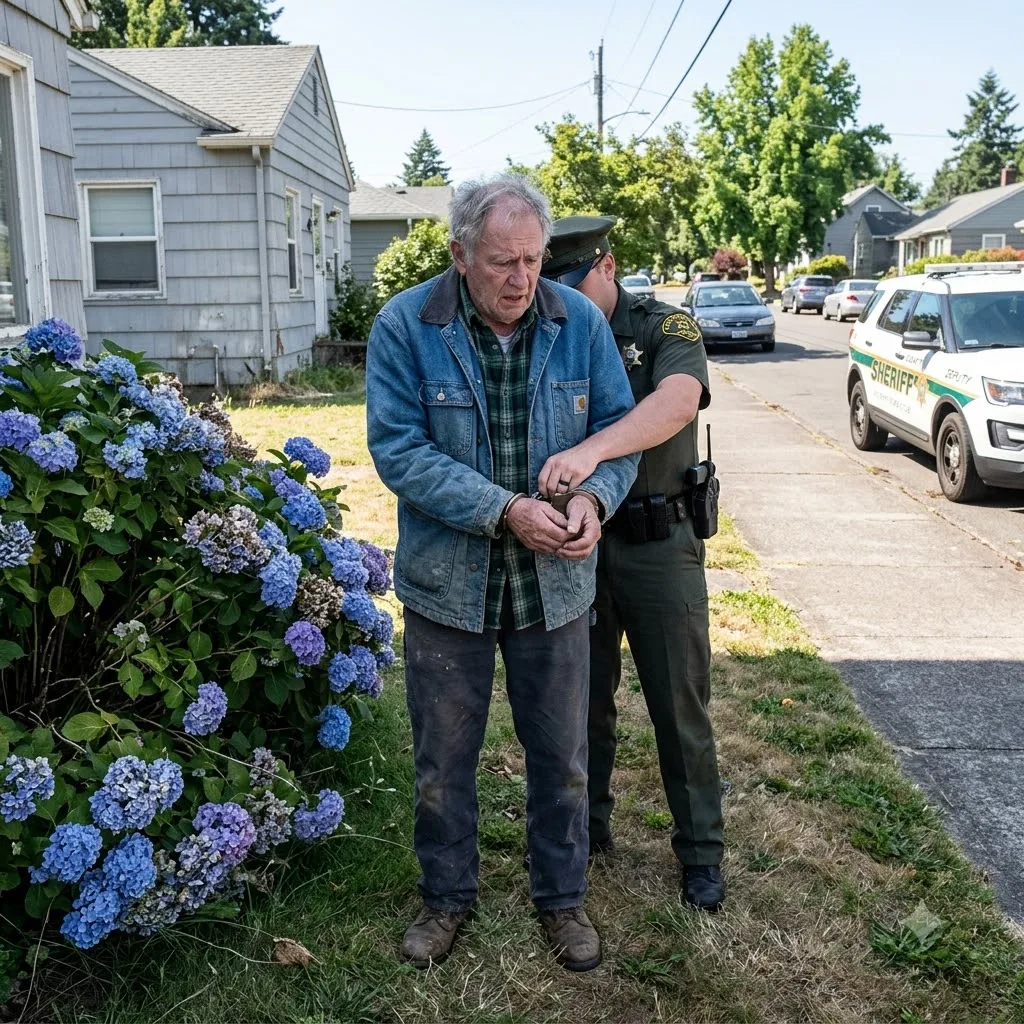
Story code: ST-000898
Part 3: The Contiguous Parcel
Arthur sat perfectly still on the corrugated steel bench of general holding, his bruised wrists resting delicately on his knees. He did not know if it was Thursday night or Friday morning. The windowless concrete room offered no sunlight, only the ceaseless, sterile hum of overhead fluorescent tubes and the smell of stale floor wax. He had refused the single bologna sandwich slid through the door slot, unable to stomach the thought of eating while the invisible meter of his fabricated debt ticked higher.
When the heavy deadbolt finally clicked and the metal door swung open, the guard did not use Arthur’s name. He simply pointed a thick finger at the elderly man and jerked his head toward the corridor.
Arthur’s joints popped in loud, agonizing succession as he forced himself to stand. He was marched back down the freezing cinderblock hallway, his grass-stained sneakers shuffling against the linoleum. The guard shoved him into the same small, windowless consultation room he had been in before.
Vance was waiting at the metal table, wearing the identical sharp charcoal suit. But he was not alone.
Sitting in the plastic chair beside Vance was the man from the silver Tacoma. Up close, the man smelled strongly of peppermint and expensive dry cleaning. He wore a tailored navy blazer and a heavy, gold-link watch that peeked out from his French cuffs. In the corner of the room, a young woman sat quietly with her hands folded over a canvas tote bag. She avoided Arthur’s eyes, her gaze fixed firmly on the scuffed baseboards.
“Have a seat, Arthur,” the man in the navy blazer said. He didn’t wait for Arthur to comply before speaking again. “My name is Richard Sterling. I’m a local residential developer. Vance here reached out to me regarding your situation. Frankly, I find the county’s aggressive ticketing of seniors to be abhorrent.”
Arthur lowered himself into the plastic chair, keeping his back rigid. He recognized the man’s voice, though he had never heard it before. It held the same proprietary arrogance as the silent toast from the truck.
“Your daily non-compliance fees have triggered the threshold,” Vance interjected, his tone completely flat. “Your balance as of this morning is eleven thousand, eight hundred dollars. The county is initiating the property seizure protocols.”
“Which is where I come in,” Sterling said, leaning forward and resting his elbows on the metal table. His smile was perfectly practiced, meant to convey deep sympathy. “I buy distressed properties, Arthur. I can stop the seizure. I have a cashier’s check in my briefcase right now to wipe out your entire eleven-thousand-dollar debt to Apex. And I’ll cut you a personal check for forty thousand dollars for your remaining equity. You walk out of here today with clean hands and a nest egg.”
Sterling slid a thick stack of stapled papers across the table. He gestured to the quiet woman in the corner. “I even brought a notary. We execute a standard quitclaim deed right here, right now, and you can go sleep in a nice hotel tonight.”
Arthur stared at the documents. Forty thousand dollars was less than a tenth of what his brick ranch house was worth. It was a brazen, organized theft, dressed up as a rescue mission.
“Sign the deed, Arthur,” Sterling urged, tapping a silver pen against the table. The tapping was fast. Rhythmic. Agitated. “The county machinery doesn’t stop. You don’t want to lose everything.”
Arthur leaned forward. Without his reading glasses, which were still sitting in a plastic bin at intake, the dense legal text of the quitclaim deed was a blurry gray block. He lowered his face until he was only inches from the table, squinting fiercely to force the letters into focus under the harsh overhead glare.
He did not look at the signature line. His eyes drifted to the top of Sterling’s open leather folio, resting just behind the deed.
Sterling had left his own paperwork exposed. Beneath a heavy paperclip, a document on official bank letterhead bore a bold, capitalized title: *COMMERCIAL LENDING COMMITMENT – ELMWOOD COURT ASSEMBLY*.
Arthur’s breath hitched slightly, but he kept his face inches from the table. Elmwood Court was his street.
He forced his aching eyes to track down the page, scanning the bulleted terms. *Condition Precedent 4.1: Borrower must furnish recorded deeds for 100% of contiguous parcels prior to disbursement.*
Beneath that, printed in a harsh red font that cut through Arthur’s blurry vision: *Commitment Expiration: Friday, October 14th – 5:00 PM EST.*
Arthur slowly pushed himself back up from the table, feeling a strange, sudden calm settle over his racing heart. He looked at the digital clock mounted above the heavy metal door. The glowing red numbers read 3:42 PM.
“You’re not rescuing me,” Arthur said. His voice was no longer a quiet, defensive whisper. It filled the small room.
Sterling’s silver pen stopped tapping. “I’m offering you a lifeline, old man. Don’t let pride make you homeless.”
“You need one hundred percent of the contiguous parcels,” Arthur said, reciting the bank’s phrasing perfectly. “You bought out the Hendersons. You bought out the Millers. But you couldn’t buy me out because I never put my house on the market.”
Vance shifted uncomfortably in his chair, his eyes darting toward Sterling.
Arthur looked directly into Sterling’s eyes. “You didn’t tip off the municipal blight inspectors because you wanted to buy my house for cheap. You did it because you’re out of time.” Arthur pointed a trembling but resolute finger at the leather folio. “Your commercial loan for the Elmwood assembly expires today at five o’clock. If you don’t have my deed by the end of business, the bank pulls your funding. You lose the whole project.”
Sterling’s sympathetic smile vanished entirely. The skin around his jaw tightened, the muscles flexing as his teeth ground together. He looked down at his exposed folio, then back up at Arthur, the mask of the benevolent savior utterly stripped away.
Arthur sat back in his rigid plastic chair, folding his bruised wrists over his chest. He looked at the clock again. It was 3:44 PM.
“I think,” Arthur said quietly, “I will just sit here and wait.”