Story code: ST-000919
Part 4: The Weight of the Glass
The lead officer froze, his thick fingers halting inches from Eleanor’s wrist. He looked down at his heavy black boot, then slowly crouched to pick up the open leather wallet. The blue and red strobes from the cruiser washed over the pavement, catching the metallic sheen of the heavy black credit card. The officer slid the driver’s license out with his thumb.
He read the name. Then he read it again.
The transformation was instantaneous, as if an invisible switch had been flipped in the crisp morning air. The aggressive tension vanished from the officer’s heavy shoulders. He dropped the black plastic zip-ties. They hit the concrete with a hollow, pathetic clatter.
“Sterling?” the lead officer breathed, his voice stripped of its previous bark. He looked up, his eyes darting from the dirt-streaked girl in the oversized jacket to the towering glass facade of the First National building directly behind her.
The second officer, who had been twisting Eleanor’s burned arm, instantly released his grip. He took a large, overly careful step backward, holding his palms up slightly, as if apologizing for his own hands.
“Miss Sterling,” the lead officer said, his tone suddenly dripping with the practiced, careful deference usually reserved for city politicians and precinct captains. “Are you alright, ma’am? Do you need us to call a paramedic for your hands?”
Marcus watched from the freezing concrete. The pain in his right knee was a blinding, rhythmic thumping that synced perfectly with his hammering heart. Every time he shifted his weight, it felt like ground glass grinding inside his joint. He lay there, clutching his leg, watching the magic trick of extreme wealth unfold right in front of him. A minute ago, she was a vandal, a downtown nuisance to be pinned, cuffed, and hauled into central booking. Now, she was untouchable royalty.
Gable stepped forward, his arrogant smirk entirely dissolved into a pale mask of panic. His pristine Italian leather shoes scuffed against the pavement as he practically tripped over himself to get into Eleanor’s line of sight.
“Miss Sterling?” Gable stammered, his voice climbing an octave. “I had no idea. I assure you, this was a complete misunderstanding. I was just trying to secure your father’s property. We get these environmental agitators all the time, I thought-”
“Stop talking,” Eleanor whispered.
She ignored Gable entirely. She looked down at her raw, chemical-burned hands, then looked down at Marcus. The righteous, defiant fire that had fueled her morning rebellion was completely extinguished. In its place was a hollow, terrified guilt. She saw the unnatural angle of his leg. She heard the ragged, shallow way he was gasping for air.
“I’m so sorry,” she said, her voice trembling, a frail and useless sound in the vast, echoing canyon of the financial district. “I’ll tell him. I’ll tell my father to pay for your knee. I’ll make sure he knows you tried to help me. You won’t lose your job.”
Marcus closed his eyes, resting the back of his head against the cold stone of the decorative planter. He didn’t want her charity. He didn’t want her naive promises. He knew how this machinery worked. Her father wasn’t going to save a sixty-two-year-old security guard just because his daughter felt guilty. The board would bury it, HR would sanitize it, and Marcus would be quietly erased from the payroll.
“Just go home, kid,” Marcus grunted, his voice hollowed out by a bone-deep exhaustion. “You did enough for one morning.”
The officers didn’t push her. They didn’t touch her. The lead officer gently guided her toward the cruiser, his hand hovering respectfully an inch off her back, never making contact. He opened the rear door for her, placing his hand over the doorframe to ensure she didn’t bump her head as she slid into the plush back seat.
There were no handcuffs. There was no reading of rights.
The cruiser pulled away from the curb, leaving its sirens off. The flashing strobes died out, leaving the plaza bathed in the cold, gray, unforgiving light of the early morning.
Gable stood on the pavement, watching the taillights disappear around the corner. He took a deep, shuddering breath, smoothing the lapels of his custom-tailored jacket. He was reconstructing his armor, snapping the pieces of his corporate authority back into place. He turned around and looked down at Marcus. The panic was gone from the manager’s face, replaced by a cold, protective self-interest.
“You’re still fired, Marcus,” Gable said, his voice completely flat. “I don’t care if she was the CEO’s daughter or the Pope. You let a security threat reach the glass. Turn in your badge to the front desk. And don’t even think about filing a worker’s compensation claim. The cameras show you tripped over your own feet while interfering with a police arrest.”
Gable turned on his heel and marched toward the side entrance, swiping his keycard. The heavy security door clicked shut behind him, locking automatically.
Marcus was left completely alone on the plaza.
The distant hum of city traffic was beginning to rise. The financial district was waking up, oblivious to the casualty left on the pavement. Marcus dragged his heavy, agonizingly painful leg across the concrete, inching his body forward. His breath hitched, a low groan escaping his lips with every movement.
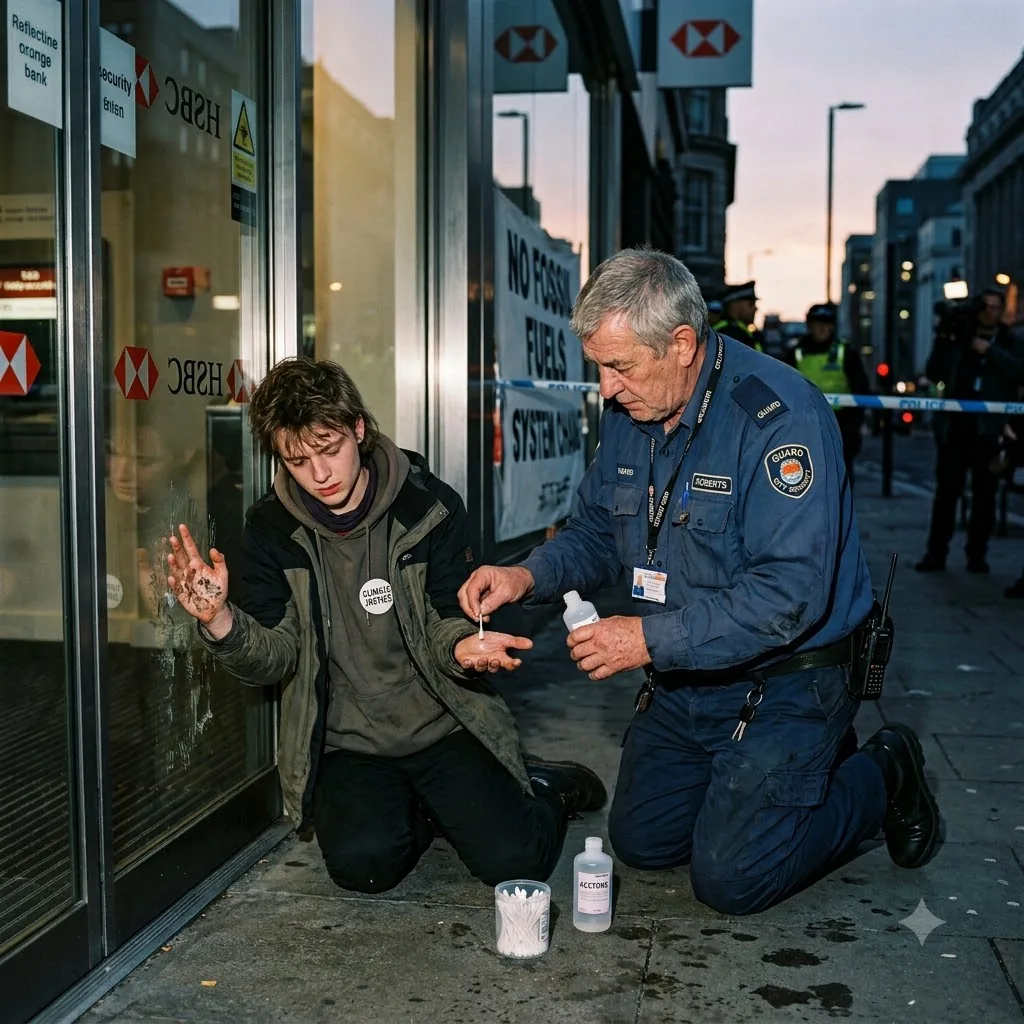
His calloused hand shook as he reached out, his fingers finding the cheap plastic putty knife he had dropped earlier.
He leaned heavily against the planter for support, looking at the smeared, gummy white residue still clinging to the pristine corporate glass, and the matching patch of dried superglue on the pavement below it. He gripped the plastic handle. With agonizing slowness, Marcus pressed the edge against the concrete and began to scrape.
The sound was dry and hollow in the quiet dawn. He had no job. He had no pension. He had a shattered knee, a wife waiting for medicine she couldn’t afford, and a mess left behind by people who would never have to clean it up. He kept scraping, watching the white flakes scatter in the morning breeze, swept away into the gutters like they were never there at all.