Story code: ST-000927
Part 3: The Weight of Brass
The acrid grey vapor rolled over the toe of Marcus’s tactical boots, carrying the bitter scent of pulverized concrete and scorching ozone. He coughed, a harsh, involuntary bark, and took three rapid steps backward in a textbook tactical retreat. The Sig Sauer P320 remained leveled at the shifting mass of dark metal. His finger hovered over the trigger, his mind racing through threat-assessment protocols that simply didn’t apply.
The deafening, industrial shriek of the drill suddenly pitched down into a heavy, grinding groan. Beneath the cracked surface of the driveway, the diamond-tipped piston hit bedrock. With a violent pneumatic hiss, the machine stopped. The thick, spider-like armatures locked into place. The vapor began to thin, blowing away into the freezing mountain air. The box hadn’t exploded. It hadn’t deployed a weapon. It had simply welded itself to the earth, a permanent, immovable parasite tapped directly into the foundation of his million-dollar estate.
“It won’t detonate, Marcus.”
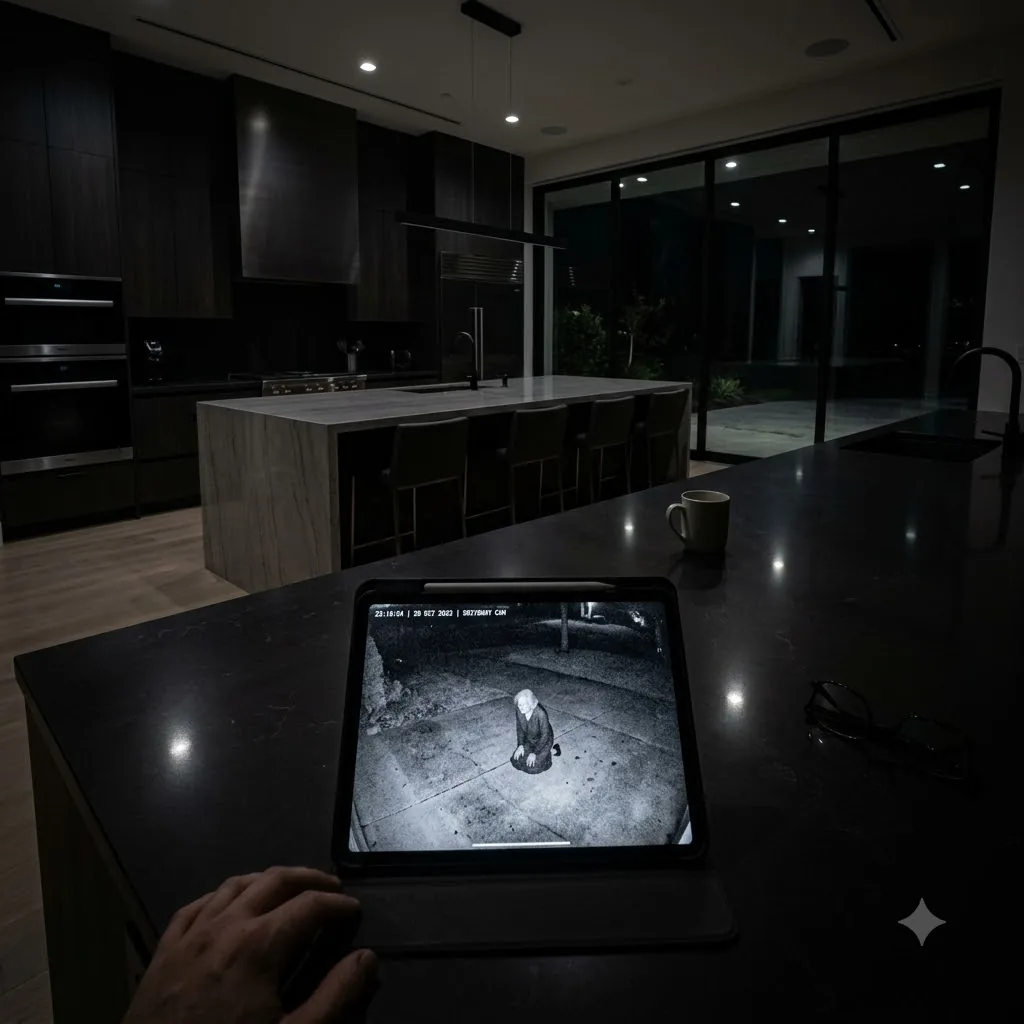
The voice was thin, but perfectly steady. Out of the suffocating darkness of the tree line, the old woman stepped back into the blinding cone of his tactical flashlight. She had not run. She had not called for backup. She simply walked back onto the ruined concrete of his driveway, her faded wool coat rustling in the wind.
“Get on the ground!” Marcus roared, relying on the aggressive, commanding tone that had kept him alive through two tours in Kandahar and a decade running elite private security. “Face down! Hands behind your head! Now!”
She didn’t stop. She didn’t raise her hands. She walked straight into the blinding glare of the thousand-lumen beam, her pale eyes unblinking.
“I said get down!” Marcus tightened his two-handed grip on the pistol, aiming dead center at her chest. “I will drop you. I have the legal right. You have breached a secure perimeter. You have deployed an unknown device. This is your final warning!”
“You don’t need a warning, Marcus,” she said, stopping just a few feet from the anchored machine. “You just need to listen.”
She reached out with her trembling, liver-spotted hand and pointed to the heavy cylinder that was now magnetically fused to the side of the metal box.
“Do you know what this is?” she asked.
“It’s a localized jammer,” Marcus said, his voice tight. “You’ve severed my fiber optics. You’ve jammed my cellular failover.”
“The box is the jammer,” she corrected softly. “My nephew built it. He’s very clever with radios. It will broadcast white noise on every frequency your house uses, forever. Its power supply is geothermal, driven straight into your bedrock. But I didn’t ask about the box.”
She pointed again to the tarnished cylinder.
“I’m talking about the casing,” she said.
Marcus stared down the sights of his gun, but his peripheral vision caught the dull gleam of the brass. It wasn’t just a cylinder. Under the harsh light, he recognized the tapered neck and the heavy primer base. It was a spent artillery shell. A massive, thirty-millimeter brass casing, scarred and weathered by sand and time.
“My name is Elena,” she said. “Three years ago, your private military firm was contracted to secure a supply route outside of Bogota. Your convoy was ambushed. You ordered your gunners to lay down suppressing fire with the heavy mounted cannons. You didn’t check your backstops. You didn’t care about the village behind the tree line.”
Marcus felt the freezing mountain air catch in his throat. The adrenaline that had been surging through his veins suddenly turned cold, heavy, and toxic.
“It was a combat zone,” Marcus snapped, the words tasting like ash. “It was a kinetic engagement. We were taking heavy fire. Collateral damage is a tragic reality of the theater.”
“Collateral,” Elena repeated, rolling the word around as if it were a stone in her mouth. “That is a very clean word for what happened to my eight-year-old son.”
She knelt beside the machine, ignoring the gun leveled at her head. She touched the cold brass casing with an awful, heartbreaking reverence.
“This metallic object is a brass casing,” Elena explained, her voice entirely devoid of anger. “It matches the exact weight of the stray bullet that tore through the corrugated tin roof of our home. The bullet that took my little boy from me in the middle of his dinner.”
Marcus swallowed hard. His arms were rigid, his combat stance textbook perfect, but his hands were beginning to shake. He was a man who understood perimeters, reinforced glass, and high-velocity ballistics. He knew how to fight cartels, insurgents, and thieves. He did not know how to fight a frail, grieving mother standing in his driveway in a wool coat.
“I came here tonight,” Elena continued, standing back up and looking directly into the barrel of his gun, “intending to hate you. I spent three years tracking the man who commanded that convoy. The man who signed off on the after-action report and retired to a mountain fortress. I thought I would find a monster.”
She looked past him, her eyes tracing the massive, imposing silhouette of the twelve-thousand-square-foot estate. She took in the dark, empty windows, the sterile stone pillars, and the absurd, aggressive floodlights washing over the manicured lawn.
“But look at you,” she whispered.
Marcus kept the gun raised, but the front sight post wavered. His tactical bravado was dissolving, stripped away by the absolute, crushing calmness of her gaze. He wanted her to scream. He wanted her to pull a weapon so he could justify his training, so he could neutralize the threat and go back inside to his safe, controlled environment.
“You have walls. You have cameras. You have motion sensors and heavy steel gates,” Elena said, her voice dropping to a tone of profound, devastating pity. “You guard a fortress that holds absolutely nothing. No laughter. No family. No life. Just cold marble and a guilty conscience.”
Marcus lowered the weapon a fraction of an inch. “Get off my property.”
“My house is silent because you ripped my son out of it,” Elena said, wrapping her wool coat tighter around her frail shoulders against the biting wind. “Your house is silent because you have nothing left to love.”
She turned her back on him, leaving her chest completely exposed to his weapon. It was the ultimate dismissal. She didn’t fear his gun because she had already seen the absolute worst thing a gun could do.
“The jammer stays,” she said to the darkness, her footsteps carrying her back toward the public road. “Every time you look at the blind spots on your screens, you will remember the weight of that brass. You will remember my son.”
Marcus stood frozen on the cracked concrete. The Sig Sauer hung heavy and useless in his hand. The machine sat anchored deep in his driveway, humming with a low, unyielding vibration. Behind him, the massive estate stood completely dark, severed from the world, and for the first time, Marcus realized just how terrifyingly empty it truly was.