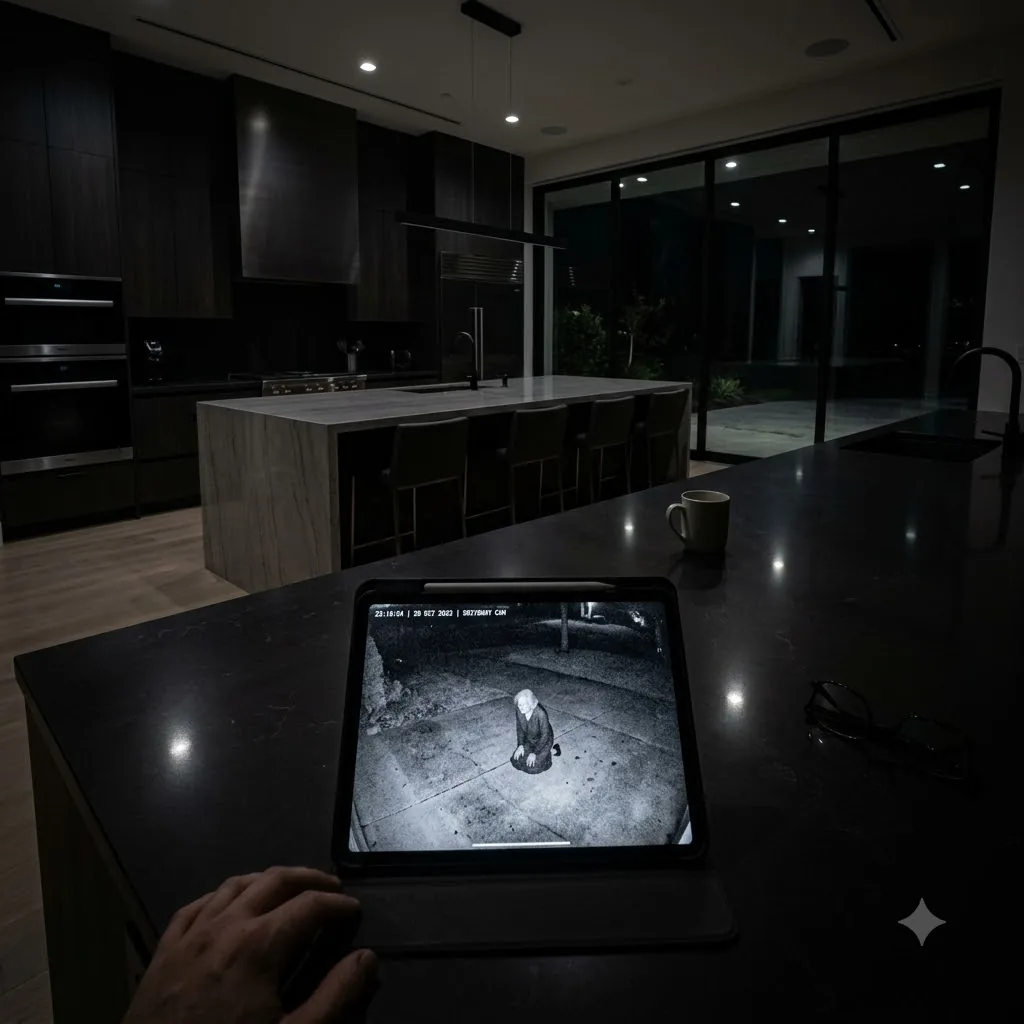
Story code: ST-000927
Part 2: The Severed Line
Marcus’s heart hammered against his ribs, a frantic, syncopated rhythm that defied the freezing air of the mountainside. He cleared the Kydex holster in a single, fluid motion. The Sig Sauer P320 felt cold and absolute in his grip, a familiar weight that usually brought him an immediate sense of control. He did not raise the weapon to eye level-not yet-but kept it compressed against his ribs in a textbook low-ready stance. The blinding beam of his tactical light remained fixed squarely on the woman’s face, washing out her weathered features into a stark, skeletal mask of deep shadows and glaring white.
“Hand out of the pocket! Empty your hand! Now!” Marcus barked. His voice tore through the dead silence of the estate, bouncing aggressively off the dense line of imported Japanese maples that lined his perfect driveway.
Her hand emerged from the oversized wool coat.
Marcus tightened his grip, taking up the microscopic slack on the pistol’s trigger. But she wasn’t holding a weapon. She wasn’t holding a detonator, a phone, or anything he could instantly categorize as a threat. Her trembling, liver-spotted fingers gripped a thick, tarnished brass cylinder, heavy and deeply scarred along its edges. She didn’t throw it at him. She didn’t make a sudden, aggressive movement. She simply opened her hand.
The heavy brass cylinder hit the immaculate stamped concrete with a dense, metallic clink that echoed sharply up the quarter-mile driveway. It rolled exactly two revolutions before coming to a dead stop against the base of the heavy, dark metallic shoebox she had just placed on the ground.
The woman finally spoke. Her voice was thin, raspy, and barely carried over the distance and the faint, icy rustle of the wind through the pines. “It isn’t yours,” she said. Or at least, that was what Marcus thought he heard through the rush of blood in his ears. She paused, her pale eyes reflecting the harsh floodlights. “The ground remembers what was stolen.”
She took another step backward, retreating into the harsh transition line where his precisely calibrated floodlights met the absolute, suffocating darkness of the public road.
“Stay right there!” Marcus commanded, stepping further down the portico stairs. The cold was beginning to seep through his tactical pants, but the pure adrenaline burned it away. He risked a micro-second glance away from her retreating figure to tap the Bluetooth earpiece synced to his home’s state-of-the-art internal network.
“Aura, lock the front gate and connect to local dispatch,” he ordered, keeping his eyes locked on the fading silhouette of the old woman.
Silence.
“Aura. Dispatch. Code Red. Acknowledge.”
A sharp, painful burst of static crackled in his ear, followed by a localized, automated voice from the earpiece’s internal chip, completely devoid of the usual smooth AI cadence. *”Network connection unavailable. External fiber lines severed. Cellular backup jammed.”*
Marcus froze, his breath catching in his throat. The twelve-thousand-square-foot fortress behind him-wired with dual-redundant underground fiber optics, a dedicated cellular failover, and military-grade encryption-was completely offline. He was totally disconnected. The realization hit him with the force of a physical blow. He was ten miles away from the nearest neighbor, isolated on a mountain peak, and someone had just silently cut the digital throat of his million-dollar sanctuary.
He looked back down the long expanse of the driveway. The woman was gone. She had slipped entirely beyond the reach of his lighting, vanishing into the dense, black treeline without a single snap of a twig.
Only the metal box remained.
Marcus kept the pistol raised, sweeping the edge of the trees, expecting an ambush. A highly coordinated home invasion? A cartel hit? But why send a frail old woman to the front door? And why leave a rusted metal box sitting in plain sight on the driveway?
Then, the noise started.
It was incredibly low at first, a heavy, rhythmic grinding that vibrated through the freezing air and traveled through the concrete straight into the soles of his boots. It didn’t sound like the high-pitched whine of a charging capacitor, nor the rapid, electronic ticking of a conventional explosive. It sounded deeply industrial. Ancient and brutal. Like heavy iron gears slipping forcefully into place.
He stepped forward cautiously, the thousand-lumen tactical light illuminating the surface of the box. It wasn’t smooth. Under the intense glare, Marcus could see thick, rusted seams and deeply etched geometric grooves running along the dark metal. The brass cylinder the woman had dropped was now vibrating violently against the concrete, pulled magnetically toward the base of the box with a sickening scrape.
*Clack.*
A rusted seam on the top of the metal object split wide open. Marcus stopped twenty yards away, raising his weapon with both hands, aiming directly at the center of the shifting, metallic mass.
“Don’t move!” he shouted, a completely useless, instinctual command directed at an inanimate object, but his training offered him no other protocol for this.
The box didn’t explode. Instead, it unfolded.
Thick, spider-like armatures of jagged dark metal snapped outward from the sides, locking into place against the concrete with a heavy crunch. The central mass of the box elevated violently on these new legs. Marcus watched in absolute disbelief as a massive central piston, tipped with a wide, diamond-hardened industrial drill bit, extended from the underbelly of the machine. The grinding noise escalated into a deafening, mechanical roar.
The machine drove the bit directly downward into his immaculate driveway.
The expensive stamped concrete cracked instantly, deep fissures spiderwebbing outward from the impact zone. Dust and jagged shards of rock kicked up into the blinding beam of Marcus’s flashlight. This wasn’t a bomb meant to blow him up. It was a machine designed to dig. It was anchoring itself, breaching his impenetrable perimeter from the ground down.
His earpiece hissed with violent static again. From the stone pillar at the end of the drive, the red power light on Camera Four flickered and died. Then Camera Three. The sound of his high-definition network shutting down, one by one, echoed in the digital whine in his ear. The machine sunk deeper into the earth, the concrete buckling violently around it, as a secondary seam on the metal box hissed open, releasing a thick, acrid grey vapor that began to roll rapidly up the driveway toward his boots.