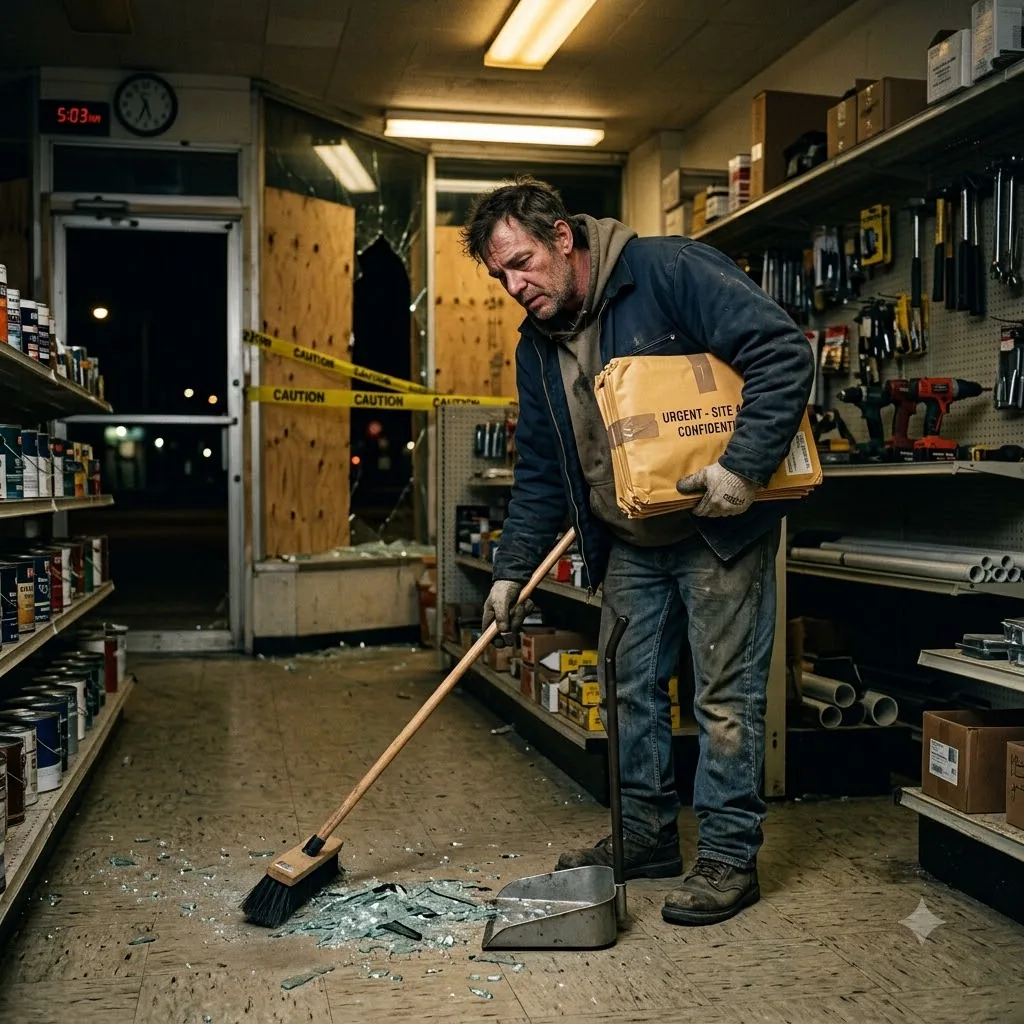
Story code: ST-000958
Part 2: The Boundary Stake
Marcus stared at the blackened chunk of wood resting on the scarred Formica counter. A melted, bubbling lump of neon-orange plastic clung to the splintered grain. The stench of chemical accelerant-gasoline, not an electrical fire-wafted up from the charred fibers, cutting straight through the ambient smell of the shop’s spilled fiberglass.
He knew exactly what the object was. It was a surveyor’s boundary stake. More specifically, the bright orange ribbon, now reduced to toxic slag, marked it as one of the new stakes driven into the Miller farm property line last month. The Millers were the only other holdouts in the district.
“Elias Miller had a tragic accident last night,” the woman said. Her voice was perfectly modulated, possessing the practiced, sterile tone of a corporate litigator, completely at odds with the brutal artifact she had just presented. “A terrible fire in his barn. He barely made it out. They lost everything.”
Marcus kept his hands flat against his thighs, pressing hard against his denim jeans to hide their sudden trembling. He looked from the burnt stake to her meticulously maintained silver pickup idling outside in the dark. “You burned Elias out,” he said, the words tasting like ash in his mouth.
“The coalition is deeply saddened by the loss,” she replied, not blinking, not breaking eye contact. “But it does simplify the zoning board’s map. The Miller property is no longer viable for agricultural use. They will be selling.”
Marcus’s jaw tightened. The coalition wasn’t some shadowy, outside mob; it was his neighbors. It was the hardware store’s regulars, the local mechanic, the diner owner. The town had been bleeding out for a decade, hemorrhaging factory jobs and youth. Then the logistics conglomerate had arrived, offering a massive, multi-million-dollar buyout for a contiguous three-mile stretch of the valley to build an automated shipping hub. It was lottery money for everyone involved.
But the conglomerate required a clean, uncontested title for the entire footprint. And sitting right in the center of that footprint was Marcus’s hardware store, along with the old municipal access roads his father had legally absorbed into the property deed forty years ago.
The town needed him to sell. More importantly, they needed the original 1978 sealed master deed that proved Marcus owned those access roads. If the conglomerate found out the town’s planning board had lied about having a clear municipal right-of-way, the entire mega-deal would evaporate overnight. The sealed envelope hiding in the fertilizer bin out back wasn’t just a piece of paper; it was a loaded gun pointed directly at the town’s financial salvation.
“I don’t have what you’re looking for, Sylvia,” Marcus lied, his voice sounding entirely too thin in the cavernous, drafty store.
Sylvia finally looked away from him. Her gaze drifted casually around the shop, taking in the shelves of PVC piping, the displays of power tools, and the gaping, wind-swept hole in the front of the building.
“This store has a lot of history,” she noted, completely ignoring his denial. “So much dry lumber. So many flammable solvents in the back room. Paint thinner, kerosene, raw fertilizer. It would be a nightmare for the volunteer fire department. Assuming they even got the dispatch call in time.”
Outside, the low rumble of Sylvia’s idling truck was joined by a new sound. The heavy crunch of oversized tires rolling over the gravel shoulder. Marcus watched as a rusted blue Ford pulled up behind Sylvia’s pristine silver pickup. He recognized the truck immediately. It belonged to Dave Hennessey, the man who had bought his riding mower here just three weeks ago.
A moment later, a dark green SUV pulled up across the street. Then a plumbing work van.
Men and women stepped out into the freezing pre-dawn air. Marcus’s chest seized, his lungs refusing to expand. There was Pastor Miller from the community church, his hands shoved deep into a heavy parka. There was Sarah from the diner, holding a heavy Maglite flashlight. Six people, then ten, gathering in a loose semicircle around the shattered storefront. They didn’t shout. They didn’t throw anything. They just stood there, a silent, suffocating wall of desperate neighbors blocking his only exit.
“They are tired, Marcus,” Sylvia said softly, drawing his attention back to the counter. “They are bankrupt, they are exhausted, and they are looking at a future where they can finally send their kids to college, pay off their mortgages, and escape this dying valley. And the only thing standing in their way is your stubborn loyalty to this crumbling building and a forty-year-old surveying error.”
Marcus looked out at the faces in the crowd. Dave wouldn’t meet his eye, staring instead at the broken glass on the sidewalk, but his grip on a heavy iron crowbar was white-knuckled. The isolation crashed over Marcus like a physical weight. The police weren’t coming. The police chief’s brother was on the coalition board. There was no one to call.
“You give me the envelope,” Sylvia said, her voice dropping to a harsh, demanding whisper. “You sign the release, and you take the buyout money. You get to leave a rich man.”
“And if I don’t?” Marcus asked, though the charred wood resting between them already held the answer.
Sylvia tapped a manicured fingernail against the burned surveyor’s stake. “Elias Miller lost a barn because he lived on fifty acres. We had the space to make a point. You live in an apartment directly above a store filled with industrial chemicals. If a fire starts here, you won’t have the luxury of running out into a field.”
She reached into her coat pocket again, but this time she withdrew a heavy, polished brass Zippo lighter. She set it gently on the counter next to the burnt stake.
“The bank opens at nine,” Sylvia said, turning her back on him and walking toward the shattered storefront, her boots crunching over the glass. She stopped at the threshold, silhouetted against the headlights of the blockade. “I’ll be back in two hours. Have the envelope on the counter, Marcus. Or we won’t bother throwing a brick next time.”