Story code: ST-001026
Part 2: Worthless Paper
The heavy hand belonged to Elias, the shop’s senior alignment tech. Elias squeezed Marcus’s shoulder, his calloused fingers leaving a faint impression of grease on Marcus’s blue work shirt.
“Vance is on the warpath, kid,” Elias muttered, his voice barely audible over the screech of a pneumatic grinder two bays down. “He’s looking for the Ford. Wants to know why it’s still hanging in the air.”
Marcus barely registered the warning before the shop owner, Mr. Vance, rounded the corner of the wash bay. Vance was a wide, perpetually sweating man who wielded his clipboard like a broadsword. He stopped short, his boots squeaking on the wet concrete, taking in Marcus standing upright instead of wrenching under the chassis.
“Marcus!” Vance barked, slapping the clipboard against his thigh. “I didn’t hire you to stand around looking at the walls. That transmission was supposed to be drained and dropped by ten. It’s ten-fifteen.”
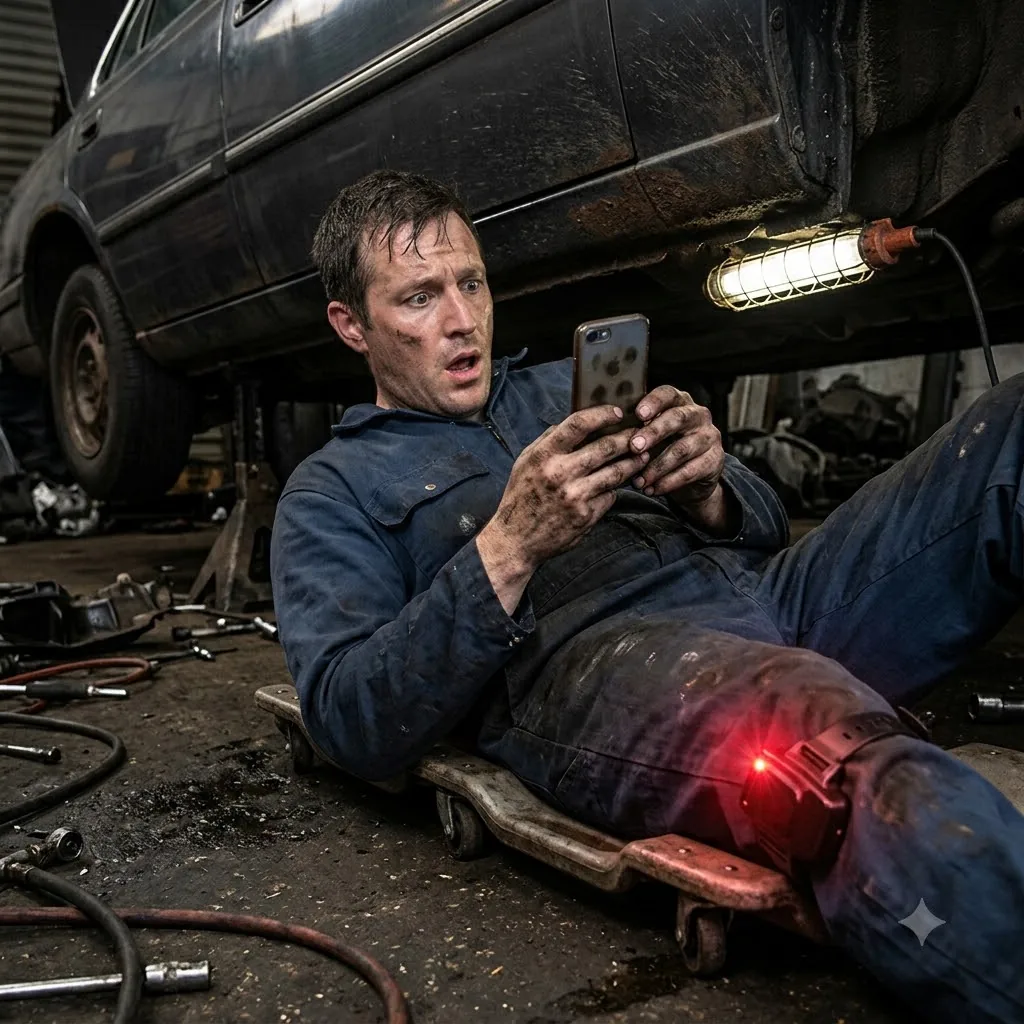
Marcus swallowed hard, his throat dry with atomized brake dust and sheer panic. He looked at Vance, then down at his grease-stained boots. The red light pulsed against his calf, a silent countdown. He had fifty-two minutes.
“Mr. Vance,” Marcus started, his voice tight. “I need an advance on Friday’s check. Just a partial. Three hundred and fifty dollars.”
Vance stopped tapping the clipboard. He stared at Marcus as if the mechanic had just spoken in tongues. “An advance? You’ve been here three months. Half the guys in this shop don’t even want their toolboxes unlocked when you’re on the floor, given your… history. And you want a loan?”
“It’s not a loan, it’s my wages. I just need them early. It’s an emergency.”
“Your emergencies are not my overhead,” Vance said, his face hardening into a scowl. “I took a chance on you because the state gave me a tax credit. That’s it. You want your money? You earn it on Friday like everyone else. Have the Ford off the lift by noon, or don’t bother punching back in after lunch.”
Vance turned and marched back toward the front office. Elias shot Marcus a sympathetic wince before walking back to his alignment rack.
Marcus stood completely alone in the echoing bay. Forty-nine minutes. He walked over to his workstation. His rolling tool cabinet sat against the cinderblock wall, painted a faded, chipped red. It was his only asset in the world. Mechanics owned their own tools. Without them, you couldn’t turn a single bolt. You were useless. Without tools, he had no job. Without a job, his parole officer would violate him by the end of the month anyway.
But if that light turned solid red, he wouldn’t make it to the end of the month. He wouldn’t make it to the end of the hour.
Marcus unlocked the top drawer. The smooth steel glided open on ball bearings. He reached past the rusted wrenches and grabbed his heavy-duty, half-inch pneumatic impact gun. He bought it used for two hundred. Next, he grabbed his digital torque wrench, still shining in its molded plastic case. That was another three hundred. He hesitated, his hands shaking, before pulling out his entire master set of metric impact sockets. They were heavy, solid molybdenum steel. His livelihood, packed into three armfuls of metal.
He carried the pile across the shop floor, dodging air hoses and rolling oil drains, until he reached Elias’s bay. Elias was calibrating a laser sensor on a suspended sedan.
“Elias,” Marcus said, dumping the tools onto a metal workbench with a heavy clatter. “I need cash. Right now.”
Elias lowered his hands, pushing his safety glasses up onto his forehead. He looked at the tools, then at Marcus’s pale, sweating face. In a garage, buying another man’s daily drivers was practically a taboo. It meant the man was quitting, dying, or drowning.
“I’m not pawning your gear, Marcus,” Elias said softly. “You need that torque wrench for the suspension job on the Chevy this afternoon.”
“I won’t be here this afternoon if I don’t get three hundred and forty-two dollars,” Marcus pleaded, his voice cracking. He kept his right leg angled sharply away, hiding the violent red pulse beneath his denim. “Please. Three hundred flat for all of it. The torque wrench alone is worth that.”
Elias rubbed the back of his neck, leaving a streak of oil on his skin. He looked toward the front office, then back to the tools. “I don’t have three hundred on me, kid.”
“What do you have?”
Elias sighed, walking over to his own locker. He spun a combination dial, opened the metal door, and pulled a worn leather wallet from his street jacket. He thumbed through the bills. “Two hundred and eighty. It’s my grocery money for the week.”
“Give it to me,” Marcus begged. “I’ll give you the tools, plus my diagnostic scanner. Tomorrow.”
Elias handed over the crumpled twenties and fifties. “Keep the scanner. Just take it.”
Marcus snatched the cash. “Thank you.”
He checked his phone. Thirty-one minutes left. He sprinted toward the employee bathroom at the back of the shop, slamming the thin wooden door shut and throwing the deadbolt. The fluorescent light flickered overhead, buzzing like an angry hornet. He dropped the toilet seat and sat down, his hands trembling so violently he nearly dropped the phone.
He had two hundred and eighty dollars in physical cash. He reached into his own pocket and pulled out his remaining crumpled bills. A ten, two fives, and four ones. Three hundred and four dollars. It was enough to cover the daily fee, the overdraft penalty, and the manual override charge Todd had quoted him.
He opened the web browser on his phone, navigating to the private monitoring company’s digital payment portal. The screen loaded slowly, struggling on the shop’s weak Wi-Fi signal. A sterile, blue-and-white page demanded his parole ID and PIN. He typed them in, leaving fresh grease smudges across the cracked glass.
The portal displayed his account status in glaring red letters: *NON-COMPLIANT. IMMEDIATE PAYMENT REQUIRED.*
Marcus tapped the ‘Make Payment’ button. He pulled his prepaid debit card from his wallet. His plan was simple: he would run across the street to the convenience store, hand the clerk his three hundred dollars in cash to load onto the prepaid card, and then use the card to pay the portal. It would take ten minutes, tops.
He opened his prepaid card app to verify the routing status before running across the street. The app spun for a moment before displaying a harsh yellow warning banner: *ACCOUNT FROZEN. NEGATIVE BALANCE LIMIT EXCEEDED.*
Because the monitoring company had attempted to pull the daily fee at midnight, the account had overdrafted. When it overdrafted past the allowed limit, the bank locked the card. A frozen card could not accept cash reloads at a register. It could only be unlocked by calling customer service, a process that usually took three business days.
Marcus stopped breathing. He toggled back to the monitoring company’s payment portal, reading the fine print at the bottom of the screen.
*We do not accept cash, money orders, or prepaid cards in arrears. Payment must be rendered via major credit card or direct bank ACH transfer.*
He stared down at the fistful of twenty-dollar bills in his lap. He had the money. He had sacrificed his tools, his job, and his pride to get it. But it was just paper. The system demanded digital data, and he was completely locked out of the digital economy. He had no major credit card. He had no bank account. He was a ghost holding worthless paper.
Fourteen minutes left.
Against his right calf, the heavy black box vibrated again. The red light shifted from a steady pulse to a rapid, strobe-like flicker, illuminating the dirty bathroom tile in frantic flashes of crimson.