Story code: ST-001050
Part 3: The Safe Demographic
The morning sun glared off the floor-to-ceiling glass of the New Horizon Recovery Center, highlighting the pristine, sterile architecture. Elias observed the ribbon-cutting ceremony from the edge of the VIP parking lot. He automatically calculated the overhead. The cost of the catered breakfast buffet, the imported floral arrangements, and the rented staging equipment alone could have funded his entire gray-market naloxone supply chain for an entire fiscal year.
Mayor Vance stood at the podium, his heavy wool overcoat replaced by a sharp, tailored navy suit. He projected perfect municipal vitality, beaming for the local news cameras. Beside him, the corporate representative held a pair of oversized ceremonial scissors, his smile practiced and hollow. The crowd of local politicians, investors, and journalists clapped politely as Vance began outlining the center’s projected ninety-eight percent retention rate.
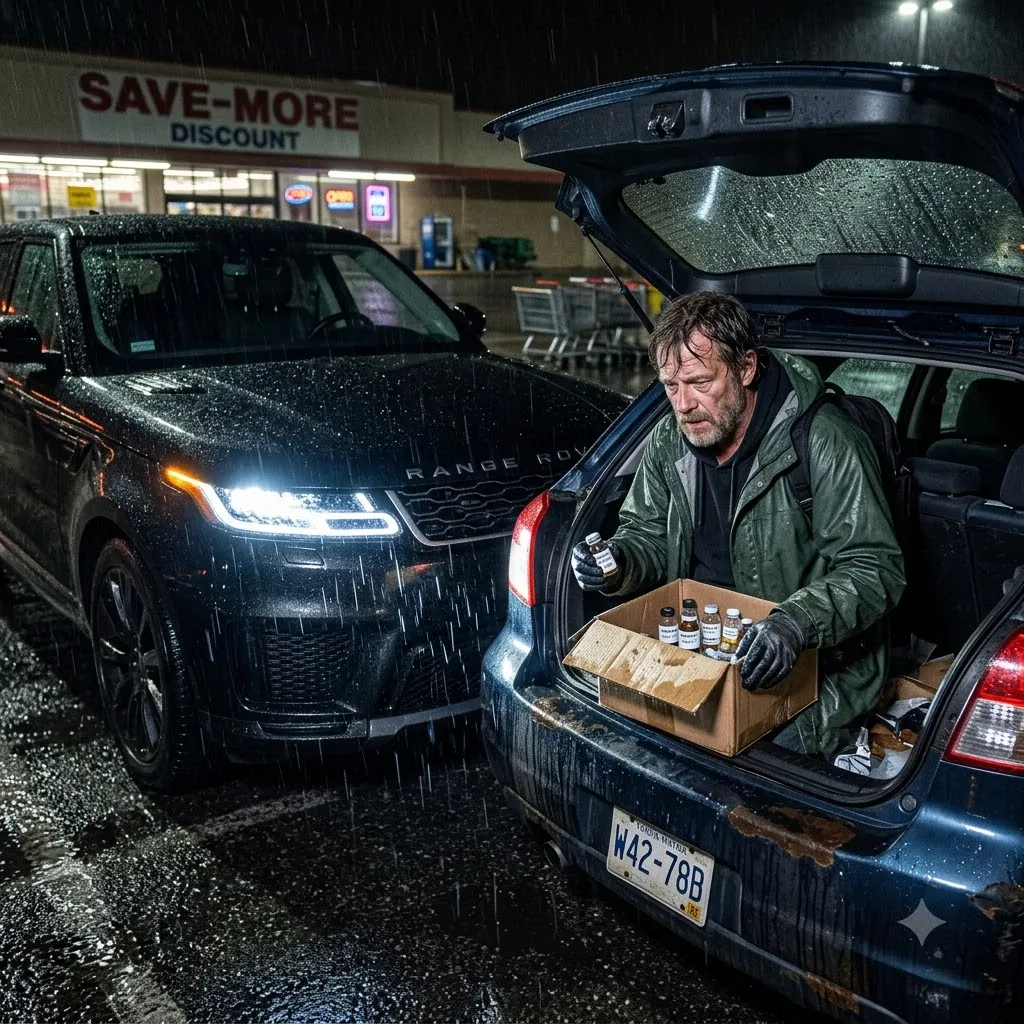
Elias adjusted his grip on the thick, moisture-warped manila folder in his hand. The railyard incident the night before had cost him his last twenty-eight vials and over an hour of aggressive, exhausting chest compressions, but he had extracted something far more dangerous than his depleted inventory. While the private security contractors were distracted by the flashing lights of a rogue fire engine Toby had managed to dispatch to the perimeter, Elias had breached one of the idling white transport vans. He hadn’t bothered fighting the guards. He had simply accessed the unsecured dashboard tablet and cloned their operational database.
He had the raw data. He had the algorithm’s actual source logic.
Elias moved through the crowd. He bypassed the private security perimeter by walking with the deliberate, unquestionable momentum of an executive late for a board meeting-a behavioral exploit he had mastered during his decade in corporate logistics. He didn’t look at the guards, didn’t break stride, and stepped right over the velvet rope just as the mayor praised the facility’s revolutionary data-driven approach.
Elias walked directly up the portable aluminum steps onto the staging platform. He did not shout. He did not wave his arms. He simply walked to the podium and placed the open folder directly over Vance’s meticulously printed speech notes.
“Your retention rate is ninety-eight percent because your intake algorithm auto-discharges anyone with a projected mortality risk above fifteen percent,” Elias stated. He spoke directly into the microphone, his modulated cadence clipping the audio feed with a sharp screech of feedback.
The corporate representative lunged forward, his smile snapping into a rigid scowl. He signaled frantically to the security contractors positioned near the caterers. “Cut the mic! Get him off the stage immediately!”
Elias kept his hand firmly on the folder, bracing his weight against the podium to anchor himself. He looked only at the mayor. Vance’s face had instantly drained of color, his eyes locked on the dense, highlighted spreadsheets Elias had printed from the van’s terminals.
“This is the export ledger,” Elias said, tapping the top page. He ignored the heavy footsteps of security boots rushing the platform. “Seventy-three names. Patients who came to this exact facility seeking help over the last month. They were processed by your proprietary intake algorithm, mathematically classified as statistical liabilities, and quietly driven across county lines in the middle of the night to preserve your baseline data.”
Vance blinked, his jaw tightening. “Elias, this is a private press event. You are trespassing.”
“You offloaded them,” Elias continued, his tone as flat and relentless as a quarterly audit. “But the algorithm didn’t just dump them. It scheduled the transports to coincide with high-traffic hours in neighboring districts, minimizing the chance of local emergency response. It optimized their deaths for maximum geographic distance.”
Two heavy-set security guards grabbed Elias’s shoulders, their fingers digging fiercely into his jacket. Elias didn’t fight them. He simply leaned closer to the microphone and raised his voice, reading the highlighted lines from the manifest while the guards tried to pull him backward.
“Marcus Thorne. Discharged Tuesday. Found dead in the regional transit hub. Sarah Jenkins. Discharged Thursday. Dumped at the Route 9 overpass, coded as a voluntary walk-out. David-”
“Remove him!” the corporate representative barked, dropping the ceremonial scissors onto the stage with a loud metallic clatter.
Elias dug his boots into the stage carpeting, holding his ground just long enough. “You let a predictive model dictate human triage because it guaranteed your next round of federal funding. It is a closed-loop system designed exclusively to erase the dying.”
Vance stared at the names on the paper. His hands began to tremble. It was not the subtle, controlled shake of public speaking adrenaline. It was a violent, systemic tremor that rattled his expensive cuffs. The corporate representative stepped in, trying to physically rip the folder off the podium, but Vance suddenly slammed his palm down on the papers, pinning them to the wood.
“Mayor?” the representative asked, his sterile cadence slipping into genuine alarm.
Vance didn’t look at his handler. He looked at Elias, his chest heaving under the navy suit. The polished, authoritative presence he had weaponized against Elias in the Dollar General parking lot was entirely gone, replaced by something deeply fractured and raw.
“It said the margin of error was negligible,” Vance whispered. The microphone picked up the ragged, wet edge of his voice, broadcasting it over the stunned, silent courtyard.
“It’s a machine learning model, Mayor,” Elias said, his voice dropping to a steady, clinical baseline. “It doesn’t calculate acceptable loss. It enforces it.”
“No,” Vance gasped, his knuckles turning white as he gripped the edges of the podium. He wasn’t looking at Elias anymore; he was staring straight through the glass doors of the new facility, seeing something else entirely. “The software… the beta program in the city. The private clinic. They told me the algorithm was flawless. They told me it mapped the exact matrix of neuro-chemical recovery.”
The corporate representative grabbed Vance’s arm, his fingers digging into the mayor’s bicep. “Arthur, stop talking. Now. We are cutting the feed.”
Vance shook off the handler with a violent, desperate jerk. His eyes were wide and unblinking, tracking invisible data points in the air. “They ran her profile. They ran my daughter’s intake profile through the exact same goddamn predictive engine. It promised a ninety-five percent recovery probability.” A tear tracked through the heavy stage makeup on Vance’s cheek, catching the glare of the morning sun. “It promised me she was in the safe demographic.”
Elias analyzed the mayor’s sudden systemic collapse. The fragmented data clicked into place perfectly. Vance hadn’t bought into the rehab center’s ruthless operational model out of pure municipal greed; he had bought into it because he was desperately trying to validate the exact system that had processed his own child. If the algorithm worked here, it meant his daughter’s death was an unavoidable anomaly, not a systemic failure.
“If she was in the safe demographic,” Elias said quietly, leaning past the struggling security guards, “why isn’t she standing here with you?”
Vance shattered. A strangled, guttural sound ripped from his throat, a sound completely stripped of political optics or corporate poise. He gripped the edges of the podium so hard the wood groaned, his knuckles entirely bloodless.
“Because it reclassified her!” Vance screamed, his voice tearing through the speakers, echoing violently off the clinic’s pristine glass facade. “Two weeks in, she missed one benchmark. One! And the system flagged her as an operational liability. They discharged her in the middle of the night to protect their metrics! The algorithm said she was a toxic asset!”
Vance stood trembling, sobbing over the open ledger of the dead, as the flashbulbs of the local press erupted into a blinding, silent wave.