Story code: ST-001078
Part 4: The Glass
David pinched the edge of the heavy azure paper, pulling with a desperate, sudden strength. It didn’t yield a millimeter. Marcus held the other side from within the control room with the unyielding, mechanical grip of a man who had guided molten iron for forty years. David’s sweat-slicked fingers slipped off the thick stock. The brass mail slot snapped shut with a hollow, metallic clack, taking the signed confession back into the shadows of the booth.
David scrambled backward, his knees scraping painfully against the rusted iron grating. His bespoke trousers were stained black with decades of industrial grease. He hauled himself up using the handrail, stumbling sideways away from the heavy steel door until he stood directly in front of the large, grime-streaked window of the control booth.
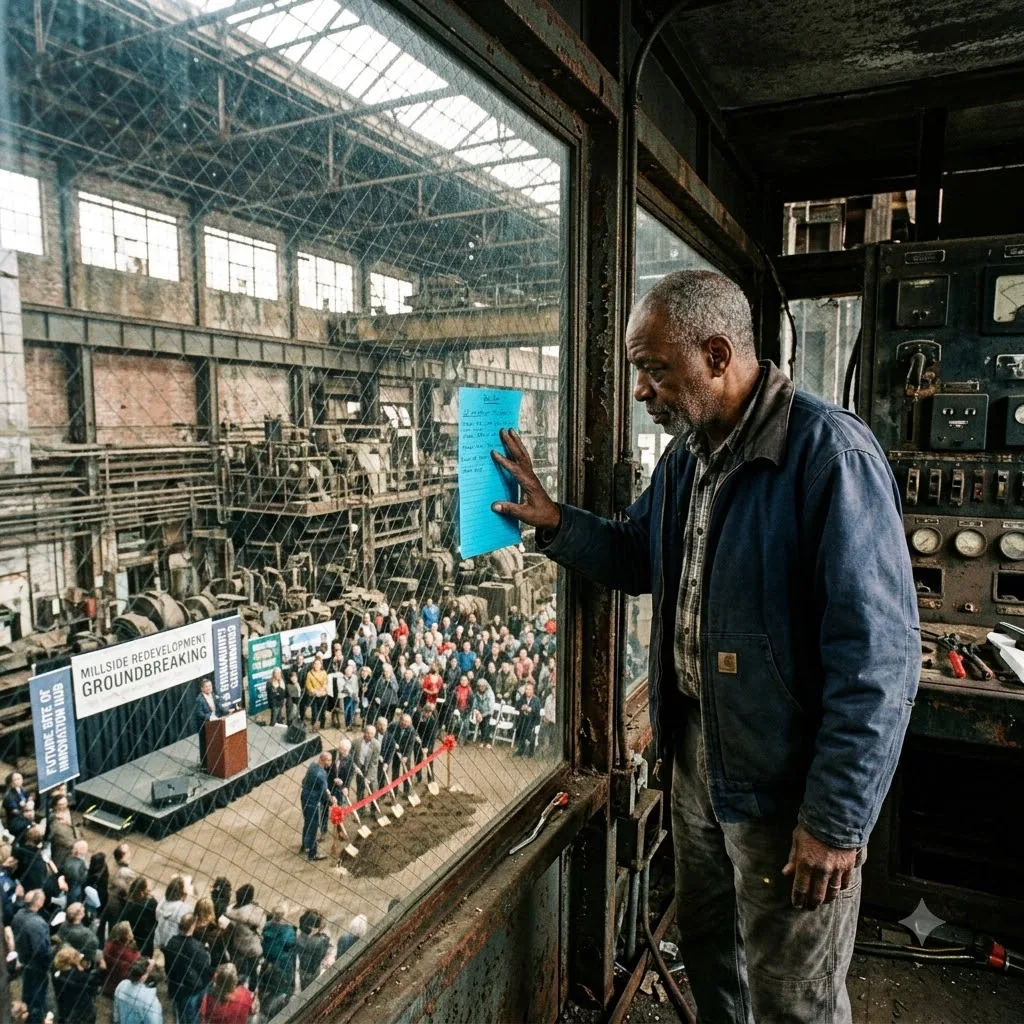
Inside, Marcus stood in the dim, dust-motes-filled light. The old man wasn’t looking at the door anymore. He was looking down at the stage below, taking a slow, deliberate step back toward the ventilation slit. The blue paper was rolled tightly in his grease-stained hand once again.
David pressed his face near the glass and looked down. The pristine white stage was entirely abandoned, save for his discarded microphone resting near a decorative fern. The press pool had completely breached the designated seating area, clustering directly beneath the control room like a pack of starved wolves. A sea of upturned lenses and flashing strobes aimed directly at the ventilation slit. Vance and the security team were shouting, trying to form a perimeter, but they were hopelessly outnumbered. Worse, David saw the wealthy investors and city council members hastily retreating down the central aisle toward the exits, their expressions hardening from mild confusion into deep, litigious self-preservation. They smelled the toxicity in the air. They were cutting their losses.
“Marcus!” David slammed his open palms against the thick safety glass. The sound was a dull, impotent thud that barely penetrated the booth. “Don’t do it! I’ll double the fund! I’ll give you the whole company!”
Inside the booth, Marcus didn’t even turn his head. His weathered face was a mask of absolute, terrifying peace. He didn’t look like a dying, desperate man anymore; he looked like a judge who had already written the verdict. He extended his arm, aiming the blue cylinder directly over the narrow gap at the bottom of the window frame.
David’s carefully crafted public narrative-the heartwarming story of the visionary honoring the working-class spirit, the tribute to his grandfather’s legacy, the luxurious, profitable future of Oakhaven-evaporated into the stagnant, humid air of the mill. Three years of meticulous planning, aggressive bribery, and ruthless offshore accounting were being effortlessly dismantled by a single, sick man in a faded denim coat.
A visceral, ugly rage boiled up from the pit of David’s stomach, entirely eclipsing his panic. It wasn’t just the fear of prison anymore; it was the sheer, burning humiliation of being publicly bested by someone so far beneath his tax bracket. He was David Thorne. He bought mayors. He reshaped skylines. He did not lose to men who punched timecards.
“Look at me!” David screamed, the veins bulging against the tight collar of his dress shirt. He balled his right hand into a tight fist. He forgot about the high-resolution cameras tracking his every movement. He forgot about the retreating politicians. He drew his arm back and drove his knuckles squarely into the center of the reinforced safety glass.
The glass didn’t shatter, but a sharp, jagged spiderweb of white lines exploded outward from the point of impact. Pain flared up David’s arm, white-hot and blinding, as the skin over his knuckles split open against the industrial pane.
He didn’t stop. He hit the glass again, leaving a thick smear of bright crimson blood across the spiderweb fracture. “I made this city!” he roared, his voice tearing his vocal cords, blood and spittle flying from his lips to dot the window. “You are nothing! You are a dead man!”
Below, the cacophony of mechanical shutters intensified into a deafening roar. Telephoto lenses zoomed in, capturing every microscopic detail of his unraveling. They captured the celebrated, visionary developer, his designer suit torn and covered in rust, his face contorted in a mask of feral, unhinged fury, violently pounding on a glass cage like a rabid animal.
Inside that cage, Marcus stood entirely motionless. The old steelworker slowly turned his head to look at the bleeding, screaming man on the landing. Marcus didn’t smile. He didn’t gloat. He simply watched David destroy himself with mild, detached pity.
Then, without breaking eye contact with David, Marcus opened his fingers.
Through the fractured, bloody glass, David watched the blue cylinder slip through the ventilation slit. He didn’t look down to watch it fall. He heard the collective gasp of the press corps, followed instantly by the frantic, violent rustle of a dozen journalists diving over each other to claim the heavy azure paper.
David stood frozen on the rusted landing, his chest heaving, his breath wheezing through his clenched teeth. The sharp pain in his shattered hand throbbed in time with his racing heart. Blood dripped slowly from his knuckles, pooling on the corroded iron grate beneath his ruined leather shoes. The camera flashes strobed mercilessly against the dirty glass, illuminating David’s reflection in the spiderwebbed pane, permanently capturing the monster he had spent his entire life trying to hide.