Story code: ST-001079
Part 2: The Price of Admission
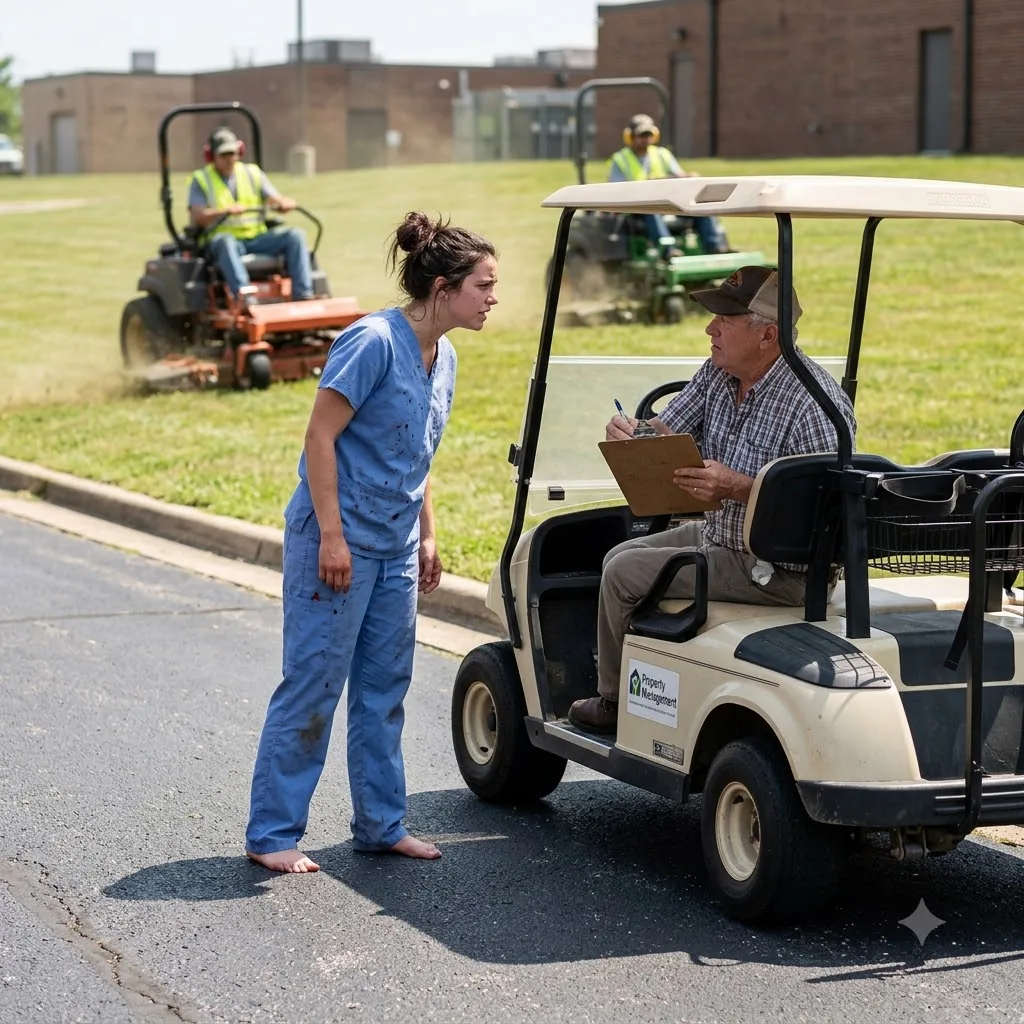
The asphalt burned the soles of Maya’s feet, the sharp granules of gravel biting into her skin with every step. She barely felt it. The adrenaline spike had temporarily overridden her exhaustion, but it left a sickening, hollow tremor in her hands. Behind her, the commercial mowers hit a patch of dry dirt, sending a cloud of pulverized topsoil drifting across her front porch.
She crossed the centerline of the quiet suburban street. Arthur Pendelton didn’t move. He stood at the apex of his freshly pressure-washed driveway, his hands resting lightly on his hips, watching her approach like a judge observing a disruptive defendant.
“Mr. Pendelton,” Maya said, her voice raspy from disuse and severe sleep deprivation. She stopped at the edge of his property line, instinctively aware that stepping onto his concrete would somehow put her at a tactical disadvantage. The bright morning sun stabbed at her retinas, her temples throbbing in time with her elevated heart rate.
“Good morning, Maya,” Arthur said. His voice was smooth, carrying effortlessly over the mechanical roar behind her. “Though I suppose it’s the middle of the night for you. A shame about the noise. Spring maintenance waits for no one, unfortunately.”
Maya pulled the crumpled yellow carbon copy from her pocket and held it up, her hand shaking with a mixture of fury and fatigue. “Eighty dollars for mailbox fade?”
Arthur gave a small, sympathetic sigh that didn’t reach his cold, assessing eyes. “The covenants, conditions, and restrictions are very clear. Section four, paragraph nine. All receptacles must maintain a uniform factory-finish appearance. We have property values to maintain. I noticed the discoloration during my morning walk.”
“It’s black metal,” Maya said, her chest tightening. “It’s facing the sun. It’s barely dull. And you taped this to my door and then sent a landscaping crew to run heavy machinery against my bedroom window for twenty minutes. They’re cutting the same patch of grass over and over.”
“They are aerating the easement,” Arthur corrected, adjusting his sunglasses. “It’s scheduled common-area maintenance.”
“On a Tuesday morning? Directly outside my window? You know I work the night shift in the ER.”
“The landscaping crew sets their own routes,” Arthur said smoothly, offering a practiced, diplomatic smile. “But if you are finding the neighborhood standards too rigorous, perhaps Oak Creek isn’t the right fit for your… lifestyle.”
Maya stared at him, the implications clicking into place through the thick fog in her brain. It wasn’t about the mailbox at all. It was about the fact that she parked her ten-year-old Honda Civic in the driveway at 8:00 AM instead of hiding it in the garage. It was about her wrinkled scrubs, her chaotic hours, her failure to conform to the retired, manicured rhythm of the street. She had emptied her savings, taken a penalty-heavy loan against her meager retirement fund, and worked double shifts for a year to scrape together the down payment for this house. She had exactly two hundred and fourteen dollars in her checking account to last her until Friday.
“I don’t have eighty dollars for a faded mailbox,” Maya said, trying to keep the raw desperation out of her voice. “I just moved in. The closing costs wiped me out.”
Arthur reached into the back pocket of his khaki shorts and produced a small, leather-bound notepad. He clicked a silver pen. “I’m afraid the fine isn’t the primary issue, Maya. The HOA requires the physical violation to be corrected within twenty-four hours. You’ll need to replace the mailbox entirely.”
“Replace it? I can just buy a can of spray paint.”
“Modifications and DIY repairs are strictly prohibited,” Arthur said, scribbling on the pad without looking up. “You must use the community’s approved vendor, Heritage Ironworks. They can install a compliant model by tomorrow afternoon. I believe their base rate is four hundred and fifty dollars.”
Maya’s stomach plummeted, the phantom nausea of her shift returning. “Four hundred and fifty? I can’t afford that. And if I don’t?”
“Then the eighty-dollar fine compounds daily,” Arthur said, tearing a fresh slip of paper from his pad. “After thirty days, the association places a lien on the property to recover the debt. It’s all in the binder you signed at closing.” He stepped forward and held out the new piece of paper. “Which brings me to this.”
Maya didn’t reach for it. Her arms felt too heavy to lift. “What is that?”
“Section two, paragraph C,” Arthur said, his polite smile finally widening into a genuine smirk. “Appropriate attire in public view. Sleepwear is not permitted outside the physical boundaries of the home. That will be an additional fifty dollars.”
The roar of the mowers suddenly cut out. The silence that rushed in to fill the void was deafening, leaving a high-pitched ringing in Maya’s ears. Across the street, the two men in neon vests were leaning against their machines, unscrewing the caps from their water bottles, watching the exchange with blatant amusement. Two houses down, Mrs. Gable, a woman who had warmly welcomed Maya with a plate of snickerdoodles on move-in day, abruptly turned her back and hurried inside, pulling her front blinds shut with a sharp snap.
Isolation washed over Maya, cold, heavy, and absolute. No one was going to help her. They were either terrified of Arthur, or they agreed with him. She was an outsider who didn’t belong, and he was methodically pricing her out of her own home.
“You’re harassing me,” Maya said, her voice shaking with a mix of exhaustion and rising panic. “I save lives for twelve hours a night. I need to sleep.”
“We all have jobs, Maya,” Arthur said, dropping the new fine at her feet. It fluttered onto the hot asphalt. “Oak Creek is a community of high standards. If you refuse to meet them, the community will simply expel you.”
He turned his back and walked up toward his pristine, silent house, the heavy front door clicking shut behind him with finality.
Maya stood alone on the hot street, staring at the white slip of paper near her toes. Her head pounded in brutal rhythm with her erratic heartbeat. If she paid the fines, she couldn’t buy groceries or gas for her commute for the rest of the month. If she bought the mailbox, she would overdraft her account and immediately default on her very first mortgage payment. If she did nothing, the fines would swallow the equity she had bled for, and she would lose the house anyway.
Behind her, the mowers fired back up with a violent, concussive boom. Maya flinched, spinning around to see one of the landscapers deliberately nudging the heavy front bumper of his zero-turn mower against the wooden post of her mailbox. The metal box rattled loudly, the post groaning as it tilted five degrees to the left.
The landscaper caught her eye, gave an exaggerated, mocking half-shrug, and revved the engine, backing away to leave the newly crooked post in his wake.
Maya picked up the second fine. Her fingers were trembling so hard she almost dropped it again. She had to be back on the ER floor in nine hours. She desperately needed to close her eyes. But as she looked at the tilted mailbox and the yellow citation still clutched in her other hand, she realized sleep was no longer an option. She walked back across the burning street, ignoring the choking exhaust fumes, her exhausted mind shifting away from panic and locking onto a cold, desperate need to find a flaw in Arthur’s impenetrable rules before she lost everything.