Story code: ST-001087
Part 4: The First Dollar
The silence in the gutted dry cleaner stretched, heavy and suffocating under the harsh glare of the single halogen work light. Julian stared at Mateo’s tape-bound ledger, the numbers on the yellow legal pad glowing with an undeniable, terminal finality. The frantic, neighborly warmth that had defined Julian’s entire persona was completely gone. His face had drained of all color, leaving his skin a sickly, translucent white.
His hands began to tremble.
Julian turned away from the plywood desk, staggering toward a cluster of partially unpacked shipping crates in the back corner of the freezing room. These held the heart of his highly curated aesthetic. Even in the dim light, Mateo could see the gleam of expensive copper gooseneck kettles, precision burr grinders, and delicate, imported glass pour-over stations resting safely in custom foam inserts.
“It was supposed to be a seamless transition,” Julian muttered, his voice fracturing into a wet, breathless rasp. “A flow-through concept. The seed round… they promised a bridge loan if I secured the footprint…”
He reached into the crate and picked up a heavy, cast-iron espresso tamper.
Julian swung his arm wildly. The heavy iron collided with a row of hand-blown glass carafes set out on a folding table. The explosion of glass was deafening in the hollow, unfinished room.
Mateo didn’t flinch. He remained planted by the plywood desk, his expression flat.
Julian let out a wordless, ragged roar. He swung the tamper again, sweeping it across the tabletop. Copper kettles clanged violently against the poured concrete floor. A two-thousand-dollar commercial grinder toppled over, its plastic hopper cracking down the middle, sending a spray of premium, single-origin coffee beans skittering across the dust. Julian was weeping now, a pathetic, gasping sound of pure panic, systematically destroying the very assets he had bought on credit to impress his invisible investors.
Mateo picked up his battered ledger and tucked it under his arm. There was nothing left to say to a man drowning in a puddle of his own making. Without a backward glance, Mateo turned his back on the shattering glass and walked out into the freezing November night.
He stepped past the yellow caution tape and pushed open the heavy glass door of his bodega. The mechanical two-tone bell chimed, announcing his return to an empty room.
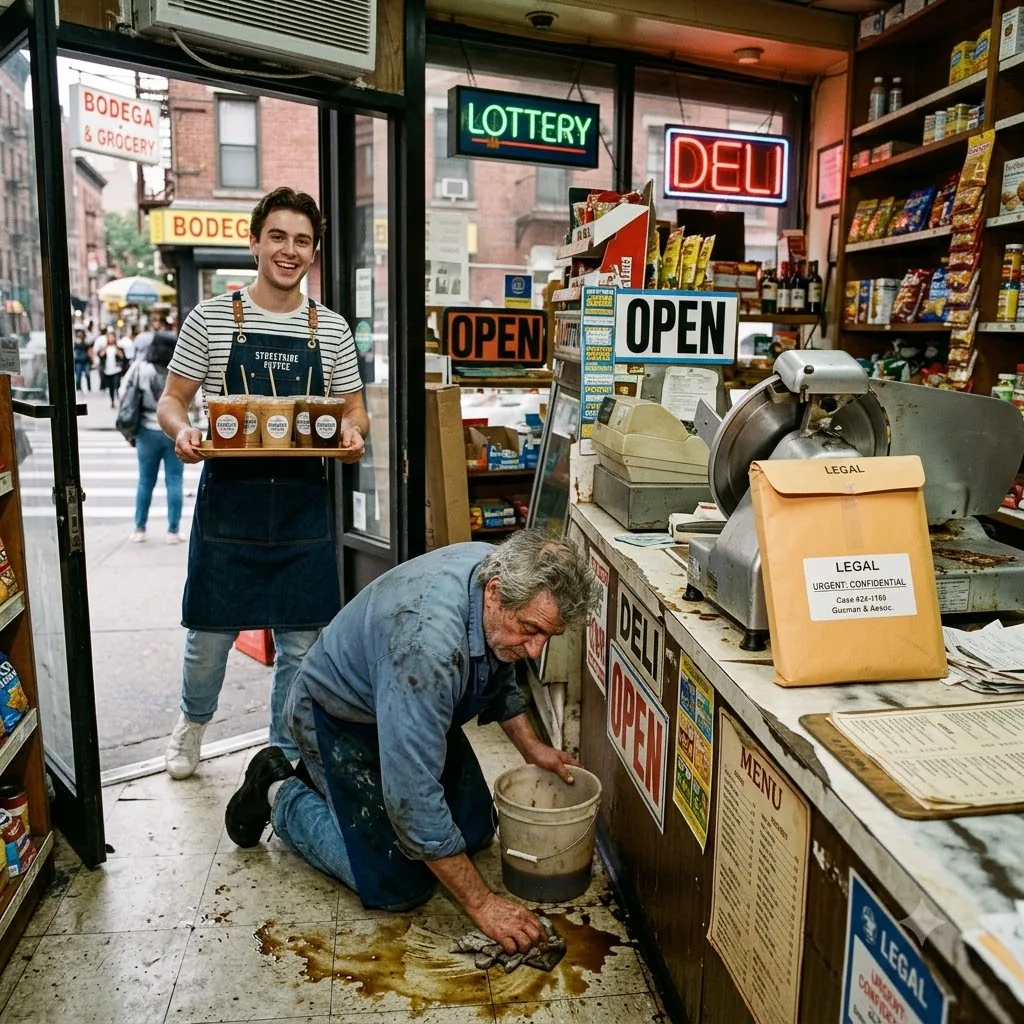
The contrast was absolute. The air inside was warm, heavy with the deeply ingrained, inescapable smells of industrial floor wax, stale Café Bustelo, and aging refrigeration coils. The ancient Frigidaire compressor rattled loudly, a rhythmic, metallic sound Mateo had slept through as a child when his grandfather used to make him take naps on bags of dry rice in the back room.
Mateo walked to the deli counter. The unassigned buyout contract and the twelve-thousand-dollar eviction notice still sat on the stainless steel tray of the Hobart slicer.
His lower back throbbed, a sharp, sudden reminder of the imitation maple syrup still hardening into an impossible glue on the linoleum in aisle four. He thought about grabbing the rusted putty knife. He thought about the beverage distributors he owed money to, the fourteen-hour shifts that swallowed his weekends, the constant, grinding anxiety that had defined his waking life since the day he took over the master lease.
Julian was finished. The venture capital money was choked off, the construction was permanently stalled, and the bank would inevitably foreclose on the entire building when Julian’s shell company defaulted in January. Apex Commercial Ventures was a dead entity walking. Mateo realized he could stay. He could fight the eviction in housing court, dragging it out for eight months while the building sank into receivership. He could win the war of attrition.
He looked around the cramped, dim aisles. He looked at the yellowing, sun-faded lottery signs in the window, the scuffed linoleum, the sagging shelves holding cans of beans that yielded pennies in profit.
He didn’t want to win.
For three generations, this store had been his family’s anchor. Now, looking at it through the lens of Julian’s shattered ambitions next door, Mateo finally saw the bodega for what it truly was. It wasn’t an anchor; it was a cage. It was a generational burden disguised as a sacred legacy. He had been slowly killing himself to protect a tomb.
Mateo walked past the Hobart slicer, leaving the eviction notice and the buyout offer untouched on the metal tray. He moved to the front register. Pinned to the wall just above the cash drawer, protected inside a cheap, cracked plastic frame, was a single, grease-stained dollar bill. It was the first dollar his grandfather had ever taken across the counter in nineteen eighty-two.
Mateo pulled the frame off the wall. He popped the plastic backing open, letting the frame clatter to the counter. He took the fragile, worn bill out, folded it carefully in half, and slipped it into his wallet.
He walked to the main electrical panel by the front door and threw the master breaker.
The rattling Frigidaire compressor shuddered and died. The neon sign in the window went dark. The faint hum of the fluorescent overhead lights vanished, plunging the store into a deep, sudden, and absolute silence.
Mateo stepped out onto the sidewalk and pulled the heavy glass door shut. He slid his key into the deadbolt and turned it until it clicked. The two-tone bell chimed its final, muted note against the glass. He didn’t look back at the dark windows of his family’s bodega, nor did he look at the gutted dry cleaner next door, where the muffled sounds of Julian’s breakdown had finally ceased. Mateo zipped his jacket up against the November chill, turned his collar to the wind, and walked away down the block, stepping into the evening entirely free.