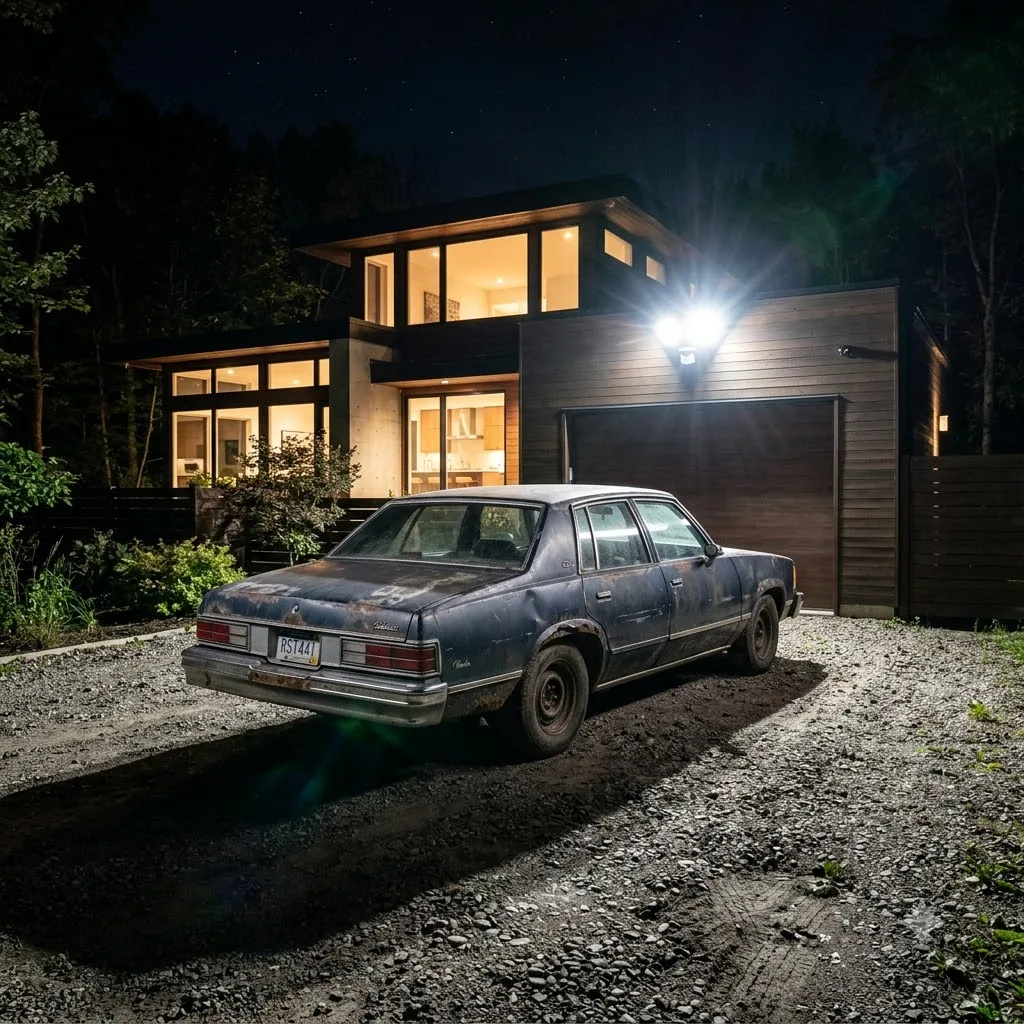
Story code: ST-001096
Part 2: Ghosts in the Glare
Mateo’s fingers trembled so violently he fumbled the ignition twice before the engine finally died. The sudden absence of the Civic’s rattling idle left a vacuum that was instantly filled by the harsh, whistling wind and his own ragged breathing. He raised both hands, pressing his palms flat against the top of the steering wheel.
“Keys out the window. Slowly.” The voice was devoid of panic. It was the calm, measured tone of someone entirely comfortable holding a firearm.
“My window is rolled up,” Mateo said, his voice cracking into a pathetic, reedy squeak. “I have to move my hand to roll it down.”
“Two inches. Left hand only. Keep the right on the wheel.”
Mateo lowered his left hand to the door panel. His finger found the switch. He pressed it, and the glass whirred down with a painful, agonizing screech. The freezing night air instantly invaded the cabin, carrying the scent of pine needles and damp earth, violently overpowering the stale smell of the fast food.
“That’s enough. Drop them.”
Mateo plucked the keys from the ignition, careful not to make any sudden jerks, and pushed them through the two-inch gap. They hit the decorative gravel with a dull clink.
“I’m a delivery driver,” Mateo said, the words tumbling out of him in a desperate, breathless rush. “My app froze. The GPS died. I just pulled over to restart my phone. The food is right here. You can see the bag.”
“Shut up,” the man snapped. “Don’t reach for anything.”
The silhouette shifted, heavy boots crunching closer. The long barrel of the rifle caught a gleam of the floodlights, a stark, terrifying line of matte black metal pointed directly through the windshield at Mateo’s chest.
“You think I’m an idiot?” the voice demanded, hovering just outside the driver’s side door, staying cautiously behind the A-pillar so Mateo still couldn’t see a face. “You’ve been sitting at the end of my driveway for three minutes with your lights off.”
“My headlights were on!”
“Don’t lie to me. I’ve been watching you on the cameras. You parked, cut the lights, and just sat there. Watching the house.”
Mateo’s mind raced. His headlights. The old Civic had a wiring short he hadn’t been able to afford to fix; sometimes the headlights flickered out entirely when he shifted into park. He had been so focused on the frozen phone screen he hadn’t even noticed the beams dying. To this guy, it looked like he was intentionally going stealth in the dead of night.
“It’s a short,” Mateo pleaded, his right hand gripping the wheel so hard his knuckles ached. “My car is a piece of junk. Please. I just want to leave.”
“You’re not going anywhere until the sheriff gets here. Keep your hands where they are.”
Mateo swallowed hard. He was trapped. If the sheriff came, how long would that take? How jumpy was this guy? One sneeze, one slip of the hand, and that rifle would go off. The sheer adrenaline pumping through his system made his legs shake, his knee bouncing against the steering column.
He turned his head slightly, squinting against the blinding glare of the floodlights, desperately looking for anything to focus on other than the barrel of the gun. As he looked toward the house, the bank of motion sensors on the far right side of the property finally timed out.
A third of the driveway plunged back into darkness, and the resulting shift in contrast allowed Mateo’s eyes to finally adjust to the structure behind the aggressive light.
He saw the porch first. It was a massive, wraparound structure made of dark stained timber. But it was the stonework at the base of the nearest column that caught his breath. Three massive, uneven river stones formed the foundation, stacked in a slightly jagged, precarious-looking arrangement that defied the clean architectural lines of the rest of the property.
Mateo’s heart skipped a beat.
He looked past the pillar to the front door. Solid oak, with a custom, semi-circular stained-glass window at the top depicting a rising sun over a green valley. He looked to the left, toward the edge of the lawn where an old, gnarled willow tree stood, its roots lifting the concrete of the walkway into a distinct, jagged crack shaped remarkably like a lightning bolt.
A cold, heavy dread settled in Mateo’s stomach, an emotion entirely different from the visceral terror of the gun.
He knew that crack. He had tripped over it and broken his collarbone when he was eight. He knew those three uneven river stones. He had helped his father haul them from the creek bed behind the subdivision when he was ten. He knew the stained glass window because his mother had spent three months designing it in the garage.
This wasn’t just some random mansion in a sprawling, anonymous cul-de-sac.
This was 4242 Willow Creek Drive.
He was parked in his own childhood driveway.
It was the house his parents had lost to the bank during the crash twelve years ago. The house that had shattered his family and sent them spiraling into the cramped apartments and endless debts that Mateo was still trying to deliver his way out of at one in the morning. He had driven in circles for so long, utterly lost in the cookie-cutter expansion of the neighborhood, that he hadn’t realized the frozen app had routed him right back to his own ghost story.
“Why are you looking at the house?” the gravelly voice barked, the barrel of the rifle tapping sharply against the driver’s side window glass. The sound made Mateo flinch violently. “Eyes forward!”
Mateo’s mouth was completely dry. The shock of the realization briefly overrode his self-preservation.
“The… the river stones,” Mateo whispered, unable to stop staring at the porch.
“What did you say?”
“The corner pillar. The stones. My dad pulled them from the creek.”
Silence stretched out, thick and incredibly dangerous. The wind seemed to die down, leaving only the sound of Mateo’s frantic heartbeat thudding in his ears.
Then, the man laughed. It was a harsh, humorless sound that sent a fresh spike of panic down Mateo’s spine.
“You’re really trying this?” The voice was no longer calm; it was laced with a venomous, volatile paranoia. “You think you can play games with me? You think I don’t know what you’re doing?”
“I’m not playing games,” Mateo said, finally turning to look at the silhouette. “I used to live here. My name is Mateo. My family built that porch.”
“Liar,” the man hissed, stepping fully into the edge of the light. He was an older man, wearing a thick wool jacket over a bathrobe, his pale face contorted with intense anger. He brought the stock of the rifle tight against his shoulder, the barrel now aiming squarely at Mateo’s head through the thin glass. “You think because you did your research on the property history, you can talk your way out of casing my house?”
Mateo’s blood ran ice cold. The truth sounded exactly like a rehearsed lie. The man didn’t see a confused delivery driver anymore; he saw an organized, well-informed criminal who knew too much about the property.
“Step out of the car,” the homeowner commanded, stepping back to give the door clearance, his finger tightening visibly on the trigger. “Slowly. And if you so much as twitch toward your waistband, I will drop you right here on the gravel.”