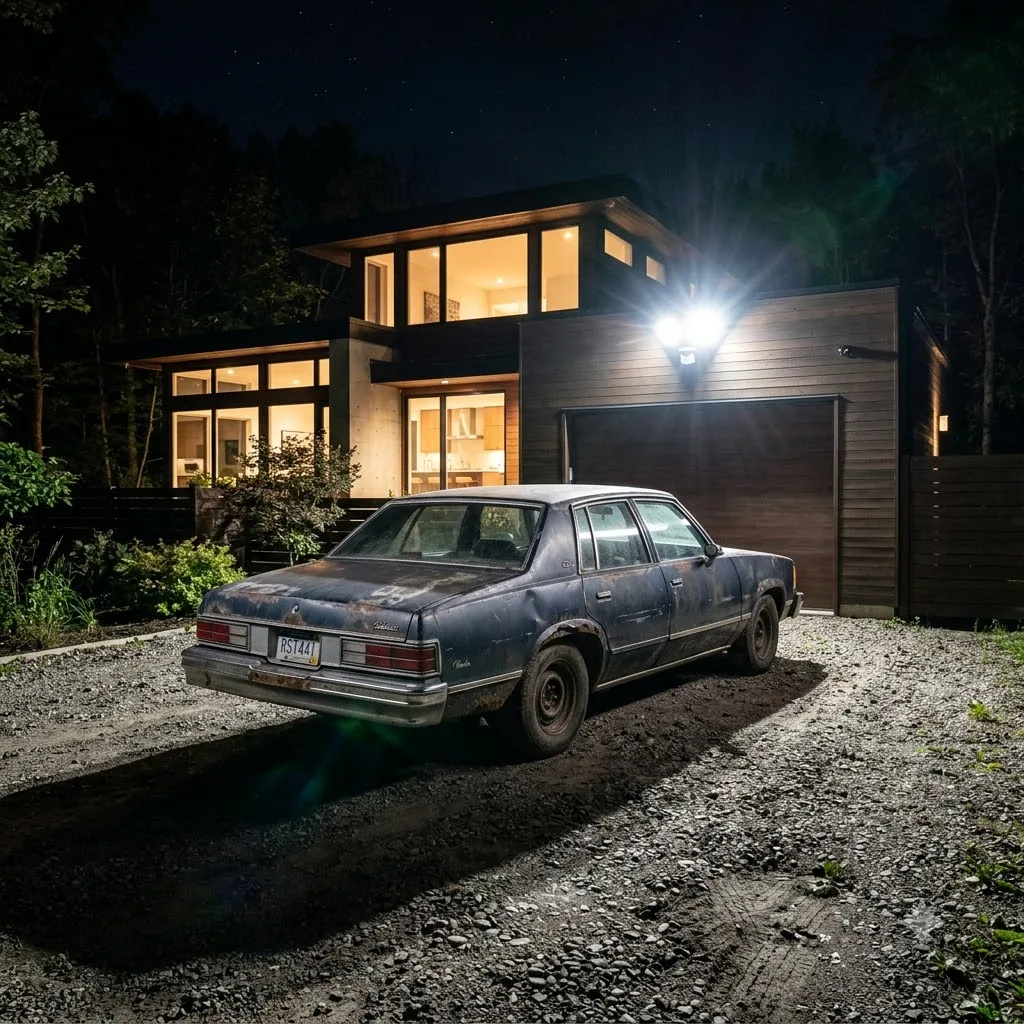
Story code: ST-001096
Part 3: The Foundation
Mateo pushed the driver’s side door open. The aging hinges let out a high, metallic shriek that made the man with the rifle take a sharp half-step backward, the long black barrel tracking Mateo’s chest with terrifying precision.
“Hands up. All the way up. Get out,” the homeowner ordered, his voice tight, the gravelly edge now betraying a thin wire of panic.
Mateo stepped out into the freezing night air, raising his hands until his shoulders ached. The decorative gravel crunched loudly beneath his worn sneakers. It felt wrong. The driveway used to be cracked, uneven asphalt, permanently stained with dark blooms of motor oil from his father’s endless weekend attempts to keep a dying Ford running. Now, it was a pristine sweep of expensive, imported stone.
Standing outside the car, Mateo could finally see the man holding him at gunpoint. He was in his late forties, wearing a high-end, moisture-wicking fleece jacket over flannel pajama pants. A heavy, tactical-looking smartwatch glowed with a faint green interface on his left wrist. The rifle he held wasn’t a dusty hunting gun; it was a pristine, matte-black modern sporting rifle heavily modified with expensive aftermarket optics and a blinding tactical flashlight mounted to the rail. He was a tech-transplant, one of the wealthy remote workers who had flooded the county during the pandemic, buying up the older properties with cash and outfitting them like suburban fortresses.
“Wallet. Out of your pocket with two fingers. Toss it on the ground,” the man commanded, keeping a solid ten feet of distance between them.
Mateo slowly reached into his back pocket, pinched his cheap faux-leather wallet, and tossed it onto the gravel.
The man didn’t take his eyes off Mateo. He crouched slightly, keeping the rifle shouldered, and kicked the wallet open with the toe of his expensive leather slipper. He shined the blinding weapon-light downward for a fraction of a second, just long enough to illuminate the plastic ID card.
“Mateo Reyes,” the man read aloud, straightening back up. He let out another short, breathless laugh. “You guys are getting sophisticated. I’ll give you that.”
“What?” Mateo asked, his arms trembling from the cold and the adrenaline. “It’s my real ID. I told you, I used to live here.”
“Don’t insult my intelligence,” the homeowner snapped, his grip tightening on the rifle stock. “Anyone can pull up the county tax records online. Anyone can see the foreclosure history and the names on the old deeds. You find out who lived here a decade ago, you print a fake ID with their name, and you use it as your alibi when you get caught casing the property. It’s textbook. You probably read about it on some dark web forum.”
Mateo stared at the man, the sheer absurdity of the accusation momentarily overriding the visceral terror of the gun. A mastermind criminal? A dark web forum? Mateo was running on three hours of sleep, living off lukewarm energy drinks, and stressing over a fifteen-dollar overdraft fee.
He looked past the man, his eyes tracing the massive, wraparound porch, the aggressive array of security cameras tucked under the eaves, and the motion sensors hardwired into the immaculate landscaping. The homeowner had spent a fortune turning this house into an impenetrable citadel. He was terrified of the world outside his property line.
And then it hit Mateo, a wave of profound, bitter irony that hollowed out the fear in his chest. This rich, paranoid transplant was willing to kill to protect this house, fiercely defending the very same walls that had already broken Mateo’s family. The homeowner was guarding Mateo’s own ghost.
“You think I memorized a county tax record?” Mateo asked, his voice suddenly steady, dropping the reedy, pleading tone he had used in the car.
“Shut up. Not another word until the sheriff arrives.”
“County records tell you who owned the land,” Mateo said, taking a deliberate half-step forward.
“I said freeze!” the man barked, raising the rifle to Mateo’s eye level.
Mateo didn’t move any closer, but he didn’t lower his hands. He pointed a single, trembling finger toward the dark stained timber of the porch. “County records don’t tell you that the foundation is uneven. Look at those river stones on the corner pillar. My dad dug those out of the creek, but he didn’t pour the footings deep enough. The winter of 2008 heaved the concrete. The whole porch pitches two degrees to the left.”
The man’s eyes flicked to the porch, then instantly back to Mateo.
“You probably have a wooden wedge jammed under your custom front door right now,” Mateo pressed, his voice rising, thick with a decade of buried grief and sudden indignation. “Because if you don’t prop it open, the tilt of the frame makes the door swing shut on its own. Did you read that on a dark web forum?”
The homeowner blinked. The rigid, aggressive set of his shoulders faltered for a fraction of a second. The front door did exactly that.
“And the oak tree,” Mateo said, gesturing wildly to the left, past the gnarled willow they had argued over earlier, pointing toward the massive, twisted oak sitting squarely on the property line. “The big one. Zillow probably called it a heritage oak. Do you know why the main trunk is twisted like that?”
“Stop talking,” the man said, but the venom was bleeding out of his voice, replaced by a sudden, frantic uncertainty.
“It’s twisted because there’s a heavy steel tow chain embedded in the bark,” Mateo said, the memories flooding back with crystal clarity. “My dad wrapped it around the trunk twenty years ago to pull his truck out of the mud. He forgot it there, and the tree swallowed it as it grew. You can’t see it from the street. You can’t find it in a deed. But if you walk over there and shine your fancy thousand-lumen tactical light right at the crook of the main branches, you will see the rusted steel links biting into the wood.”
The silence that followed was deafening, save for the low, constant whistle of the winter wind blowing through the cul-de-sac.
The homeowner stared at Mateo. The terrifying certainty of the armed man was gone, evaporating into the freezing air. Slowly, hesitantly, the man lowered the barrel of the rifle just a few inches. He turned his head, aiming the blinding beam of the weapon-light away from Mateo and sweeping it across the lawn, pinning the massive, twisted oak tree in a circle of stark white brilliance.
The beam dragged up the thick trunk, stopping dead at the main crook.
Even from ten feet away, Mateo could clearly see the jagged, orange rust of the heavy steel links bursting through the scarred bark.