Story code: ST-001134
Part 3: The Mechanics of a Bluff
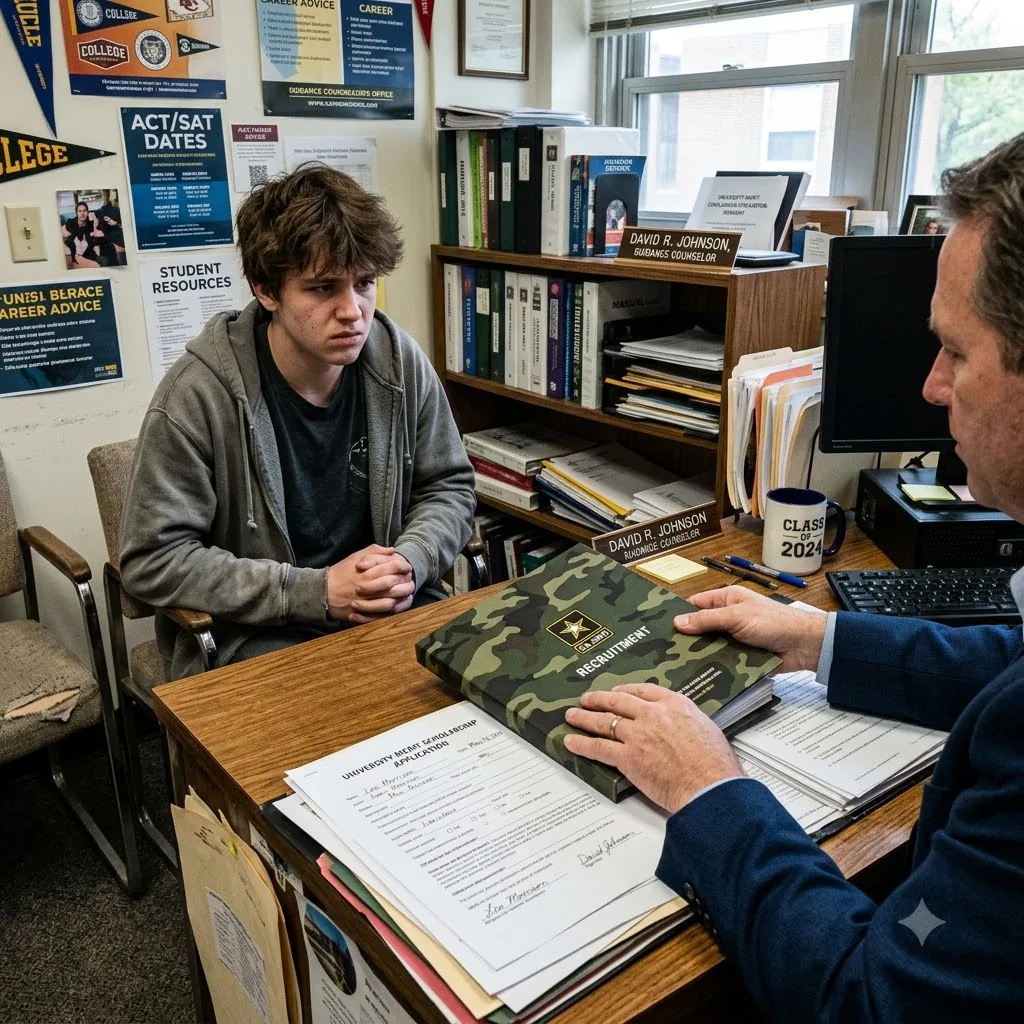
Mateo’s hand hovered over the yellow-highlighted signature line. The heavy metal pen felt slick against his sweating palms. Above him, Sergeant Hayes shifted his weight, his combat boots creaking against the thin carpet, an immovable wall of camouflage blocking the only door. Across the desk, Counselor Vance held the telephone receiver against his shoulder, a physical manifestation of the countdown.
*Twenty minutes.*
Mateo stared at the enlistment contract. His heart battered against his ribs in a frantic, erratic rhythm. *Save your mom. Be a hero.* The trap was perfectly constructed, a bureaucratic vise tightening from both sides. But as Mateo stared at the glossy paper, his panic began to hit a ceiling. It was the same cognitive shift he experienced in his garage when his pneumatic robotic arm suffered a catastrophic pressure failure. Panic didn’t fix a stuck valve. Panic didn’t rewrite a flawed schematic. When a system threatened to crush you, you didn’t close your eyes. You analyzed the mechanics of the machine.
Mateo stopped looking at the terrifying, bolded words at the top of the page-*DELAYED ENTRY PROGRAM, WAIVER OF DEMOGRAPHICS*-and looked at the tiny, densely packed text at the very bottom. The structural foundation of the contract.
His eyes scanned the microscopic print of the DD Form 4. Section VI. *Certification by School Official and Recruiting Officer.*
*I certify, under penalty of perjury, that the applicant’s academic standing has been reviewed, and no coercion, undue influence, or suppression of academic opportunities has been utilized in securing this contract.*
Mateo read it again. *Suppression of academic opportunities.*
He looked up from the desk. He didn’t look at Vance’s fleshy, expectant face, nor at Hayes’s imposing frame. He looked past Vance, to the large dry-erase board mounted on the wall beside the filing cabinets. Usually, Vance kept the pull-down map of the United States pulled over it. Today, perhaps in the rush of coordinating with Hayes, the map was rolled up, exposing the grid drawn in thick black marker.
The header read: *Q3 Alternative Pathways (DEP).*
Underneath was a tally system. It was divided by student demographics. One column was labeled *ESL/Pending*, heavily populated with hash marks. Another column tracked *Endorsements Withheld*. The final column read *Hayes Quota: 15. Actual: 14.*
A cold, diamond-hard clarity washed over Mateo. The vise wasn’t made of steel; it was made of smoke.
Vance had threatened to flag Mateo’s scholarship application for fraudulent demographic reporting. He claimed it would automatically route through the federal verification system, triggering an investigation into his mother’s pending residency status.
Mateo analyzed the inputs and outputs of that threat. If Vance initiated a federal flag, it wouldn’t just be an automated email. It would require a formal administrative audit from the Department of Education. Federal auditors didn’t just look at a single student’s file in a vacuum. To verify the flag, they had to audit the school’s compliance protocols. They had to audit the mandatory reporting official who triggered the investigation.
They would audit Mr. Vance.
They would pull the records of every student Vance had counseled. They would see the staggering statistical anomaly of minority, high-GPA students whose state university endorsements were inexplicably withheld. They would see the whiteboard. They would find the direct pipeline of extortion fueling Sergeant Hayes’s recruitment quota, a blatant violation of federal education funding laws and military recruiting directives.
Vance was sitting on a mountain of administrative fraud, and he was threatening to invite federal auditors into his own office.
It was a bluff. A structural impossibility. Triggering the federal verification system would be an act of mutually assured destruction, and Vance had infinitely more to lose than a single undocumented laundry worker.
Mateo’s grip on the metal pen loosened. He set it down on the desk. It landed with a soft click, breaking the oppressive silence of the room.
“No,” Mateo said.
Vance’s thick fingers tightened around the telephone receiver. “I don’t think you understand the timeline here, Mateo. The clock is ticking.”
“I understand the timeline,” Mateo said, his voice dropping the frantic edge it had carried minutes before. He sat back in the undersized plastic chair, squaring his shoulders. “I also understand how a federal academic compliance audit works. I spent two months researching Department of Education grant requirements for my scholarship application.”
Hayes frowned, stepping slightly away from the door. “Kid, don’t try to play lawyer. Just sign the paper.”
Mateo ignored the recruiter, keeping his eyes locked entirely on the guidance counselor. “If you flag my application for irregular tax documents, you have to submit a Declaration of Suspicion to the federal financial aid database. That initiates an automatic review of the district’s Title I compliance. The feds don’t just investigate my mother. They investigate the office that filed the report.”
Vance’s face remained still, but the fleshy skin around his jaw twitched. “You are bluffing. You don’t know anything about district procedure.”
“I know what is written in Section VI of that contract,” Mateo said, pointing a steady finger at the glossy paper. “You have to certify under penalty of perjury that you didn’t suppress my academic opportunities. But my application proves I have a 4.0 GPA. My letters of recommendation prove I am a top candidate for the mechanical engineering program. If the feds come to look at my mother’s ITIN, they are going to see my un-endorsed binder sitting in your trash can.”
Mateo shifted his finger, pointing past Vance’s shoulder directly at the dry-erase board.
“And then,” Mateo continued, his voice echoing cleanly off the cramped walls, “they are going to look at your whiteboard. They are going to see exactly how many ‘ESL/Pending’ students you withheld endorsements from. They are going to see that Sergeant Hayes is exactly one recruit short of his quarter-three quota. How long do you think your career will last when the state board realizes you are running an extortion ring to meet military recruitment targets?”
The hum of the fluorescent overhead lights seemed to grow louder in the sudden, suffocating vacuum of the room.
Vance slowly lowered the telephone receiver from his shoulder. He didn’t hang it up; he just let it hover inches above the cradle, his thumb frozen over the dial pad. The flat, indifferent mask he had worn all morning was gone, replaced by a pale, rigid tension.
Sergeant Hayes looked from Mateo to the whiteboard, his confident posture dissolving into a rigid, defensive stiffness. He didn’t look at Vance. He didn’t say a word about the twenty-minute countdown.
Mateo leaned forward, reaching across the desk. He didn’t touch the enlistment contract. He placed his hand flat over the cover of his ninety-page, spiral-bound engineering scholarship application, and pulled it back to his side of the desk.
“Make the call, Mr. Vance,” Mateo said softly. “Call the federal authorities.”