Story code: ST-001134
Part 2: The Camouflage Lifeboat
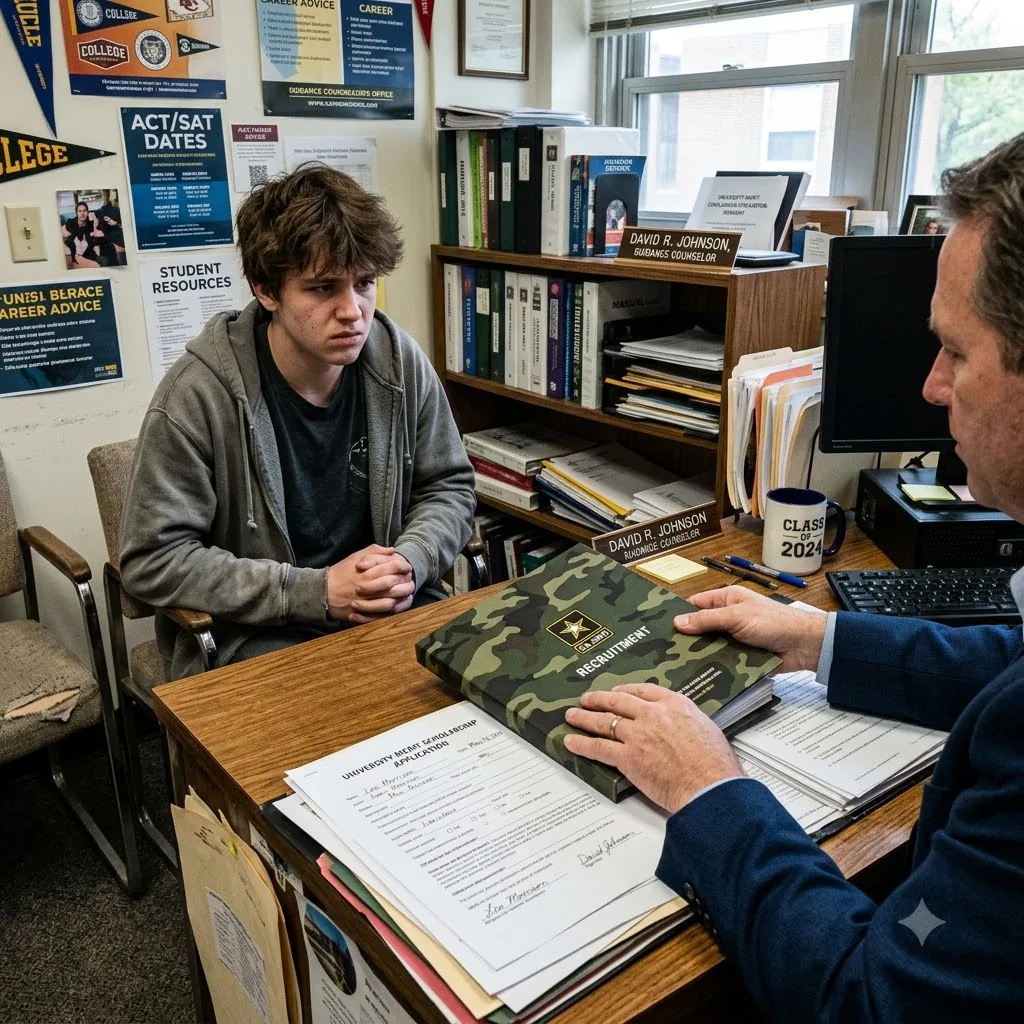
Mateo gripped the heavy metal pen. It felt cold, like a weapon, but he didn’t lower it to the yellow-highlighted signature line on the enlistment contract. Instead, he reached across the scratched laminate desk and used the blunt end of the pen to hook the spiral binding of his engineering application. He dragged his life’s work back from the precipice of the trash can, sliding it until it rested squarely in front of his chest.
Vance didn’t blink. The guidance counselor merely leaned further back in his groaning leather chair, crossing his arms over his chest.
“I am not enlisting,” Mateo said, his voice remarkably steady despite the adrenaline flooding his veins. “I have a 4.0 GPA. I built a working pneumatic robotic arm in my garage from scrap metal. I am going to the state university.”
“You are going exactly nowhere,” Vance replied, his tone devoid of anger, which somehow made it worse. It was the tone of a man reciting a weather forecast. “You seem to be misunderstanding the mechanics of this situation, Mateo. Let me clarify exactly what happens to your missing paperwork if you walk out of here without signing that delayed entry form.”
Vance sat forward, resting his heavy forearms on the desk, crowding Mateo’s space. “If you try to mail that binder yourself, it lacks the district seal. The university admissions office will immediately kick it back to my desk for verification. And when they do, I will not just decline to sign it. I will be legally obligated, under district policy, to flag the application for fraudulent demographic reporting.”
Mateo’s stomach plummeted. “It isn’t fraudulent. I used the ITIN. The university explicitly allows-”
“The university allows it,” Vance interrupted, raising a thick finger. “The school district, however, has a strict policy regarding unverified households and state-funded endorsements. If I flag your file for irregular tax documents, it generates a report. That report doesn’t just go to the university. It goes to the state board of education. It goes to the financial aid databases. And, automatically, it gets routed through the federal verification system to check exactly why a legal guardian lacks a Social Security Number.”
Mateo stopped breathing. The hum of the fluorescent lights suddenly sounded like a roar in his ears.
Vance let the silence stretch, watching the horror wash over Mateo’s face. “Your mother’s residency status is pending, isn’t it? A delicate time. One administrative flag in a federal database, one inquiry from a suspicious state agency, and her pending status becomes an active investigation. Do you want to risk her deportation over a mechanical engineering degree?”
Mateo stared at the counselor, paralyzed. The threat wasn’t just about losing the scholarship anymore. Vance was actively weaponizing his mother’s vulnerable immigration status. He was threatening to tear Mateo’s family apart over a missing signature on page four.
Vance tapped the glossy camouflage folder with his knuckles. “Now, look at the military brochure again. Look at the waiver on page two.”
Mateo didn’t want to look, but his eyes were drawn to the bold text Vance was pointing at.
“The Armed Forces,” Vance said smoothly, “have a different set of rules. They don’t care about your mother’s paperwork. If you enlist, you become a ward of the government. You get an immediate waiver for all household demographic requirements. No flags. No state reports. No federal verification systems looking into your mother’s tax history. I sign off on your enlistment, and the district closes your file as a success story. Your mother stays safely off the radar.”
The trap was flawless. It was a closed loop, meticulously designed to corner students exactly like Mateo. Vance wasn’t just a lazy counselor; he was a gatekeeper who had figured out how to use the bureaucracy as a cudgel to meet recruitment quotas.
Before Mateo could process the sheer scale of the extortion, the heavy wooden door of the cramped office swung open. The sudden draft blew a stray recruitment flyer off the desk.
A man in pristine military fatigues stepped into the room, his combat boots thudding loudly on the cheap carpet. He had a tight buzz cut, a sharp jawline, and a smiling demeanor that didn’t reach his cold, calculating eyes. The nametape on his chest read *HAYES*.
“Morning, Vance,” Sergeant Hayes said, his voice booming in the tiny space. He closed the door behind him, effectively blocking the only exit. He leaned against the doorframe, crossing his massive arms and looking down at Mateo. “Is this the mechanic you were telling me about?”
“This is him,” Vance said, his flat demeanor instantly transforming into a convivial, cooperative warmth. “Mateo is just weighing his options. I was explaining how the motor pool could really use a guy with his pneumatic expertise.”
“Oh, absolutely,” Hayes said, taking a step closer. He smelled of starch, cheap cologne, and stale black coffee. He reached out and casually flipped through the first few pages of Mateo’s painstakingly assembled scholarship binder. “Smart kid. Wasting away in a classroom when you could be getting hands-on experience with multi-million-dollar diesel engines. Plus, you sign today, we fast-track your processing. No messy background checks on your family. We keep things simple.”
Mateo looked back and forth between the two men. They had rehearsed this. They had done this before, probably dozens of times, to dozens of other kids who didn’t have the money or the legal standing to fight back. The counselor created the administrative terror; the recruiter offered the camouflage lifeboat.
“I need to think,” Mateo managed to say, his throat tight. He moved his hands over his scholarship binder, wanting to pull it into his chest, to protect it from Hayes’s casual, dismissive touch.
“Not a lot of time to think, son,” Hayes said, tapping his heavy diver’s watch. “I’m only on campus until the bell rings for fifth period. That’s twenty minutes. After that, I head back to the processing station. You want the demographic waiver, you need to sign while I’m physically here to counter-sign it.”
“And the scholarship deadline is tomorrow at noon,” Vance added, picking up his desk phone and resting the receiver against his shoulder, his finger hovering over the dial pad. “If Sergeant Hayes leaves without that contract, I have to make my calls to the district compliance office before my lunch break. Standard operating procedure for incomplete files. I can’t leave a liability sitting on my desk overnight.”
Mateo looked at his engineering binder, the culmination of his entire life’s ambition. He thought of his mother, working double shifts at the commercial laundry, her hands cracked and bleeding, just to pay for the parts he needed to build his robotic arm. He thought of the federal databases, the immigration enforcement vans he sometimes saw idling near his neighborhood.
Hayes uncapped a second pen and dropped it directly onto the yellow-highlighted line of the enlistment contract.
“Twenty minutes, Mateo,” Hayes said softly. “Save your mom. Be a hero.”