Story code: ST-001134
Part 4: The Blast Radius
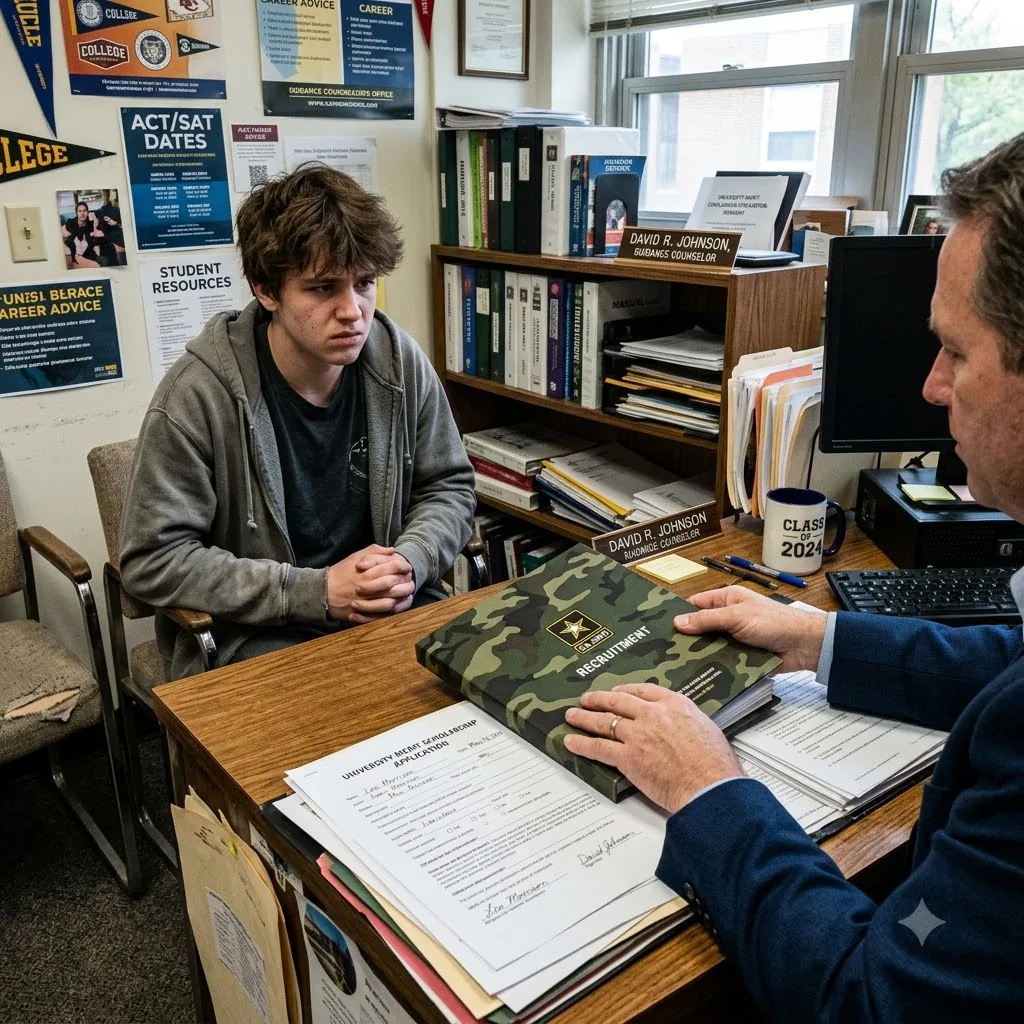
The telephone receiver hovered inches above the cradle. Mateo kept his eyes locked on Mr. Vance, his breathing perfectly steady, betraying none of the adrenaline still surging violently through his veins.
“Make the call,” Mateo repeated, his voice quiet but echoing cleanly in the cramped, windowless office. “Tell the federal verification system about my application.”
Vance did not move. His fleshy face had lost all its color, taking on the waxy hue of old parchment. The thick finger resting over the dial pad trembled imperceptibly. For a long, agonizing moment, the only sound in the room was the harsh hum of the fluorescent lights and the heavy, rhythmic ticking of the plastic wall clock.
Then, with a sharp clatter, Vance dropped the receiver into the cradle.
Beside the door, Sergeant Hayes cleared his throat. The recruiter’s commanding presence had completely evaporated. Hayes looked at the dry-erase whiteboard, refusing to make eye contact with either of them.
“Looks like my time is up,” Hayes said, his voice stripped of the brotherly warmth he had weaponized just minutes earlier. He reached across the desk and snatched up the camouflage folder. “I am just here to distribute informational materials, Vance. District compliance is your department. Do not call my cell again.”
Hayes walked out, his combat boots thudding rapidly down the linoleum hallway. The heavy wooden door clicked shut behind him, leaving Mateo and Vance alone in the stifling air.
Vance stared at the closed door, his chest heaving. When he finally looked back at Mateo, the panic in the counselor’s eyes had hardened into a brittle, defensive spite. He placed his heavy hand flat over Mateo’s scholarship application.
“You think you are clever,” Vance spat. “You think you figured it all out. But I am still the designated academic advisor for this school. I am the only authorized signature. And I am telling you, right now, I will never sign this paper.”
Mateo looked at the heavy, ringed hand pressing down on his life’s work. It was his guaranteed full-ride to the mechanical engineering program, housing included. It was the end of worrying about rent, the end of patching his shoes with silver duct tape.
He knew what it would take to force Vance’s hand. He would have to march directly to the principal’s office, call the local news, and blow the whistle on the extortion pipeline. Vance would be fired. The district would face a massive scandal.
But a district-wide investigation meant federal auditors. It meant his family’s name exposed in official reports. In the blast radius of taking down Mr. Vance, his mother’s pending residency status would become collateral damage. The authorities might dismantle the school’s corrupt pipeline, but they would still process the undocumented names caught in the wreckage.
The truce required absolute silence. Mutually assured destruction only worked if neither side pressed the button.
Mateo stood up from the undersized plastic chair. He didn’t reach for the ninety-page application.
“Keep it,” Mateo said. “Throw it in the trash.”
Vance blinked, his thick fingers twitching against the cover page. “What are you doing?”
“I am leaving,” Mateo said. “You do not flag my tax documents. You erase my name from your files. In exchange, I leave my application on your desk.”
Vance stared at the binder, a slow, dawning comprehension washing over him. He realized he was being offered a way out, but the cost was Mateo’s entire future. Vance slowly pulled his hand away from the binder and gave a single, tight nod.
Mateo turned and opened the door.
He stepped out into the crowded hallway just as the bell rang for fifth period. Teenagers laughed and shouted, slamming locker doors, entirely oblivious to the quiet war that had just concluded.
Mateo walked through the sea of students, his hands empty. The phantom weight of the heavy binder seemed to pull at his arms. A profound, aching grief settled deep in his chest. Tomorrow at noon, the state university deadline would pass, and his flawless application would be resting at the bottom of a municipal landfill. The easiest, clearest path out of poverty was gone forever.
He pushed open the double doors and stepped out into the bright, late-morning sun. He would have to enroll in community college. He would have to work night shifts to pay for tuition and build his robots from cheaper scrap metal, fighting for every single inch of ground he had just surrendered.
But as Mateo walked down the cracked concrete steps, he pictured his mother at the commercial laundry. He imagined her hands, tired but safe, working without the terrifying shadow of a federal enforcement van idling across the street. He had engineered a perfect solution. He had protected the only thing in his life that truly mattered. Mateo put his hands in his pockets, lifted his chin against the warm wind, and began the long walk home.