Story code: ST-001135
Part 3: The Dispatch Logs
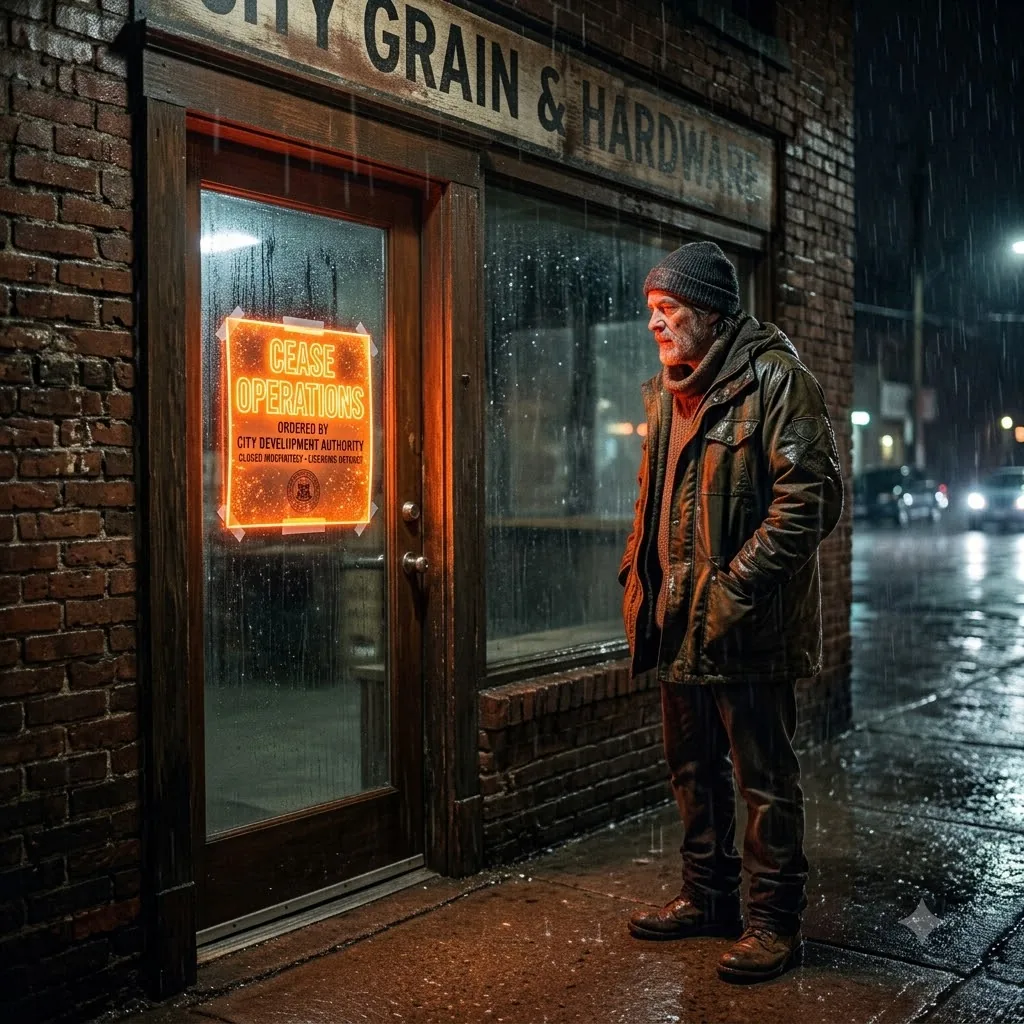
The taillights of the Sheriff’s cruiser dissolved into the freezing mist, leaving Harlan alone in the quiet of his shop. He stood motionless behind the glass counter, listening to the steady hiss of the cast-iron radiator. He looked up at the antique wall clock. It was eight-forty-five. He had exactly seven hours and fifteen minutes to move two thousand pounds of ammunition and a floor full of heavy steel safes across county lines.
If he called every cousin, every hunting buddy, and every regular customer who owned a pickup truck, they still wouldn’t beat the deadline. The county knew it. Dr. Elias Vance knew it. It wasn’t a clearance order; it was a guaranteed seizure. It was the execution of a generational legacy disguised as a zoning technicality.
Harlan didn’t walk to the stockroom to start breaking down pallets. He turned his back on the front door and walked into the cramped rear office. The air back here smelled heavily of old paper, pipe tobacco, and floor wax. He stepped around a stack of wooden crates and approached his grandfather’s heavy oak desk. He pulled a brass key from his pocket, unlocked the bottom right drawer, and reached past the leather-bound ledger books.
He pulled out a thick, unmarked manila envelope. Chief Miller of the local town police had dropped it on the glass counter three days ago, right after the zoning board rumors started. Miller had been chewing a toothpick, looking out the front window at Vance’s coffee shop table. *”County boys are sniffing around,”* Miller had said. *”Your new neighbor has friends in high places. But he’s got a funny definition of a safe community. I ran the 911 dispatch logs for his place up on the Ridge. Thought you might want some reading material.”*
Harlan unwound the red string from the envelope’s clasp. He pulled out a stack of municipal dispatch printouts and police reports, scanning the highlighted sections. He didn’t need to read them all again. He knew exactly what they proved. He tucked the papers back into the envelope, walked out of the office, and locked the front door of the shop behind him. He stepped back out into the freezing rain.
The artisan café across the street, *The Daily Grind*, was glowing with warm, amber Edison bulbs against the gray morning. Harlan crossed the slick asphalt, ignoring the icy water seeping into the eyelets of his boots. He pushed open the heavy glass door of the café. The blast of warm air smelled of roasted espresso beans, oat milk, and vanilla syrup. The low murmur of acoustic guitar music and quiet conversation filled the room.
Dr. Elias Vance was sitting at his usual reclaimed wood table by the front window, perfectly framed against the gloomy street. He was typing on a sleek silver laptop, his leather folio resting next to a ceramic mug of steaming coffee. Several other weekend residents were scattered at nearby tables, bundled in expensive fleece and cashmere, tapping on phones or reading tablets.
Harlan’s heavy boots thudded against the polished concrete floor, drawing a few nervous glances from the patrons. He didn’t stop until he was standing directly over Vance’s table, his broad shoulders blocking the ambient light from the window.
Vance stopped typing. He looked up, a condescending smirk playing at the corners of his mouth. “I told you, Harlan, the offer was a one-time courtesy. If you’re here to ask for the check back, you’re out of luck. The county will handle the cleanup now.”
Harlan didn’t say a word. He slapped the manila envelope down on top of Vance’s keyboard. The loud smack of heavy paper on metal echoed sharply in the quiet café. The barista stopped steaming milk. The acoustic music suddenly seemed entirely too quiet.
“I’m not here for your money, Doctor,” Harlan said, his voice a low, steady rumble that carried across the hushed room. He reached down and pulled the stack of dispatch logs from the envelope, spreading them out over Vance’s laptop and folio. “I’m here to talk about the wellness corridor.”
Vance frowned, eyeing the official police letterhead. “What is this?”
“Those are the 911 dispatch logs for your weekend estate up on the Ridge,” Harlan said, tapping a thick, calloused finger on the top page. “Town police records. Public information.”
Vance’s smirk faltered. He glanced nervously at the table next to them, where a woman in a quilted yoga jacket had paused mid-sip to listen. “Keep your voice down, Harlan. You’re making a scene.”
“October fourteenth,” Harlan said, ignoring the warning and projecting his voice even louder. “Mrs. Higgins called the town police because her fourteen-year-old grandson was looking for his lost golden retriever near your property line. The boy was detained by two men in unmarked black tactical gear. They stepped out of the tree line with AR-15 rifles at the low ready.”
Vance stiffened, his face draining of its smug color. “They were on my private property. My security team is fully licensed.”
“November second,” Harlan continued, flipping to the next page, keeping his heavy hand pressed against the documents. “A utility meter reader, wearing a high-visibility yellow vest, was held face-down in the mud at gunpoint for twenty minutes by your private security firm until Chief Miller arrived to de-escalate the situation.”
“The world is a dangerous place,” Vance hissed, leaning forward, desperately trying to keep the conversation localized to their table. “I have a right to protect my home and my family from trespassers.”
“A dangerous place,” Harlan repeated, letting the words hang in the quiet café. He looked around the room. Several of Vance’s fellow weekenders were staring openly now, their expressions shifting from annoyance to deep discomfort. The champion of their peaceful, gun-free downtown was running a private paramilitary force in the woods.
“You paid the town council to shut down my family’s sporting goods store because you said the smell of cordite and the sight of hunting rifles was a hazard to families,” Harlan said, looking back down at the doctor. “You said you wanted a safe, welcoming community. But the second you leave city limits, you pay mercenaries to aim combat rifles at local kids and meter readers.”
“That is entirely different,” Vance whispered sharply, the veins in his neck tight. “That is a matter of personal security for a high-net-worth estate. It has nothing to do with downtown zoning.”
“It has everything to do with it,” Harlan said. “Because the Mayor and the zoning board are under the impression that you’re a philanthropist building a peaceful retreat. They don’t know you’ve brought a private militia into their backyards. They don’t know you’re terrorizing their constituents.”
Vance stared at the dispatch logs. His perfectly curated image-the cashmere scarf, the artisan coffee, the civic-minded donor-was evaporating in front of his peers. He looked at the woman in the yoga jacket, who immediately averted her eyes, visibly disturbed by the revelation.
“If my inventory isn’t safe for this town,” Harlan said, leaning his knuckles on the edge of the reclaimed wood table, bringing his face inches from Vance’s, “then what do you think the local paper, the town council, and every mother in this county is going to say when I hand them these logs at the emergency town hall meeting tonight?”
Vance opened his mouth, but no words came out. His eyes darted from the damning police reports to Harlan’s unwavering stare. The doctor’s hands remained frozen on the edge of the table, trapped by his own exposed hypocrisy, with absolutely no clean answer to give.