Story code: ST-001135
Part 2: The Four O’Clock Mandate
Harlan’s thumb slid over the embossed return address of Dr. Elias Vance’s LLC. The freezing rain continued to fall, tapping a frantic rhythm against the metal awning above the shop. The doctor’s smile remained fixed, a portrait of rehearsed corporate benevolence. Vance had likely practiced this exact expression in the mirror of his renovated farmhouse, preparing to play the magnanimous savior to a stubborn local.
Harlan did not open the envelope. He did not check the amount on the cashier’s check. Instead, he brought his other hand up, pinning the damp paper between his thick, calloused thumbs, and twisted his wrists in opposite directions.
The heavy cream paper and the rigid check inside gave way with a thick, satisfying tear. Harlan tore it again, quartering the bribe, and let the pieces fall from his fingers. The wet confetti landed in a gray puddle of slush by the doctor’s expensive leather boots. The icy water immediately began to dissolve the dark blue ink.
Vance’s smile shattered. The smug warmth drained from his face, replaced by a rigid, cold fury. He stared down at the pieces of paper in the slush, then up at Harlan, as if trying to comprehend a dog that had refused a prime cut of steak.
“That was an incredibly foolish thing to do,” Vance said, his voice stripped of its practiced patience. The cashmere scarf suddenly looked inadequate against the biting wind.
Harlan leaned his weight onto the wooden handle of his push broom. “You missed a spot of ice on your side of the street, Doctor. Better get back before you slip and hurt yourself.”
Vance’s jaw worked silently for a moment. He took a sharp step back out from under the awning, letting the freezing rain hit his shoulders again. He pulled a sleek black phone from his overcoat pocket. “I tried to handle this with dignity,” Vance said, jabbing a finger at the screen. “Don’t say I didn’t give you an out.”
Harlan turned his back on the man and walked inside, pulling the heavy oak door shut behind him. The brass bell chimed, sealing out the hiss of the rain and the murmur of Vance’s voice. The shop was warm. The antique cast-iron radiator in the corner hissed softly, filling the room with the familiar, grounding scent of Hoppe’s No. 9 solvent, aged walnut rifle stocks, and floor wax.
He walked behind the glass counter and began his morning routine out of sheer muscle memory. He wiped down the glass over the revolvers, checked the till, and straightened a display of cleaning kits. But beneath his calm exterior, his pulse hammered against his ribs.
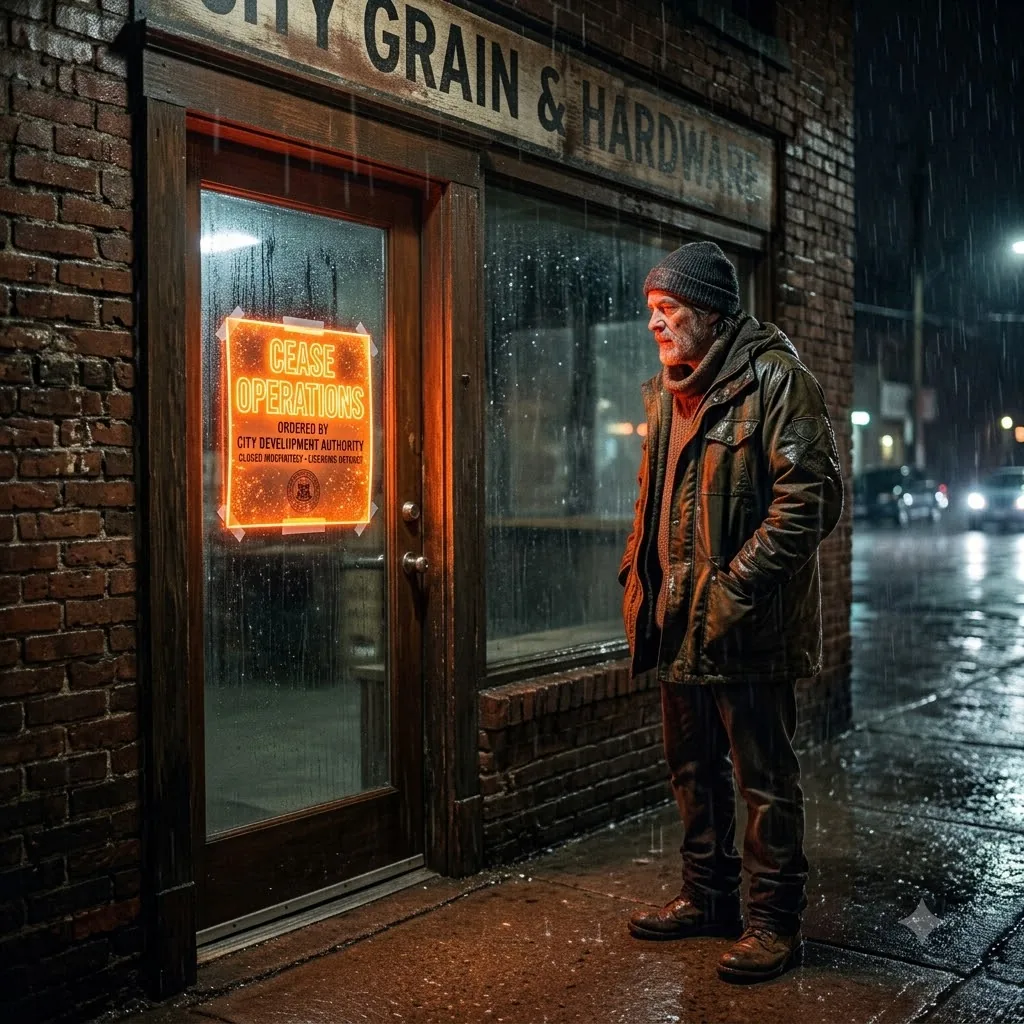
He looked out the front window, past the jagged white scar of the torn orange sticker. Vance was pacing furiously under the coffee shop’s awning across the street, the phone pressed hard against his ear. If three town council members who had known Harlan since childhood had flipped overnight, Vance’s pockets were far deeper than Harlan had calculated. The doctor wasn’t just buying buildings; he was buying the town’s infrastructure.
Thirty minutes later, the mechanical whine of a heavy engine cut through the quiet street. Harlan looked up from polishing a display case. A cruiser pulled up directly in front of the shop, blocking the loading zone. But it wasn’t the familiar white sedan of Chief Miller or the local town police. It was a heavy, dark green SUV belonging to the County Sheriff’s Office.
Vance had bypassed the local jurisdiction entirely. He knew the town cops would drag their feet on enforcing a phantom zoning law against a fixture of the community, so he had gone straight to the county level, leveraging whatever political capital he had purchased the night before.
Two deputies stepped out into the freezing rain. Harlan recognized the younger one immediately-Deputy Barrett. Harlan had taught the kid how to sight his first hunting rifle twelve years ago. Barrett looked miserable, keeping his eyes fixed firmly on the wet asphalt as he walked toward the door. The older deputy, a broad-shouldered man with a tight, graying buzz cut and hard eyes, carried a thick manila folder.
The brass bell chimed. The two men stepped onto the floor mats, their heavy boots squeaking against the wet rubber.
“Morning, Barrett,” Harlan said, keeping his hands resting loosely on the glass counter.
Barrett winced, refusing to meet Harlan’s gaze. “Morning, Mr. Webb.”
“Harlan Webb?” the older deputy interrupted, stepping in front of Barrett. He slapped the manila folder down on the glass directly over a display of antique Colt revolvers. “I’m Sergeant Gable, County Sheriff’s Office. We’re here to execute a municipal enforcement order.”
Harlan glanced at the folder. “The zoning board gives a thirty-day grace period for appeals on any commercial re-zoning. You boys are out of your jurisdiction.”
“This isn’t a standard zoning dispute, Mr. Webb,” Gable said, his voice flat and authoritative. “As of eleven o’clock last night, this district was re-classified as a pedestrian wellness corridor. Your business license is suspended under the newly amended municipal hazardous materials ordinance.”
Harlan’s brow furrowed. “Hazardous materials? It’s a sporting goods store.”
Gable opened the folder and tapped a highlighted paragraph on a freshly printed document. “Ammunition and propellant storage over fifty pounds in a non-compliant commercial zone. You have roughly two thousand pounds of smokeless powder, primers, and live ammunition in the back room, according to your last fire marshal inspection.”
Harlan looked through the front window. Vance was standing beside the coffee shop, holding a black umbrella, watching the interaction with a look of supreme satisfaction.
“Emergency public safety injunctions bypass the thirty-day appeal window,” Gable continued, closing the folder. “You are currently maintaining a public hazard in a pedestrian zone.”
“So what’s the play, Sergeant?” Harlan asked, his voice tightening. “You’re going to arrest me for selling the same birdshot I’ve sold for thirty years?”
“No,” Gable said, checking his watch. “I am serving you with a mandatory clearance order. You have until four o’clock this afternoon to vacate the premises and remove all hazardous inventory from city limits.”
Barrett finally looked up, his face pale. “I’m sorry, Harlan. The Sheriff got a direct call from the Mayor’s office this morning. They threatened to pull the county’s municipal policing contract if we didn’t clear the building.”
Harlan turned his head to look at the antique clock on the wood-paneled wall. It was eight-forty in the morning. Moving fifty years of accumulated inventory, heavy steel safes, and thousands of boxes of ammunition in seven hours was physically impossible. It would take a fleet of trucks and a crew of ten men just to load it all.
“And if I don’t?” Harlan asked, turning his gaze back to Gable.
“If the hazardous materials are not gone by four o’clock, the county will seize the inventory for public destruction,” Gable said, his tone devoid of any sympathy. “And we will chain the doors shut. I suggest you start packing, Mr. Webb.”