Story code: ST-001136
Part 3: The Cannibalized Coast
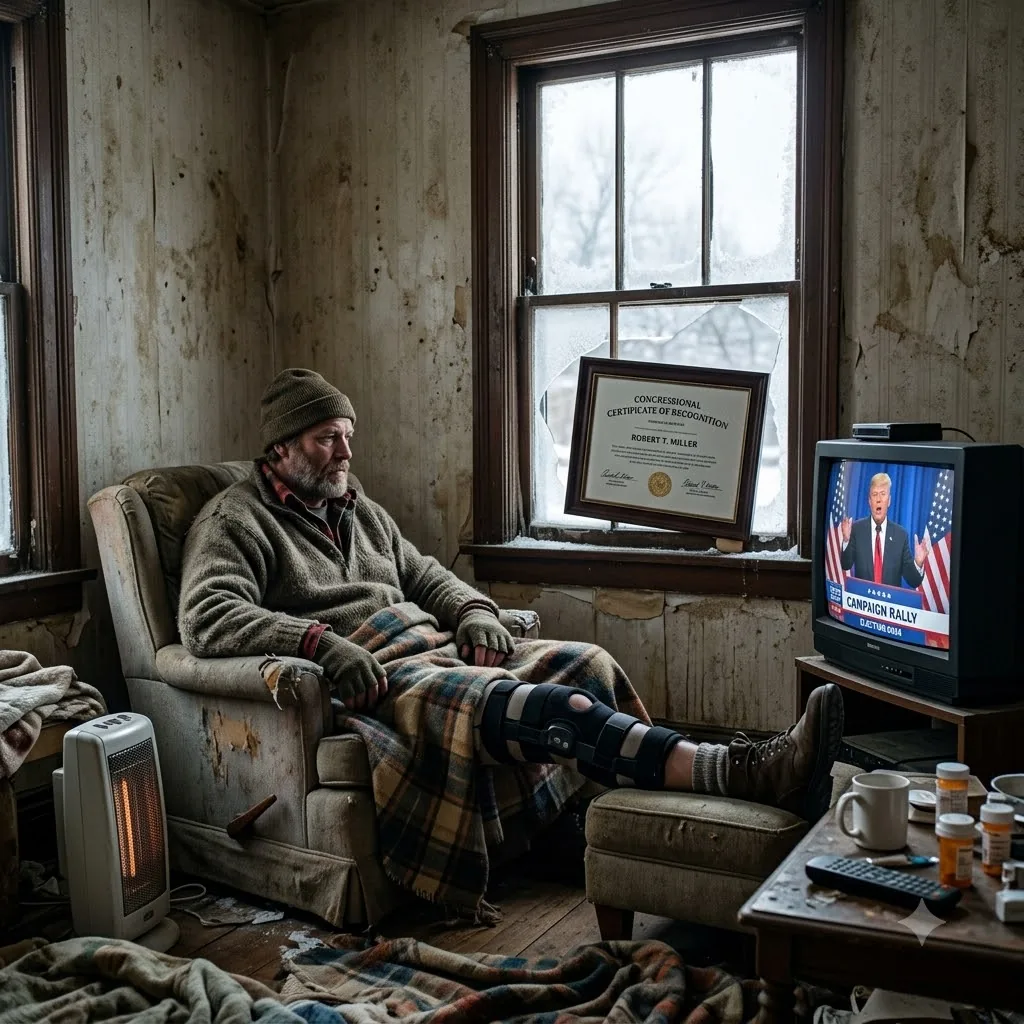
The deep vibration shook the empty soup cans lined up along the edge of the kitchen counter. Marcus dragged his stiff leg toward the shattered window, his pulse hammering a frantic rhythm in his throat. He pressed his hand against the cold oak frame, his rough fingers brushing the edge of the Hometown Hero certificate. The heavy parchment bowed inward as an icy gust of wind hit it. Through the narrow gap, he saw amber strobe lights cutting through the falling snow at the far end of the block, painting the dark houses in harsh, rhythmic flashes.
“They’re clearing the access roads,” Marcus muttered, his breath pluming against the icy glass. He pointed a trembling finger at the street. “For the supply trucks. The governor said the new tooling equipment was arriving this month. You’re lying to me.”
Elias stood completely still in the center of the freezing room. The caseworker reached into his heavy parka and pulled out a bulky, rubber-cased tablet. He swiped a thumb across the screen, the harsh white glow illuminating his tired, wind-chapped face.
“Step away from the window, Marcus,” Elias said, his voice flat and exhausted. “Look at this.”
Marcus turned, leaning heavily on the windowsill to take the weight off his throbbing knee. He glared at the caseworker. “I don’t want to see another damn state form.”
“It’s not a form. It’s the live security feed from the county surveyor’s office,” Elias said, turning the tablet around so the glowing screen faced Marcus.
Marcus squinted at the glare. The camera angle was pitched high, looking down over the chain-link perimeter of the valley auto plant. It was the exact yard where Marcus had spent fifteen years loading heavy freight. But the loading docks were gone. In their place sat three massive excavators, their yellow hydraulic arms tearing into the corrugated steel siding of Assembly Building C. A heavy wrecking ball swung in a brutal, lazy arc, smashing through the brick facade of the main administrative office. A massive plume of gray dust billowed into the winter sky, swallowing the familiar smokestacks.
Marcus stared at the destruction, his chest tightening until he couldn’t draw a breath. The image on the screen was crisp, the time-stamp in the bottom corner ticking away in real-time. He watched a steel support beam buckle, bringing the entire south roof down in a chaotic tangle of rebar and concrete.
“No,” Marcus breathed, shaking his head. “No, the governor just did a press conference from the floor. He was holding a machined part. There were people cheering.”
Elias tapped the screen, minimizing the live feed. He opened a raw video file from his local storage, tapping the properties tab. He held the tablet closer so Marcus could read the digital metadata.
“The broadcast the network keeps looping was filmed twenty-two days ago,” Elias said. “It was shot at a private holding facility three counties north. If you look at the hardhats in the crowd, they aren’t local union workers. They’re non-union extras hired for the afternoon. The engine part he was holding was a discontinued manifold from a bankrupt subsidiary. It was political theater, designed to keep the valley quiet while the state finalized the demolition contracts behind closed doors.”
Marcus felt a cold sweat break out on the back of his neck, completely at odds with the freezing temperature of the living room. He looked from the tablet back to the black screen of his television. The cheering crowd, the promises of dignity, the loyalty owed to the working man-all of it manufactured.
Outside, the rumble grew louder. The amber lights flashed across the peeling wallpaper of the living room, casting long, erratic shadows across the faded rug.
Marcus gripped his ruined knee. The joint burned with a deep, grinding ache, the missing cartilage grinding bone on bone. “Fine,” he choked out, his voice trembling with a desperate mixture of rage and panic. “Fine. They took the plant. But I’m still a veteran. I have my disability rating. Once my back-pay comes through next week, I’ll go to the VA clinic in town. They’ll schedule my second surgery, and I’ll pack up and get the hell out of this state. You can keep your solar panels.”
Elias slowly lowered the tablet. The caseworker looked at the gold-foil certificate wedged into the window frame, then back to Marcus. The silence between them stretched, heavy and suffocating, beneath the mechanical roar outside.
“Marcus,” Elias said softly, the sudden pity in his voice far worse than the biting cold. “Where do you think the state found the money to subsidize the demolition contractors?”
Marcus frowned, his brow furrowing as he swayed on his good leg. “What?”
“The logistics hub is a private enterprise, but clearing the industrial land required an eight-million-dollar matching grant from the county,” Elias explained, his gaze locked intensely on Marcus’s face. “The county didn’t have it. So, the governor signed an emergency reallocation order.”
Elias brought up a scanned ledger on his tablet. The columns of numbers were highlighted in stark red and green.
“They defunded the local VA clinic,” Elias said, tapping a heavy red line item at the bottom of the document. “They stripped the county auxiliary health budget to the absolute bone. The clinic in town is permanently closing its doors next Friday. Your back-pay isn’t delayed by a clerical error, Marcus. It doesn’t exist anymore. They took the money meant for your knee surgery to pay the contractors currently driving bulldozers down your street.”
Marcus stared blindly at the glowing screen. The numbers blurred together. The realization hit him with the force of a physical blow, knocking the remaining wind from his lungs. The state hadn’t just abandoned the factory; they had actively cannibalized his medical care to pay for its destruction. Every freezing night he had spent rationing firewood, waiting patiently for a check, the state had been using his money to fuel the diesel engines now idling outside his front door.
He looked slowly toward the broken window. The heavy oak sash held the Hometown Hero certificate tight against the glass. The gold foil of the state seal caught the flashing amber lights of the heavy machinery crawling up his street. The seal on the demolition orders. The seal on the budget cuts. The seal on his fake medal.
The diesel engines roared, shaking the floorboards beneath his boots, shaking the cold walls, waiting for him to move. Elias stood silently in the center of the room, offering no apologies, holding the heavy black tablet that contained the exact price of Marcus’s ruined life.