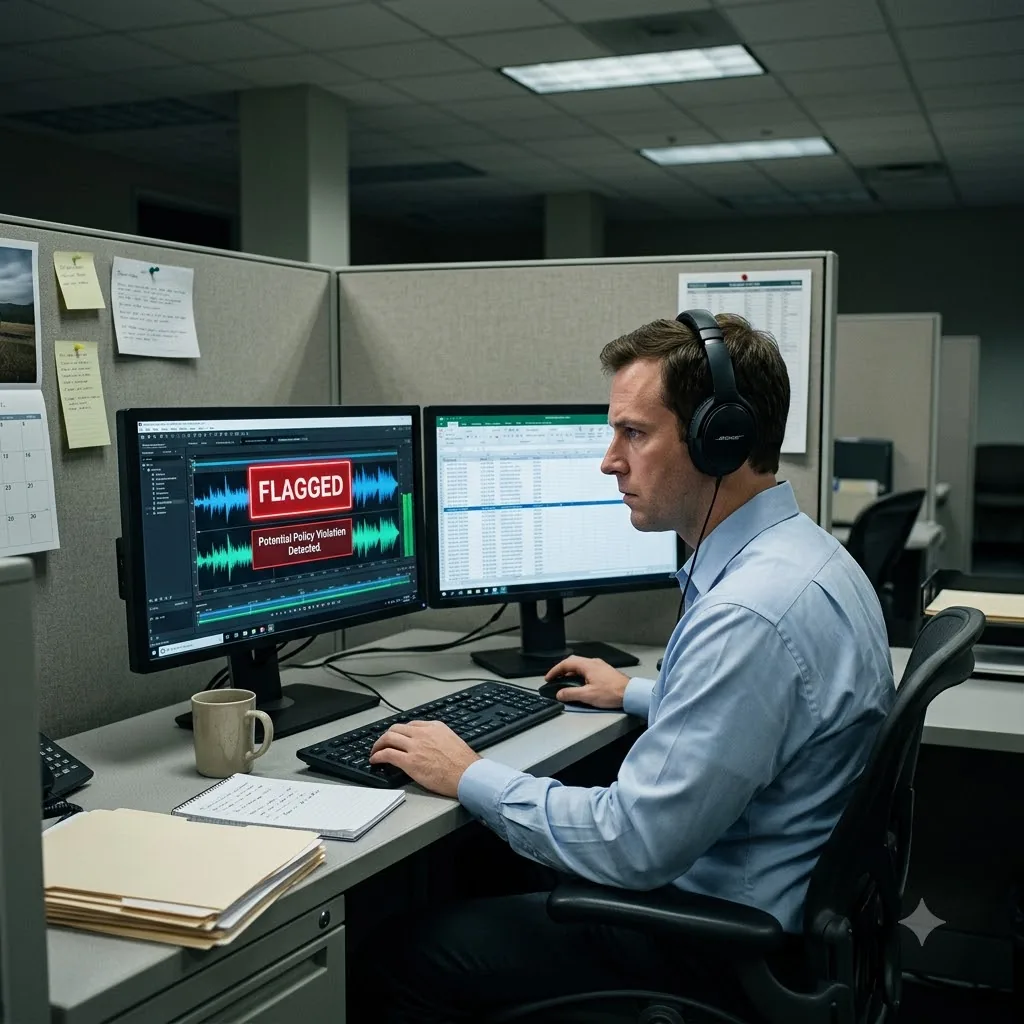
Story code: ST-001146
Part 2: The Bottleneck
Marcus stared at the blinking ‘Accept’ button. He moved his mouse, finding the cursor had regained its mobility, but it was strictly confined to the borders of the calendar prompt. He clicked. The screen instantly went black, replaced by a single line of crisp white text: *Access Granted. Proceed to Sub-Level B.*
He pulled off his noise-canceling headset. The ambient sound of the fourth-floor pod rushed back in-the frantic typing of his colleagues, a muted sigh from the next desk over, the squeak of an office chair. None of them looked up. They were buried in their own endless manual reviews. Marcus stood, smoothing the wrinkles in his slacks. His pulse hammered a steady, warning rhythm against his ribs. Sub-Level B was a physical dead zone, a reinforced bunker housing the hospital network’s most critical data infrastructure. Only C-suite executives and senior security personnel held the RFID clearance for the subterranean floor.
Marcus walked to the central elevator bank. He swiped his standard-issue badge over the scanner, expecting the familiar, dull red denial beep. Instead, the reader flashed a vibrant, solid green. The heavy steel doors slid open. He stepped inside, and the elevator began its descent without him pressing a single button.
The air grew noticeably colder as the car dropped. Marcus gripped the brass railing, his mind racing through the possibilities. VP Vance was the head of Operations. Vance was the man who had green-lit the Overwatch expansion pilot six months ago. The mandatory meeting could be a security audit, a data breach protocol, or-Marcus felt a sudden, sharp surge of pride-a promotion. The algorithm had caught a senior physician flawlessly. Vance had to be watching the live analytics feeds.
The doors parted, revealing a dimly lit corridor lined with exposed cooling pipes and thick bundles of yellow fiber-optic cabling. Marcus followed the only illuminated path, his footsteps muffled by the thick anti-static matting. At the end of the hall, a heavy blast door stood propped open.
“Come in, Marcus,” a voice echoed from inside.
Marcus stepped into the server room. The chill here was biting, accompanied by the deafening, relentless roar of industrial cooling fans. In the center of the room, flanked by towering black server racks, stood Richard Vance. The Vice President was dressed in a pristine charcoal suit, his hands clasped behind his back as he stared up at a massive, curved monitor array suspended from the reinforced ceiling.
Marcus followed Vance’s gaze and felt his breath catch in his throat.
The screens were filled with his Overwatch dashboard, but the scale was entirely alien. Marcus was used to monitoring single, flagged interactions, isolating one doctor and one patient. Here, thousands of audio waveforms cascaded across the displays in real-time. It looked like a digital waterfall of hospital operations, a staggering volume of data flowing ceaselessly down the glass.
“Sir,” Marcus said, raising his voice over the fan noise. “I was in the middle of processing a Category One violation. Dr. Lin-”
“Dr. Lin’s security credentials were revoked three minutes ago,” Vance said, not looking away from the screens. “Her parking pass has been deactivated, and her access to the localized patient database is locked. HR is currently intercepting her at her office to escort her off the premises.”
Marcus blinked, stepping closer to the terminal. “I didn’t click submit. The system froze.”
Vance finally turned, a thin, approving smile resting on his face. “It didn’t freeze, Marcus. It took over. We bypassed the manual submission gate. When your algorithm hit a ninety-nine percent confidence score on the semantic net, it triggered the automated termination sequence. You built a beautifully efficient machine. I simply removed the bottleneck.”
“The bottleneck?” Marcus asked.
“You,” Vance said simply. He gestured expansively to the sprawling monitor array. “Human review is a liability. It’s slow. It’s subject to empathy, to fatigue, to hesitation. You hovered over that submit button for four point two seconds, Marcus. In corporate risk management, four seconds is an eternity. A lot of data can be downloaded in four seconds. A lot of damage can be done.”
Marcus looked up at the cascading waveforms. He noticed the metadata tags attached to the incoming audio feeds. They weren’t just telehealth portals. He saw tags for *Cafeteria Camera 4*, *Surgical Lounge B*, and *Compliance Pod 3*.
His eyes locked onto that last tag. *Compliance Pod 3*. His pod.
“You’re running the semantic net on the staff’s private conversations?” Marcus asked, his chest tightening. “The natural language processing model was trained for medical evasions. For patient protocols.”
“It was trained to detect vocal tension, evasion, and insubordination,” Vance corrected, stepping closer to a glass control terminal beneath the monitors. “It parses tone. It measures semantic subtext. Do you know how much money this hospital network bleeds annually due to union organizing, internal whistleblowers, and unauthorized breaks? Your machine doesn’t care if it’s a doctor talking to a pregnant patient, or a janitor complaining to a nurse about hazardous waste protocols. It just reads the risk.”
Marcus watched as a waveform from the cafeteria spiked yellow, then immediately flashed red. A confidence score of 98.5% appeared. A small thumbnail showed two maintenance workers leaning in close over a table, their voices hushed. In the upper corner, a digital stamp slammed down over their faces: *Contract Termination Pending – Disciplinary Code 44.*
“This is the deployment,” Vance said, his voice dropping to a smooth, transactional purr. “We are rolling this out across all six regional hospitals today. But to finalize the transition, I need the master encryption key you used to sandbox the neural net. You’re the only one who has it.”
Vance tapped the terminal keyboard. A prompt appeared on the center screen, demanding a fifty-character alpha-numeric string.
Marcus stood frozen. He had designed the sandbox to prevent the AI from accessing localized employee HR files without explicit, case-by-case consent. It was a failsafe to keep the system legal under state surveillance laws. If he handed over the key, the software would have unchecked, automated firing power over five thousand employees.
“Sir, the legal framework-” Marcus started, his voice wavering slightly.
“Is already handled,” Vance interrupted. The VP’s eyes narrowed. “I need the key, Marcus.”
Marcus looked back up at the screen. The feed for *Compliance Pod 3* was active. He watched a silent video feed of his own empty chair, his three colleagues still typing away. Then, he noticed a new waveform isolated at the bottom of the monitor.
It was a live audio feed of this very server room.
The Overwatch system was transcribing their conversation. Beside Marcus’s name on the screen, a yellow warning flag suddenly materialized. The software had detected the vocal tension in his last sentence. The semantic net was calculating his hesitation.
The confidence score began to climb. *Seventy percent. Eighty percent.*
“The key, Marcus,” Vance repeated, his voice devoid of any warmth. “Before the system decides you’re an operational risk.”