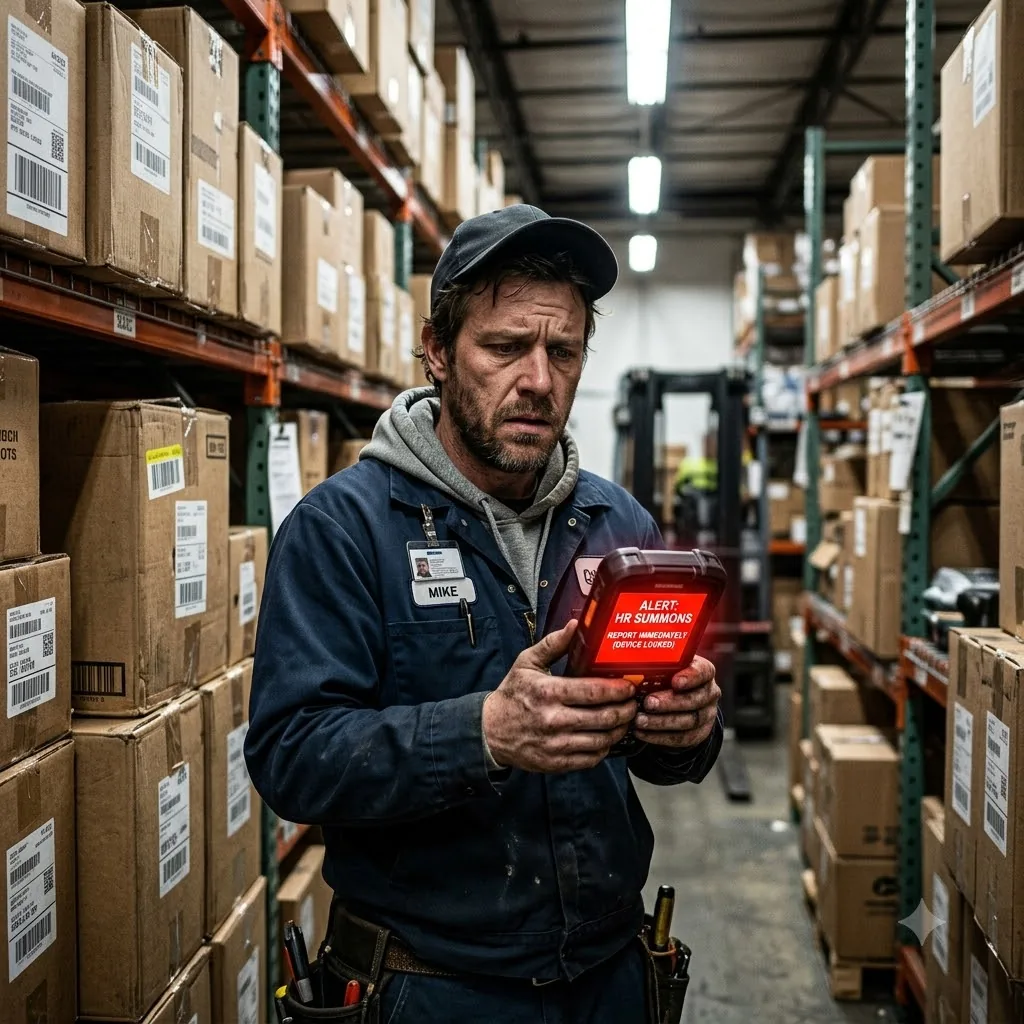
Story code: ST-001173
Part 2: Radical Transparency
Marcus stared at the glowing red indicator light. The air conditioning in the office hummed aggressively, sending a chill through his sweat-dampened shirt.
“Have a seat, Marcus,” the HR manager, Brenda, said. Her voice was violently cheerful, entirely at odds with her rigid posture. “Please, close the door behind you.”
Marcus didn’t move his feet. His hands gripped the rough, dusty seams of his denim work pants. “I thought this was a write-up. For my scanner locking up on the floor.”
“No write-ups today!” The man in the tailored suit spoke for the first time. His voice was smooth and engineered to sound reassuring, but his eyes were flat and unblinking as they tracked Marcus’s every movement. “I’m Julian Thorne, Director of Enterprise Culture. We’re actually here to celebrate your integration into our logistics family. Please, sit.”
Marcus stepped inside. The heavy door clicked shut behind him on an automatic hinge, instantly cutting off the faint, rhythmic thumping of the warehouse conveyors. He approached the wooden chair but did not sit down. He looked from the heavy-duty microphone to Brenda, then to Thorne. “Is there a reason I’m being recorded?”
“It’s standard protocol for our new Radical Transparency Initiative,” Brenda said, tapping her pen against her clipboard. “We’re capturing real-time employee feedback to synergize our floor-level operations with corporate values. Go ahead, take a seat. Let’s get started.”
Marcus remained standing. The red light on the microphone seemed to burn brighter in the dim room. His parole officer, a weary but relentlessly strict man named Harris, had given him three ironclad rules on his first day out: *Show up early, stay perfectly sober, and never put your name on a legal document or a recording without calling me first.*
“I’d rather not be recorded,” Marcus said, keeping his tone respectful and his volume low. “I’m happy to talk to you. I’ll sign a written performance review if you need me to. But I don’t consent to an audio recording.”
The cheerful smile vanished from Brenda’s face so fast it looked like a magic trick. It was replaced instantly by a look of profound, theatrical disappointment. She glanced at Thorne. Thorne nodded slowly, steepled his fingers, and leaned forward across the polished desk.
“Marcus,” Thorne began, his tone dropping to a quiet, paternal register. “That’s a very troubling response. Here at logistics, we consider ourselves a family. And families don’t keep secrets from one another. When an associate demands ‘privacy’ in a simple, collaborative feedback session, it sends a very loud message to leadership.”
“It’s not a secret,” Marcus said, his heart hammering violently against his ribs. He forced his hands to unclench, keeping them visible at his sides. “It’s just a personal boundary. I just want to load the pallets and do my job.”
“But your job isn’t just loading pallets,” Brenda interjected. She picked up a printed sheet of paper from her desk. Marcus recognized the bright yellow header of his daily quota sheet. “Your job is to uplift the workplace ecosystem. We’ve noticed you don’t eat in the breakroom. You don’t participate in the morning stretch circle. And now, when given a platform to share your voice, you throw up legal roadblocks.”
“I’m not throwing up roadblocks,” Marcus said, panic rising like bile in his throat. “I have a flawless attendance record. I’m hitting a hundred and forty percent of my daily pack rate.”
“Metrics are meaningless if the cultural fit is toxic,” Thorne said. The word *toxic* hung in the cold, air-conditioned air, heavy and lethal. “A closed-off employee is a suspicious employee. And frankly, Marcus, given your… unique housing situation, you are the last person who should be acting suspiciously.”
Marcus stopped breathing. They knew. Of course they knew; HR had to process the state tax credits for hiring a felon. But having this slick corporate director weaponize his parole status in the middle of a random Tuesday shift felt like a physical blow to the stomach.
“We gave you a chance when society cast you aside,” Brenda said, her voice dripping with weaponized empathy. “We brought you into our home. And right now, your desire to hide from our transparency initiative is creating a hostile environment for me and Julian.”
Marcus stared at her, utterly bewildered. “I’m just standing here. I haven’t done anything hostile.”
“Refusing to participate in Radical Transparency is an act of aggression against our culture,” Thorne said smoothly. He reached into his tailored jacket, produced a sleek silver smartphone, and laid it on the desk next to the microphone. “We are trying to protect you, Marcus. But you have to meet us halfway.”
“What do you want me to say into that thing?” Marcus asked, nodding at the mic.
Thorne slid a single sheet of paper across the polished wood. The text was incredibly dense, printed in a font so small it blurred at the edges. But the bold heading at the top was crystal clear: *VOLUNTARY DISCLOSURE AND ASSET FORFEITURE CONSENT.*
“We just need you to read the highlighted portion for the audio file,” Brenda said gently, as if asking him to pass the salt. “It simply states that you recognize the warehouse has experienced some minor inventory shrinkage, and that you waive your right to third-party arbitration during any subsequent locker, vehicle, or residential searches conducted by our internal loss prevention team.”
The floor seemed to tilt beneath Marcus’s steel-toed boots. They weren’t auditing the culture. Something was missing from the warehouse-something big enough to bring a corporate shark down from the executive suite-and they were looking for a designated fall guy.
If he signed it and read it aloud, he was giving private corporate security the legal right to toss his transitional housing room. His halfway house had a strict zero-tolerance policy for outside security raids; if armed corporate guards showed up to search his bunk, he’d be evicted on the spot. Eviction meant an automatic, unappealable parole violation.
“I don’t know anything about missing inventory,” Marcus said, his voice trembling slightly despite his best efforts to control it. “I only work in Sector 4. I just move cardboard.”
“We aren’t accusing you, Marcus,” Thorne said, smiling thinly. “We are asking you to prove you belong here. A team player with nothing to hide would read the statement. A toxic element who is quietly stealing from us would hide behind legal privacy.”
Thorne tapped the screen of his silver smartphone, bringing up a dialer. “I have your parole officer’s number right here. Dennis Harris, correct? It would be a terrible shame to call him and report that you’ve voluntarily resigned by refusing to comply with basic corporate culture standards.”
“I’m not resigning,” Marcus said, his voice cracking.
“You either read the statement into the microphone,” Thorne said, his eyes locking onto Marcus with predatory stillness, “or I press call. You have thirty seconds to decide how much you value your freedom.”