Story code: ST-001179
Part 2: The Contraband
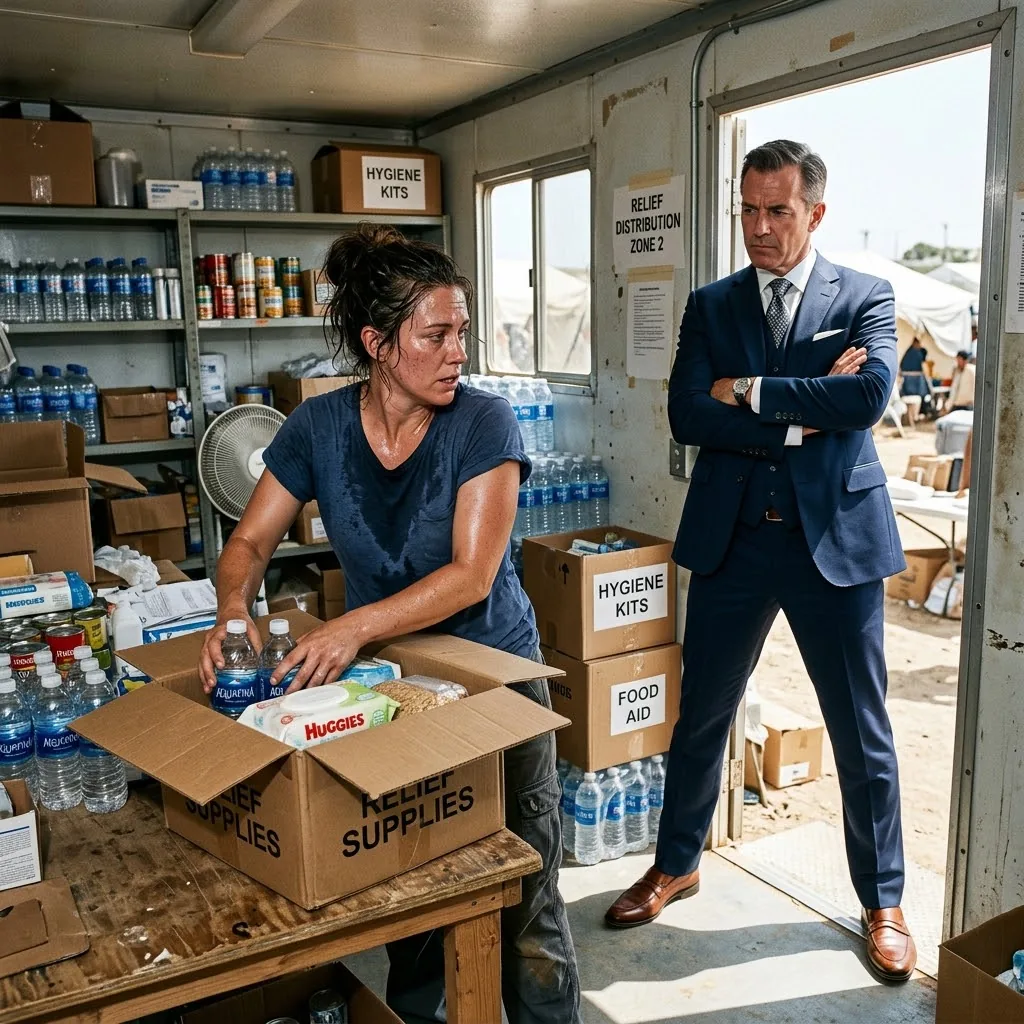
The crinkling sound hangs in the thick, humid air of the temporary trailer. Arthur’s hand stills completely inside the cardboard box. His manicured fingernails are digging slightly into the black plastic garbage bag. He doesn’t look at the box; he looks directly at me, his pale blue eyes pinning me in place.
“What is this?” he asks, his voice barely above a whisper, yet it easily cuts through the dull hum of the failing diesel generator outside.
“Heavy-duty contractor bags,” I say, fighting the sudden urge to swallow. “For the shelter. The gymnasium floor is damp, and the volunteers need them to keep the sleeping cots dry.”
Arthur’s thin lips press into a flat line. He doesn’t believe a word. He wraps his fingers around the knotted top of the plastic bag and pulls upward. The heavy, dense block of hardcover and paperback books resists. The black plastic stretches tight, outlining the sharp, rectangular corners of the stacked volumes hidden inside.
“Contractor bags do not have rigid, ninety-degree corners,” he notes, his tone perfectly conversational.
He pulls harder. A gallon jug of distilled water tips over inside the box, the heavy plastic slamming against the cardboard wall. I step forward, closing the distance until my chest is only inches from his pristine polo shirt. I reach into the box and wrap my dirty, grit-covered hand directly over his pale wrist. His skin is surprisingly cold, chilled by the aggressive air conditioning of whatever luxury sedan he drove here.
“Leave it alone, Arthur,” I say, keeping my voice low.
He stares down at my hand gripping his wrist. He doesn’t flinch. He doesn’t pull away. “Are you attempting to physically restrain a school board official, Elena?”
He uses my first name like a weapon, a sharp reminder of the power dynamic in this suffocating room. I pull my hand back as if his skin burned me. When my hand drops to my side, it brushes my damp jeans. The folded insurance denial letter in my pocket crinkles loudly-a pathetic, papery echo of the hidden books.
With a soft grunt of exertion, Arthur uses both hands to heave the heavy black bag up and out of the disaster relief box. He drops it onto the center of the folding table. It hits the thin plastic surface with a heavy, unmistakable *thud* of densely packed paper. It sounds exactly like thirty bound books hitting a table.
“Books,” he says softly. It is a statement of absolute fact, not a question.
I need a lie. I need something that fits his worldview, something that won’t get me immediately fired. “Bibles,” I say, the word tumbling out of my mouth before I can fully think it through. “Donated from the First Baptist congregation this morning.”
Arthur pauses. He tilts his head, studying the tight knot at the top of the garbage bag. For a second, I think the lie might actually hold. Bibles are the only text his committee hasn’t subjected to the new community decency guidelines.
“That is incredibly strange,” Arthur says, his fingers tracing the stretched black plastic. “Because First Baptist dropped off their entire donation allotment directly at the high school yesterday afternoon. I know this because I personally signed the intake receipt.”
The stifling heat inside the trailer suddenly feels twice as heavy, pressing down on my chest until my lungs ache. My heavy work boots stick to the cheap, peeling linoleum floor. I have nowhere left to maneuver.
Arthur begins picking at the tight plastic knot. The plastic is thick, and my knot is stubborn, tied in a rush of paranoid adrenaline an hour ago.
A heavy diesel truck horn blasts outside, vibrating the thin aluminum walls of the trailer. Someone yells from the metal loading ramp. “Library trailer! We need the outbound pallets loaded! We have five minutes before we roll out, or we leave without them!”
Arthur entirely ignores the shout. He continues working his manicured nails into the tight plastic loops of the knot.
“The families need that water and those baby wipes right now,” I tell him, reaching for the open cardboard box to fold the flaps shut. “The truck is leaving.”
“The truck can wait exactly sixty seconds,” Arthur replies smoothly, finally loosening the first loop of the knot.
I have to stop him. If he unties that bag, he will see the bright spines of *The Hate U Give*, the challenged coming-of-age memoirs, and the dystopian novels he personally campaigned to ban from the district. He will see the exact titles he called “ideological poison” at the last board meeting.
I plunge my hand into my wet pocket and rip out the heavy, watermarked insurance denial letter. I slam the crumpled paper onto the folding table, mere inches from his hands.
“I need to file an emergency appeal,” I say, forcing my voice to tremble. It isn’t entirely an act. “You signed this letter. Your firm said the storm surge wasn’t covered. But my roof failed from the wind long before the river rose. The wind damage caused the flooding. I have date-stamped pictures.”
Arthur stops picking at the knot. His pale eyes flick down to the paperwork. He cannot help himself; he loves bureaucracy. He loves the power of denying someone’s livelihood with a simple stroke of a pen.
“This is neither the time nor the venue for an insurance dispute,” Arthur says, though his hands leave the plastic bag to smooth out the crumpled edges of the letter. “My role as your regional adjuster and my role as the board president are entirely separate.”
“They aren’t separate when you’re standing in my workspace using my livelihood as leverage,” I counter, my heart hammering against my ribs. “You are holding all the cards. If you deny this appeal, I can’t rebuild. I have absolutely nowhere to go.”
Arthur smirks. It is a cruel, victorious expression. “The policy language you signed is abundantly clear regarding wind-driven rain versus ground surge, Elena. A structural failure of the roof does not negate the primary flood exclusion if the damage vector was the rising river. Read section four.”
He is distracted. He is lecturing me. Slowly, I slide my hand onto the table and pull the black garbage bag an inch toward my hip.
Arthur’s hand snaps out like a trap, slamming down flat on the black plastic, pinning it immovably to the folding table.
“Nice try,” he whispers. The smirk vanishes entirely. “You actually almost had me.”
He reaches into the pocket of his pressed khakis and pulls out a slim, expensive-looking silver pocket knife. He flicks it open with his thumb. The blade gleams in the harsh fluorescent lighting.
“Let’s see what you consider so much more important than your continued employment and your home,” he says.
He drives the tip of the knife into the black plastic and pulls down, slicing a six-inch gash through the heavy material.
The black plastic parts. Through the gap, I see the bright blue spine and bold white lettering of a heavily restricted LGBTQ+ memoir.
Before Arthur can peel the plastic back further to read the title aloud, the metal door of the trailer violently bangs open. A National Guardsman in soaked fatigues steps inside, holding a waterproof clipboard.
“Are these boxes ready or what?” the guardsman barks, wiping sweat from his forehead. “We got a secondary bridge closure happening in twenty minutes. I need to load now.”
Arthur slides his silver knife shut and drops it into his pocket, but his hand remains firmly clamped over the slit in the plastic, his fingers resting directly against the spine of the banned book.
“This specific box is out of compliance,” Arthur tells the guardsman in his smoothest, most authoritative voice. “I am confiscating this package for a district-level audit.”
“No,” I say, the word tearing out of my dry throat.
The guardsman looks between us, clearly impatient and exhausted. “I don’t care about your administrative drama. Do I take the pallets or not?”
Arthur lifts the heavy black bag wrapped around the books, clutching it securely against his chest like a shield. “Take the cardboard boxes,” Arthur tells the soldier. “I am keeping this one.”
If Arthur walks out of this trailer with that bag, he will open it in the privacy of his car. He will document every title. He will fire me, he will ensure the board blacklists me across the state, and he will use this as proof that the librarians are corrupt. And the kids in the shelter will get nothing.
As the guardsman turns to signal his loaders, I step directly in front of the open metal doorway, physically blocking Arthur’s only exit.