Story code: ST-001179
Part 4: The Mud
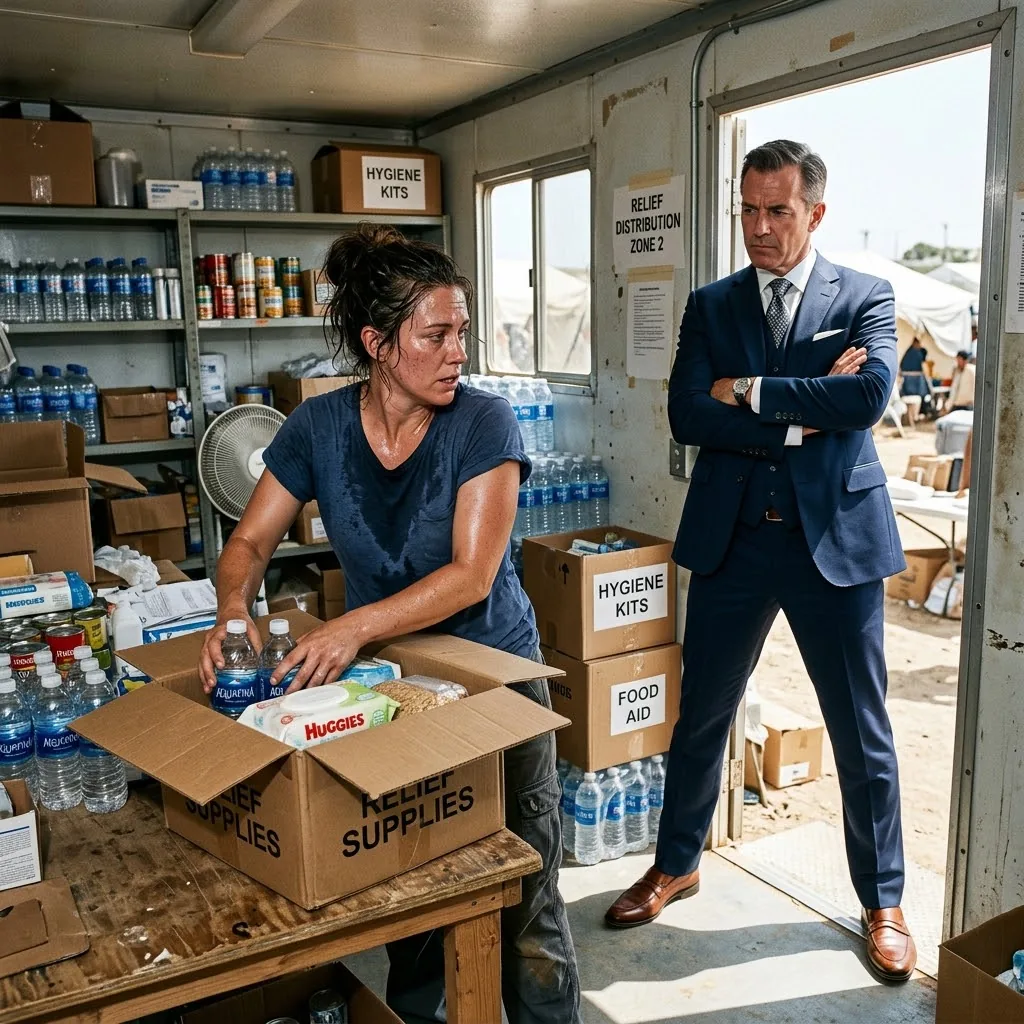
The suffocating heat in the trailer seems to press against my eardrums as the silence stretches. Arthur stands perfectly still, trapped by his own absolute insistence on the rules. The heavy plastic bag of books is pressed against his chest, staining his expensive polo shirt with a dark, damp ring of condensation.
He looks at the National Guardsman, whose jaw is set in exhausted irritation. He looks at Mateo, Sarah, and the third teenager, who are all staring at him as if he has entirely lost his mind.
“Fine,” Arthur snaps. The word cracks like a dry branch, stripped of all its polished, boardroom resonance. His pale face flushes a dangerous, mottled purple. “Fine!”
He lunges forward. I drop my shoulder, stepping back just enough to let him burst through the narrow doorway. He practically sprints down the aluminum loading ramp, his polished loafers hammering violently against the metal grating.
Fifty yards past the temporary staging area, the receding storm surge has left a deep, foul trench of stagnant brown floodwater, choked with ruined drywall and rotting tree branches. Arthur marches directly toward the muck, his breathing loud and ragged over the hum of the diesel generator.
He stops at the edge of the water. With a furious, uncoordinated heave, Arthur hurls the heavy black bag into the trench.
It hits the contaminated water with a heavy, wet splash. Foul-smelling mud arcs into the air, splattering violently across Arthur’s pressed khakis. The forceful impact pushes the trapped air out of the sliced gap in the plastic, forcing the bright blue spine of the banned LGBTQ+ memoir halfway out into the harsh afternoon sunlight.
“There,” Arthur snarls, his chest heaving. He wipes a speck of gray sludge off his cheek with a trembling hand and glares back at the trailer. “The refuse has been disposed of. Load the pallets!”
The Guardsman shakes his head, utterly disgusted by the temper tantrum. “Alright, kids, you heard him. Let’s move.”
Mateo and Sarah push the red hand truck up the ramp, brushing past Arthur without making eye contact. I help them load the boxes of baby wipes, the generic distilled water, and the canned goods. My hands are shaking, but I keep my breathing steady. We work in total silence, the only sound the scraping of cardboard and the heavy thud of the diesel engine.
When the pallet is fully loaded, Mateo wheels the hand truck down the ramp toward the transport truck. But as he nears the edge of the staging area, he stops.
Mateo leaves the hand truck and walks directly toward the trench of stagnant water. The thick, foul mud immediately swallows his worn sneakers. Sarah follows right behind him.
“Hey,” Arthur barks, his voice shrill as he steps toward them. “That is a biohazard. Leave it.”
Mateo ignores him completely. He wades a foot deeper into the muck, reaches down, and grabs the bright blue spine of the memoir. He pulls it free from the torn garbage bag. The bottom edge of the pages is soaked in brown mud, but the text is perfectly intact. Sarah reaches into the gaping hole in the plastic and pulls out a copy of *The Hate U Give*, wiping a thick smear of sludge off the cover with the hem of her damp hoodie.
Arthur loses whatever fragile grip he had left. “Put those down!” he yells, pointing a trembling, manicured finger at them. “I am the school board president, and I am ordering you to leave those restricted materials in the dirt!”
The trap snaps fully shut. He said it out loud.
Mateo stops wiping the mud from his book. He turns and looks at Arthur. The teenager has spent the last week sleeping on a military cot in a high school gymnasium, wearing the exact same damp t-shirt he was wearing when he escaped his flooded home. He looks at this angry, wealthy man in ruined khakis yelling about restricted materials in the middle of a disaster zone.
“They’re just books, man,” Mateo says. His voice holds no anger, only a profound, exhausted pity.
Sarah doesn’t even look at Arthur. She simply tucks the muddy memoir into the front pocket of her hoodie, protecting it against her chest. The third girl walks past Arthur, fishes a dystopian paperback from the stagnant water, and carries it back to the transport truck.
Arthur turns to the Guardsman, his face a mask of panicked outrage. “They are stealing confiscated district property!”
The Guardsman slams the heavy metal tailgate of the truck shut and locks the latch. He looks Arthur up and down, taking in the mud-splattered clothes and the red face. “I’m not the library police, buddy,” the soldier says, climbing into the cab. “We’re rolling.”
Arthur stands entirely alone at the edge of the floodwater. His authority is gone, washed away in a puddle of swamp water, discarded by a group of exhausted teenagers who simply stopped pretending he mattered.
I stand on the metal ramp, the suffocating heat of the trailer still at my back. I reach into the pocket of my damp jeans. My fingers trace the folded edge of the insurance denial letter. The watermarks are still there. My house is still destroyed. By tomorrow morning, Arthur will likely find a bureaucratic loophole to fire me. My reality has not changed; it is still a grim, terrifying mountain to climb.
But as the transport truck’s engine roars to life, carrying those muddy, rescued paperbacks toward the shelter, the weight in my chest finally breaks. I watch Arthur staring helplessly into the mud, and I smile.