Story code: ST-001203
Part 4: The Cost of Admission
Diane’s manicured fingers trembled violently as they hammered the sticky keys of the portable workstation. The harsh fluorescent light of the trauma bay illuminated the sweat on her forehead as she bypassed three different administrative warning screens. She hit the enter key with a desperate, forceful strike.
“It’s done,” Diane choked out, her eyes darting between the computer and the dying sixteen-year-old on the table. “Suspension voided. The payroll hold is lifted.”
Mateo didn’t ask for proof. He stepped past the thick red line on the floor, abandoning the Dilaudid vial on the counter, and moved to the head of the bed.
“He’s allergic to penicillin,” Mateo barked, translating the boy’s garbled, terrified wheezing. “He said the last time they gave it to him, his throat swelled shut in three minutes.”
“Cephalosporin cross-reactivity,” Dr. Aris snapped, instantly recognizing the deadly reaction to the Rocephin IV. “Stop that drip! Push point-five of epi, intramuscular, right now! Get me a crash cart and a glidescope!”
The bay erupted into a coordinated blur of motion. Mateo held the boy’s thrashing shoulders down as the epinephrine hit his system. Within seconds, the agonizing squeal of the monitor leveled out into a steady, rapid rhythm. The boy’s airway opened with a harsh, rattling gasp. He was going to live.
Mateo stepped back, his hands slick with sweat and stray drops of blood. He looked across the bay. Dr. Evans was gone. Diane was gone, having slipped away the moment the immediate crisis passed. The only thing left was the tiny glass vial on the stainless steel counter, standing upright in a pool of spilled iodine.
Nobody thanked Mateo. Nobody even looked at him. The nurses who usually joked with him in the breakroom now kept their eyes fixed firmly on the monitors. Dr. Aris didn’t acknowledge his presence. The invisible boundary Mateo had crossed was palpable in the air. He had gambled a patient’s life for his paycheck. In the unspoken hierarchy of the emergency room, there was no sin greater than that.
He spent the next three hours working in absolute isolation. He mopped up the blood in Bay 4. He bagged soiled linens. He restocked the trauma carts with mechanical, unthinking efficiency. The adrenaline that had fueled his confrontation with HR slowly drained out of him, leaving behind a hollow, sickening ache in his stomach. He had won, but he felt radioactive.
At exactly 12:03 AM, he felt a short, sharp buzz against his thigh.
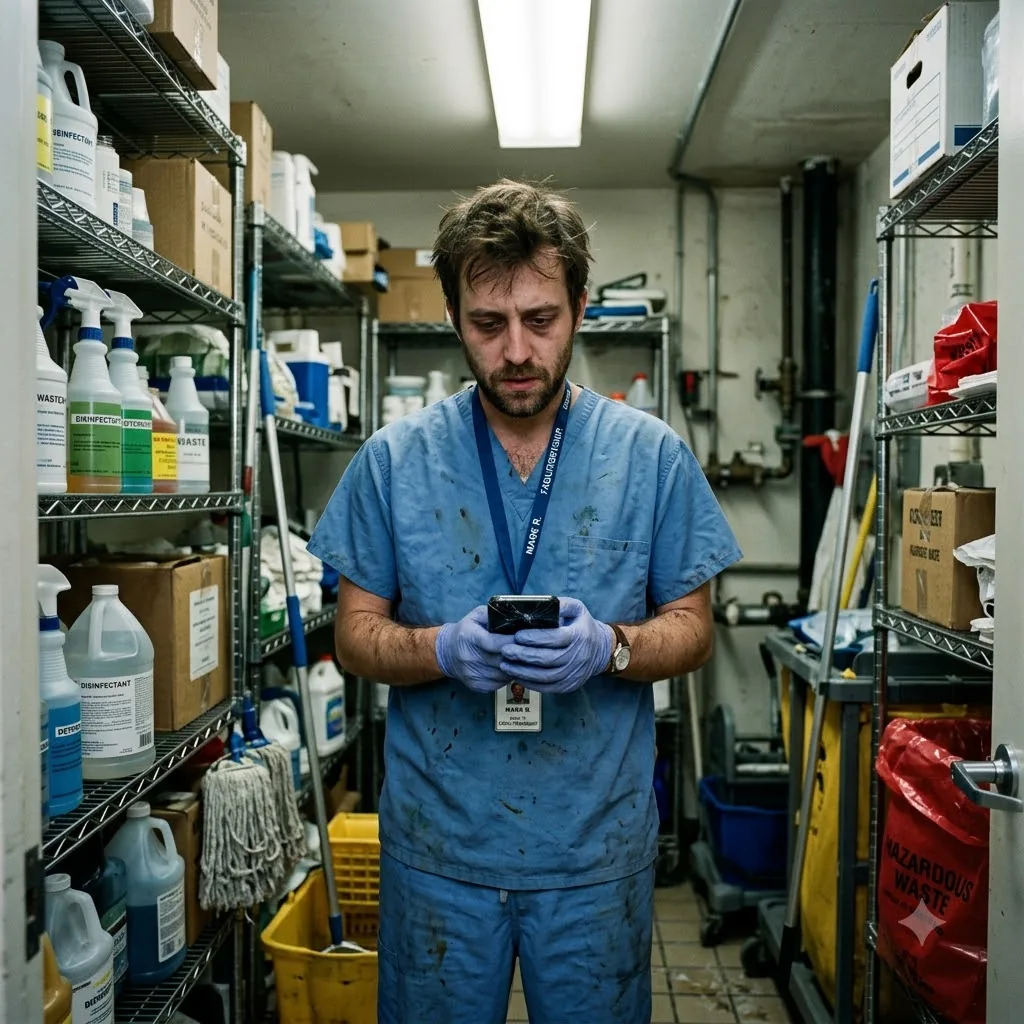
Mateo retreated to the soiled utility closet and pulled out his phone. The cracked screen illuminated his bank application. *Direct Deposit Received: $1,642.50.* He switched tabs to the USCIS portal. The payment field was green. *Processing Fee: Paid. Status: Under Review.*
He let out a long, ragged breath, sliding down the tiled wall until he was sitting on the cold linoleum floor. He stared at the ceiling, the harsh bleach smell filling his lungs. He had done it. He had sacrificed his reputation, his standing, and the very core of his moral compass, but his brother was safe. Leo wasn’t going back to a country where a cartel death sentence waited for him. The money was there. The lawyers could finish the filing tomorrow morning.
The heavy double doors of the ambulance bay blew open again, the jarring crash echoing all the way down the hall to the utility closet.
“We need a bay, right now!” a deep voice bellowed. It wasn’t a paramedic. It was a police officer.
Mateo shoved his phone into his pocket and pushed himself up from the floor. He jogged out into the corridor just as a swarm of uniformed city police wheeled a stretcher through the sliding doors. Three officers were practically sitting on the patient, holding him down.
“Suspected shooter from the drive-by!” the lead officer shouted to the charge nurse, breathless and sweating. “He crashed the getaway car into a divider on 4th Street! He’s under arrest. Do not un-cuff his right hand from the rail!”
Mateo grabbed his trauma shears, stepping toward the gurney on pure reflex to cut away the suspect’s clothing. He reached the side of the stretcher and looked down.
The shears slipped from his fingers, clattering loudly against the linoleum.
The suspect was covered in shattered windshield glass and dried blood, a deep laceration carving across his forehead. His left arm was twisted at an unnatural angle. But underneath the bruising and the blood, the face was undeniable.
It was Leo.
Mateo froze, the roar of the emergency room suddenly fading into a high-pitched ringing in his ears.
Leo blinked against the harsh halogen lights, his unfocused eyes wandering wildly until they locked onto Mateo. A flicker of recognition crossed his bloody face. He opened his mouth, his jaw trembling.
“Turn around, tech, he’s a felony flight risk,” an officer barked, shoving Mateo hard in the shoulder, physically moving him away from the stretcher. “Let the docs work.”
Mateo stumbled backward, hitting the edge of the nurses’ station. He watched numbly as Dr. Aris rushed over, flanked by armed guards, to assess the damage.
A felony charge. A mass casualty shooting. Attempted murder.
Mateo pressed his hand against his scrub pocket, feeling the solid rectangle of his phone through the thin fabric. The paid immigration portal. The hard-won paycheck. The moral line he had crossed just hours earlier, letting a teenage boy suffocate to force HR’s hand.
None of it mattered. With a violent felony arrest, the asylum application was instantly dead. The system would deport him the moment he was discharged, or bury him in a federal penitentiary for the rest of his life. Mateo stood rooted to the floor, watching the police read his brother his rights over the rhythmic beeping of the cardiac monitor, realizing he had sold his soul to buy a future that no longer existed.