Story code: ST-001203
Part 2: The Override
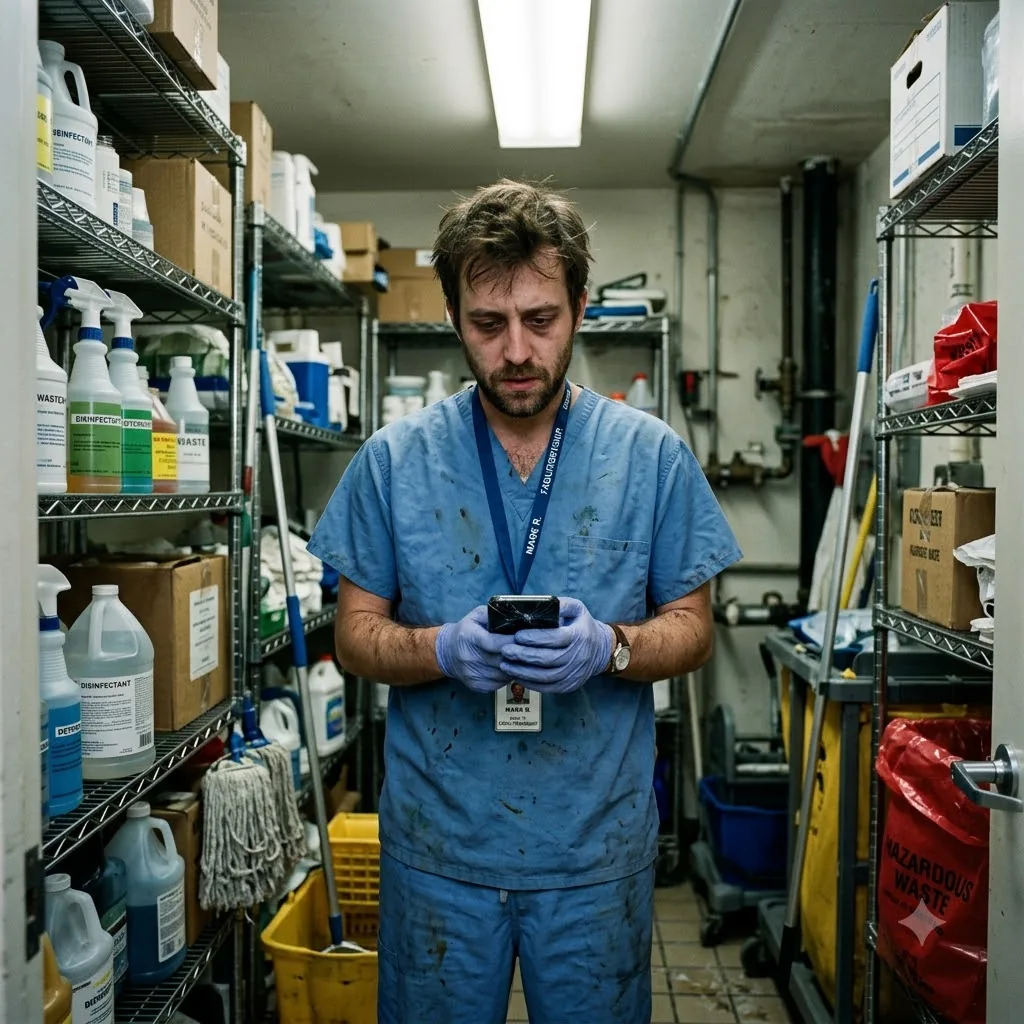
The red tag glared in the fluorescent light. Mateo knew exactly what it meant. In the hospital’s rigid administrative ecosystem, a yellow tag meant a written warning. A green tag meant mandatory peer review. Red was the end of the line. Immediate termination for cause. An escort by security to the pavement. Confiscation of the ID badge that allowed him to feed himself and pay the immigration lawyers.
“Turn off the water, Mateo,” Diane said, her voice completely devoid of inflection.
Mateo hadn’t realized the tap was still running. He reached back, his wet sneaker squeaking against the linoleum, and twisted the cold water knob. The sudden silence in the cramped closet was suffocating.
“I can explain the shoe,” Mateo started, his heart hammering a frantic rhythm against his ribs. “The arterial spray from the Bay 4 trauma-”
“This isn’t about dress code,” Diane interrupted. She flipped the red-tagged folder open with a manicured thumb. The hinges of the heavy cardboard creaked. “Two milligrams of intravenous Dilaudid went missing from the Bay 4 trauma cart twenty minutes ago. Dr. Evans reported that you were the only one left in the room when the patient was transferred up to surgery.”
Mateo’s stomach dropped out. The chill from his wet sock suddenly seeped directly into his bones. “I was holding pressure on a femoral bleed. Both my hands were covered in blood. I didn’t even touch the med cart.”
“The automated Pyxis machine records tell a different story,” Diane said, her eyes never leaving the printed spreadsheet in the file. “A manual override was logged using your employee ID number. At exactly the time Dr. Evans was scrubbing out at the sink.”
“He asked for my ID number earlier to print the patient’s blood labels because the scanner was broken,” Mateo said, the pieces snapping together with terrifying, heavy clarity. “He used my number.”
“Dr. Evans is a third-year surgical resident with a spotless record. You are a disposable hourly technician.” Diane closed the folder. “The hospital’s liability insurance does not cover narcotics theft. You are terminated, effective immediately. Your final paycheck is being withheld pending a formal police investigation.”
*Withheld.*
The word echoed in the cramped closet, drowning out the distant, rhythmic beeping of the cardiac monitors in the hallway. If his paycheck was withheld, the direct deposit wouldn’t hit his account at midnight. If the deposit didn’t hit, the debit card linked to the USCIS portal would decline. His brother’s asylum application would be automatically rejected for non-payment. Deportation proceedings would begin by the end of the week.
“You can’t do that,” Mateo said, his voice trembling, betraying the panic he fought so hard to suppress. “I need that deposit tonight. Check the hallway cameras. Check my pockets. Search me right now.”
“The cameras in Bay 4 are disabled for patient privacy,” Diane said, extending her empty left hand, palm facing up. “Hand over your badge, Mateo. Security is waiting by the ambulance bay to walk you to your car.”
Mateo looked at her hand. The plastic ID badge clipped to his scrub top suddenly felt as heavy as a lead vest. He couldn’t leave. If he walked out those sliding glass doors, it was over. His brother was as good as dead.
He had to survive this shift. He had to get the money.
“I’ll find it,” Mateo blurted out.
Diane paused, her hand still extended. “Excuse me?”
“I’ll find the vial. Evans didn’t use it on the patient, he pocketed it. He’s been sweating all shift, his pupils are pinned, and his hands were shaking when he was trying to place the central line. You know it, and I know it.” Mateo took a half-step forward, closing the distance between them in the tiny utility room. “If you call the cops, they search the hospital. It becomes a massive public scandal. The local news gets ahold of a resident stealing narcotics during a critical trauma code. The hospital board crucifies HR for letting it happen under your nose.”
Diane’s hand remained extended, but her fingers twitched slightly. He had hit a nerve. The hospital administration cared about one thing above all else: public relations.
“If you fire me now, Evans gets away with it, and you still have a missing narcotic log that the DEA will eventually audit,” Mateo pressed, his breathing shallow. “Give me until the end of my shift. Two hours. I will bring you the unopened vial. You get your meds back, you avoid a scandal, and I keep my job and my paycheck.”
Diane stared at him, her eyes narrowing as she calculated the risk. The silence stretched, filled only by the harsh buzzing of the overhead fluorescent tube.
“You have until midnight,” Diane said softly. “If that vial is not on my desk by twelve-zero-zero, I am filing the red tag. I will call the police, and I will personally ensure they arrest you for federal theft. Do not speak to Dr. Evans. Do not touch any patients. You are on administrative standby.”
She didn’t wait for a response. She turned, unlatched the heavy wooden door, and stepped out into the bright hallway, disappearing into the chaotic churn of the emergency room.
Mateo leaned against the cold porcelain of the slop sink, his legs shaking uncontrollably. He pulled out his phone. The cracked screen read 10:15 PM. He had exactly one hour and forty-five minutes to prove a doctor was a thief.
He pushed out of the closet. The ER was a madhouse of flashing lights, shouting nurses, and groaning patients, but Mateo was invisible. Technicians were supposed to be invisible. He walked right past Bay 4, heading straight for the physician corridor.
Technicians were strictly forbidden from entering the resident locker room. The electronic lock on the door tracked every badge swipe. Swiping in was an automatic disciplinary write-up.
Mateo didn’t care. The rules no longer applied to him. He waited by the water fountain until a tired-looking intern pushed through the door, clutching a lukewarm coffee. Before the heavy door could swing shut and the magnetic lock could engage, Mateo shot his foot out, wedging his damp sneaker into the jamb.
He slipped inside. The room smelled of stale sweat, bitter coffee, and strong cologne. Row upon row of gray metal lockers lined the walls. He walked down the narrow aisle, scanning the taped nameplates until he found the one labeled *Evans, T.* The padlock securing it was a heavy-duty combination dial.
Mateo reached into his scrub pocket and pulled out his heavy trauma shears. They were designed to cut through thick leather jackets and motorcycle boots during emergencies. They weren’t meant for hardened steel, but he wasn’t going to try to cut the lock. He jammed the thick, blunted tip of the lower shear blade into the narrow gap between the locker door and the frame, right next to the latch mechanism.
He leaned his entire body weight into the makeshift pry bar, listening to the thin locker metal groan in protest. If he was caught doing this, he wasn’t just getting fired. He was going to a federal prison.
The locker metal buckled with a sharp, echoing crack.
A second later, the handle to the locker room door behind him began to turn.